Leaving the Scene of an Accident Defense in Oklahoma
 A property-damage hit & run case can start with a tap in traffic, a parking-lot scrape, a sideswipe, or a confusing crash scene. However, the State usually focuses on what happened after impact: whether you stopped, returned, stayed, and gave the required information.
This guide is for people accused of leaving the scene of an accident in Oklahoma and trying to understand the charge, possible punishment, and defense options before court. It explains the law, the misdemeanor range, common weaknesses, and what happens next.
Quick links
- What is Leaving the Scene of an Accident in Oklahoma?
- Explanation of the law
- Key elements the state must prove
- Penalties
- Collateral consequences
- How prosecutors prove leaving the scene of an accident
- Practical guide if you’re charged with this crime
- What happens next
- Comparison to other crimes
- Key terms
- FAQs
- Example of this crime in the news
What is Leaving the Scene of an Accident in Oklahoma?
A property-damage-only hit & run focuses on post-crash duties. The State claims you were the driver of a vehicle involved in an accident involving damage to a vehicle, and you didn’t stop, return, stay, or exchange required information.
Because no one was hurt and no one died, this charge stays in misdemeanor territory. Still, the case can affect your record, insurance, employment, and finances.
Talk with The Urbanic Law Firm early
If you’ve been accused of leaving the scene of an accident in Oklahoma, reach out for a free consultation before you make a statement or assume the facts are locked in. An Oklahoma hit & run defense attorney can help protect you before police reports, insurance claims, and witness assumptions shape the case.
Call us at 405-633-3420 or use our secure online form.
Explanation of the law
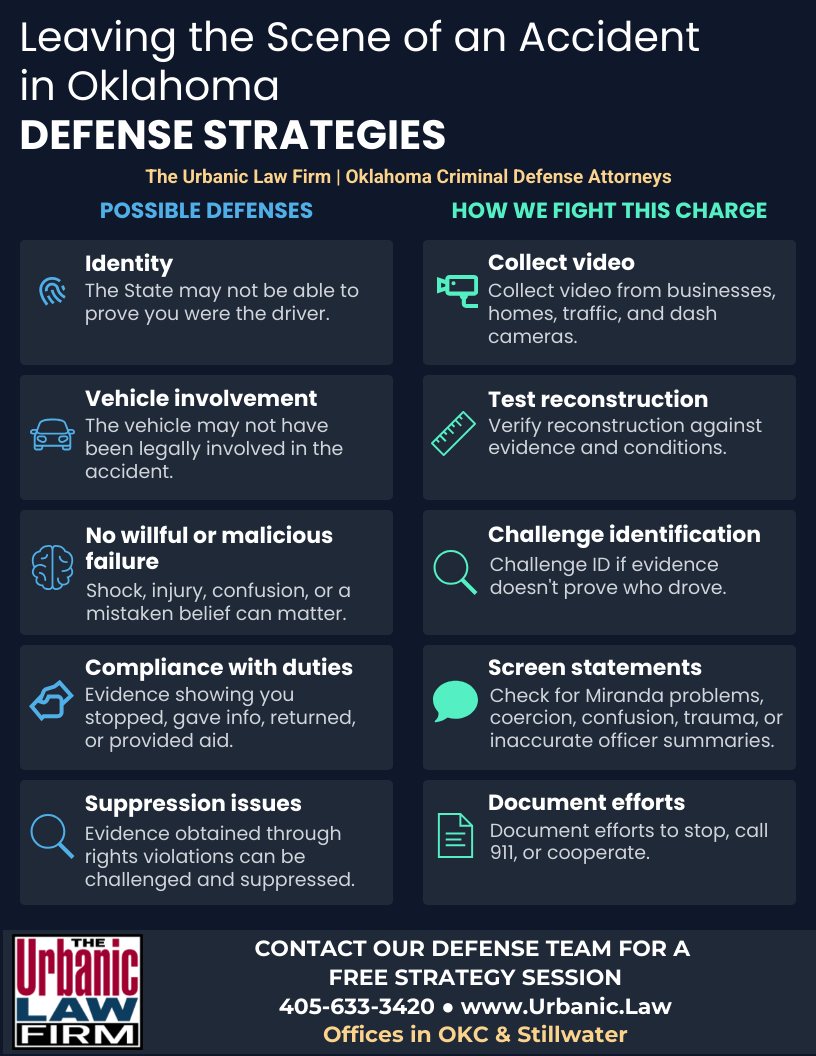
Oklahoma law requires a driver to stop and stay after a crash that only damages an attended vehicle. Under 47 O.S. § 10-103, the driver of a vehicle involved in an accident resulting only in damage to a vehicle that is driven or attended must immediately stop at the scene, or as close as possible, then return and remain until the driver completes the duties in 47 O.S. § 10-104.
Those duties usually mean giving your correct name, address, and vehicle registration number. In addition, you must show your driver license and security verification form on request.
This offense fits within Oklahoma’s broader hit & run and failure-to-stop framework. It also sits under the broader dangerous driving category.
However, prosecutors may stack related counts when the report describes more than leaving. Related allegations can include DUI, actual physical control, DWI, reckless driving, eluding, or accident duties and reporting violations. Those counts may change the case strategy, even when the hit & run count involves only vehicle damage.
Key elements the state must prove
The State has to connect you to the driver, the crash, the attended vehicle, and the failure to stay. A weak link in any part can matter.
- You were the driver of a vehicle.
- A witness saying, “I saw the car,” isn’t the same as proving who drove it.
- The accident resulted only in damage to a vehicle.
- If injury or death is alleged, different laws and much harsher consequences may apply.
- The damaged vehicle was driven or attended by a person.
- A parked, unattended vehicle can raise a different accident-duty issue.
- You failed to stop, return, or remain at the scene.
- Moving only far enough to avoid blocking traffic can be different from leaving.
- You didn’t complete the required information exchange.
- The information duties include name, address, vehicle registration number, and requested proof documents.
Penalties
For a property-damage-only hit & run, the case stays at the misdemeanor level. The court can still impose jail, a fine, and money-related consequences.
- Misdemeanor
- Jail: 0–1 year in county jail.
- Fine: Up to $500.
- Both: Jail and fine can be imposed together.
- Civil money risk
- Treble damages: Up to three times the value of the damage caused by the accident.
- Restitution: Payment for damage caused by the accident may be ordered by the judge.
A single penalty can spill into insurance, work, and background-check problems.
Collateral consequences
A misdemeanor conviction can still create real-life problems after court. That risk is why the details matter early.
- A public criminal record that can appear in background checks.
- Higher insurance costs or policy problems after the crash claim.
- A civil demand for three times the vehicle damage.
- Employment trouble for driving jobs, security jobs, or licensed work.
- Court costs, damage repayment, and collection stress.
However, the penalties don’t tell the whole story. A clean timeline, repair proof, and witness review can change how the case looks.
How prosecutors prove leaving the scene of an accident
Most cases turn on identity, timing, damage, and what you did after the crash. Prosecutors often build the case from several small pieces.
- Witness statements from drivers, passengers, bystanders, or nearby residents.
- Video evidence from dashcams, doorbell cameras, businesses, patrol cars, or traffic cameras.
- Vehicle-damage comparison between the vehicles, paint transfer, dents, and repair records.
- Your statements to police, insurance adjusters, the other driver, or witnesses.
- Timing evidence from dispatch logs, 911 calls, phone data, or officer bodycam.
Practical guide if you’re charged with this crime
What we look for first in a leaving the scene of an accident case
The first question is whether the State can prove you were legally required to stay and didn’t. The Urbanic Law Firm looks at the crash location, the damage, who was present, what information was exchanged, and whether police built the case from assumptions.
Defenses
- Wrong driver. The State may have the right vehicle but the wrong person behind the wheel.
- No driven or attended vehicle. A different accident-duty statute may apply if the vehicle was unattended.
- You stopped, returned, or stayed. Evidence may show you pulled over safely or came back as required.
- Required information was provided. Texts, calls, insurance records, or witness testimony may undercut the leaving allegation.
- Suppression issues. Unlawful detention, improper questioning, or an overbroad search can weaken key evidence.
How we fight these charges
- Preserve dashcam, surveillance, doorbell, bodycam, and 911 evidence before it disappears.
- Reconstruct the timeline so the stop, return, and information exchange aren’t judged from one report.
- Test witness identification, vehicle descriptions, lighting, distance, and line-of-sight issues.
- Challenge statements gathered during questionable detention or custodial questioning.
- Document repairs, insurance contact, phone calls, and later efforts to address the damage.
What The Urbanic Law Firm does to help clients charged with this crime
- Explain each court setting, possible outcome, and decision point in normal language.
- Track deadlines, discovery, police reports, videos, and court notices.
- Prepare you for court so you know what to expect before you walk in.
- Organize photos, repair estimates, insurance documents, and witness information.
- Communicate clearly about case progress, risks, and practical next steps.
Questions to ask your attorney
- What proof connects me to the driver, not just the vehicle?
- What facts show the damaged vehicle was driven or attended?
- What evidence shows I gave, or tried to give, the required information?
- Were my statements, stop, search, or detention legally vulnerable?
- Could a dismissal, amended charge, deferred sentence, or state court diversion program protect my record?
Things you can do if you’re arrested for this crime
- Save insurance messages, repair estimates, photos, texts, and call logs.
- Write a private timeline while details are fresh.
- Identify nearby cameras, businesses, homes, and traffic routes.
- Avoid posting about the crash or arguing about fault online.
- Preserve witness names and numbers without pressuring anyone about what to say.
What happens next
Most misdemeanor hit & run cases move through arraignment, discovery, court settings, and possible motions. You may receive a citation, get booked, or learn about the case later through a court notice.
After that, the defense reviews police reports, bodycam, crash evidence, witness statements, and any insurance or repair records. For a more detailed overview of the criminal process in Oklahoma, you can read more in our Oklahoma criminal process guide.
Different punishments can apply when the crash involves an unattended vehicle, injury, or death. So the exact charge matters.
Comparison to other crimes
Small factual differences can move a case into a different charge category. The biggest issues are whether anyone was hurt, whether the vehicle was attended, and what duty the State says you missed.
| Charge | Main conduct | Classification | Practical defense issue |
|---|---|---|---|
| Accident involving damage to a vehicle | Leaving after damage to a driven or attended vehicle | Misdemeanor, with up to one year in county jail and a fine up to $500 | Driver identity, whether the vehicle was attended, and whether you stopped or exchanged information |
| Duty upon striking an unattended vehicle under 47 O.S. § 10-105 | Failing to locate the owner or leave written notice after striking an unattended vehicle | Misdemeanor traffic-related offense | Whether the vehicle was truly unattended and whether notice was left in a conspicuous place |
| Failure to stop after a nonfatal injury accident under 47 O.S. § 10-102 | Leaving after a crash that caused nonfatal injury to another person | Felony | Whether an injury occurred, what the driver knew, and whether the driver complied with post-crash duties |
| Hit & run resulting in death under 47 O.S. § 10-102.1 | Leaving after a crash that resulted in a death | Felony with far higher sentencing risk | Causation, driver identity, timing, compliance with duties, and the difference between being involved and merely nearby |
Key terms
Vehicle
Vehicle means any device used for transportation of persons or property on a highway, which is not moved by human power or used only on fixed rails or tracks. Vehicles designed and adapted exclusively for agricultural and horticultural purposes and not subject to registration are excluded. (47 O.S. § 1-186 & jury instruction 6-35)
In a hit & run case, the defense may ask whether the object involved fits the legal term.
Operator or driver
Operator or driver means every person who drives or is in actual physical control of a vehicle. (47 O.S. § 1-140)
Because identity matters, a report about a vehicle doesn’t automatically prove who was operating it.
Public parking lot
Public parking lot means a parking lot on a right-of-way that is dedicated to public use or owned by the State of Oklahoma or a political subdivision of the State of Oklahoma. (47 O.S. § 1-142 & jury instruction 6-35)
Parking-lot crashes can create fact disputes about cameras, witnesses, control of the area, and where the vehicles were located.
FAQs
Is leaving the scene of an accident in Oklahoma a misdemeanor if only a vehicle was damaged?
Yes. If the accident only caused damage to a driven or attended vehicle and no one was hurt or killed, the charge is a misdemeanor. Jail, a fine, civil damages, and restitution can still be possible.
What counts as hit & run in Oklahoma when no one was hurt?
The State usually claims the driver was involved in an accident involving damage to a vehicle and left without stopping, returning, staying, or giving required information.
Can an Oklahoma hit & run charge be dismissed if I didn’t know there was damage?
It depends on the evidence. Lack of awareness can matter, especially when the contact was minor, the scene was chaotic, or the damage wasn’t obvious.
Can leaving the scene of an accident in Oklahoma be expunged?
It may be eligible depending on the outcome, your record, and the waiting period that applies. You can read more in our Oklahoma expungement guide.
What happens after an Oklahoma accident involving damage to a vehicle charge is filed?
The case usually moves through arraignment, discovery, court settings, and possible motions. The defense should review identity, damage, information exchange, video, and police-contact issues.
Example of this crime in the news
Oklahoma reports show how a property-damage hit & run count can appear beside other driving allegations. In a KOKH FOX 25 report, police said a teenager faced several charges after a brief pursuit, including leaving the scene of an accident involving damage, reckless driving, eluding, and DUI under 21. For this page, the key point is the post-crash duty. Other allegations may surround the case, but the property-damage count still turns on stopping, returning, staying, and giving required information.
This page is for informational purposes only and is not legal advice. Every case is unique; consult an attorney about your specific situation. Law last reviewed on May 20, 2026 by attorney Frank Urbanic. Page last updated May 20, 2026. Review the statutes cited on this page for the most current version of the law.

Two Votes, One Prison Cell: Sara Polston’s Oklahoma Voting Nightmare!

Legislative Payback or Public Safety? Sara Polston’s Shocking Constitutional Fight!

Tulsa’s “Serial Defecator” Case: Legal Analysis of a Messy Situation

Oklahoma Discovery Law Changes: 2026–2027 Guide
Oklahoma Domestic Abuse Law Updates Nov. 1: Five Big Changes
| THIS OFFENSE IN THE NEWS |