Actual Physical Control (APC) in Oklahoma: Law, Penalties, & Defenses
 Oklahoma can prosecute a person for actual physical control (APC) even when the State cannot prove that the vehicle was moving. An APC case instead focuses on whether the accused had present control over a motor vehicle in a covered location while one of Oklahoma’s alcohol or drug provisions applied. This guide is for people accused of APC in Oklahoma who want to understand the charge, possible punishment, defenses, and what may happen next.
An Oklahoma APC case can therefore create serious criminal consequences even when no officer saw the vehicle being driven. The details surrounding the vehicle, keys, person’s location, test evidence, officer observations, and applicable charging theory can become central to an APC defense.
Can you be charged with APC in Oklahoma without driving?
Yes. A vehicle doesn’t have to be moving for Oklahoma to pursue an APC charge. The prosecution instead must establish actual physical control of a motor vehicle, a location covered by the law, and the applicable alcohol or intoxicating-substance theory. A BAC-based APC prosecution also has a timing element concerning the test sample.
Get an APC case review
The Urbanic Law Firm can review the evidence that often decides an APC case, including the vehicle’s position, keys, body-camera footage, field sobriety testing, breath or blood evidence, and whether police lawfully detained or arrested you.
If you’ve been accused of APC in Oklahoma, reach out for a free consultation. Early review of an actual physical control case can help identify video, test records, witnesses, vehicle evidence, and other information that may become harder to obtain later.
Fill out our secure online form so our attorneys can better understand your situation before we speak. You may also call us at 405-633-3420.
Why clients trust The Urbanic Law Firm with Oklahoma APC charges
SFST instructor training: Frank Urbanic has completed standardized field sobriety test instructor training, which helps when examining how roadside tests were instructed, administered, and scored.
ARIDE trained: Advanced Roadside Impaired Driving Enforcement training provides additional background for evaluating alcohol- and drug-impaired-driving investigations.
OSBI Forensic Science Academy: Law-enforcement forensic science training provides useful background when reviewing physical, chemical, and other forensic evidence in an APC case.
What is actual physical control (APC) in Oklahoma?
Oklahoma’s 47 O.S. § 11-902 prohibits a person from driving, operating, or being in actual physical control of a motor vehicle in specified places when one of the statute’s alcohol or drug conditions applies. The important distinction is that an APC charge can exist without proof that the vehicle moved.
This page reflects the law effective November 1, 2026 and applies to conduct on or after that date. Conduct occurring before that date may be governed by an earlier version of the law.
The State can pursue an APC case under several theories:
- A blood or breath alcohol concentration of 0.08 or more under the applicable testing provision.
- Being under the influence of alcohol.
- Having a covered Schedule I substance, metabolite, or analog in a bodily fluid at the time of testing.
- Being under the influence of another intoxicating substance that may make the person incapable of safely driving or operating a motor vehicle.
- Being under the combined influence of alcohol and another intoxicating substance that may make the person incapable of safely driving or operating a motor vehicle.
A lawful prescription or other lawful entitlement to use a substance does not, by itself, defeat an APC allegation. The State still has to prove the applicable charging theory.
APC is part of Oklahoma’s drunk-driving laws, but the absence of observed driving can make the control issue especially important.
For a deeper fact-pattern discussion, see our blog post on what counts as actual physical control (APC) in Oklahoma.
Key elements the state must prove in an APC case
The prosecution must establish the elements that match its chosen APC alcohol or drug theory. jury instruction 6-20 identifies the elements for an actual physical control prosecution involving alcohol or an intoxicating substance.
- Actual physical control: The evidence must establish actual physical control of a motor vehicle.
- Covered location: The APC must occur on a location covered by Oklahoma law, which can include certain public places and specified private roads, streets, alleys, or lanes.
- Alcohol or drug condition: The State must prove the alcohol, drug, or combined-influence theory it alleges.
- BAC testing when applicable: A BAC-based theory must satisfy the applicable connection between the alleged APC and the test evidence.
An Oklahoma actual physical control defense attorney may challenge one element without conceding the others. For example, evidence of drinking doesn’t automatically establish actual physical control of the vehicle.
The Two-Hour Testing Rule
Under Oklahoma DUI law, a person can violate 47 O.S. § 11-902(A)(1) by driving with a blood- or breath-alcohol concentration of 0.08 or more at the time of the test. The two-hour requirement is governed separately by 47 O.S. § 756 . Section 756 provides that chemical-test evidence must generally be qualified by establishing that the test was administered within two hours after the person’s arrest before the evidence is admissible.
That makes the two-hour rule primarily an evidentiary issue, not a separate element of the 0.08-or-more DUI offense. For a blood test, the important timing question is when the blood sample was obtained, not when a laboratory later analyzed the vial. A blood draw outside the applicable two-hour period can therefore provide a basis to challenge the admissibility of the chemical-test evidence.
Penalties for an APC conviction
The possible punishment depends on prior history and whether the State alleges an aggregate, repeat-offense, or aggravated theory. A first APC offense is a misdemeanor, while several later or aggravated forms are felonies.
- First APC offense — misdemeanor
- Jail: 10 days–1 year
- Fine: Up to $1,000
- Other: Assessment and evaluation, with completion of the resulting recommendations
- Two or more separate qualifying violations within one year that are aggregated — Class C2 felony under 21 O.S. § 20M
- Prison: Baseline Class C2 punishment of up to 7 years; qualifying class-history rules can increase the sentencing range
- Fine: Up to $2,500
- Other: Assessment and evaluation, with completion of treatment recommendations
- Qualifying subsequent APC offense — Class C2 felony
- Prison: Baseline up to 7 years; qualifying class-history rules can increase the sentencing range
- Fine: Up to $2,500
- Other: Assessment, treatment recommendations, and ignition-interlock requirements can apply
- Minimum incarceration: A minimum period can apply when the treatment program does not include the required residential or inpatient component
- APC after one qualifying prior felony — Class B4 felony under 21 O.S. § 20I
- Prison: 1–10 years
- Fine: Up to $5,000
- Other: Assessment and evaluation, 240 hours of community service, ignition interlock, and other statutory requirements
- APC after two qualifying prior felonies — Class B3 felony under 21 O.S. § 20H
- Prison: 1–20 years
- Fine: Up to $5,000
- Other: 480 hours of community service, at least one year of supervision and periodic testing, ignition interlock for the required period, and other statutory requirements
- Qualifying prior DUI-caused second-degree murder or first-degree manslaughter conviction — Class A2 felony under 21 O.S. § 20D
- Prison: 5–20 years
- Fine: Up to $10,000
- Aggravated APC/DUI circumstances — Class B3 felony
- Conduct: The law identifies aggravating circumstances that can include a very high BAC, certain crashes or traffic conduct, eluding, extreme speeding, reckless driving, or having a passenger under 18
- Prison or jail: The applicable underlying sentencing tier remains important, with additional mandatory incarceration provisions for aggravated violations
- Other: Enhanced supervision, testing, treatment, and ignition-interlock requirements can apply
An aggravated allegation should be reviewed separately because aggravated DUI adds consequences beyond an ordinary first-offense case.
Depending on the facts, prosecutors may also file child endangerment, reckless driving, DUI, or related counts.
Prior-record issues can alter felony sentencing, so the firm’s sentence-enhancement guide may also matter when reviewing older convictions.
Collateral consequences of an APC case
An APC case can affect much more than the criminal court file. A criminal penalty may be only one part of the practical impact.
- Driver’s license: A separate administrative process can create deadlines and driving-privilege consequences. Review the firm’s guide to Oklahoma driver’s-license consequences.
- Interlock and treatment: Repeat and aggravated cases can carry ignition-interlock, assessment, treatment, supervision, or testing requirements.
- Employment: A conviction can create problems for jobs involving driving, commercial vehicles, security requirements, or employer background checks.
- Insurance and transportation: License restrictions and an impaired-driving record can affect transportation costs and insurance issues.
- Criminal record: Eligibility to clear a case depends on the disposition and other facts. The firm’s Oklahoma expungement guide explains that process.
An Oklahoma actual physical control defense lawyer should account for both the criminal case and any separate driver-license deadlines that apply.
How prosecutors prove an APC charge
Prosecutors usually build an APC case by combining evidence of control over the vehicle with evidence supporting one of the statutory intoxication theories. No single type of evidence necessarily proves the entire case.
- Location evidence: Where the vehicle was found and whether that place is covered by the law.
- Keys and engine status: Whether keys were in the ignition, on the person, elsewhere in the vehicle, or otherwise available.
- Seat and parking position: Where the person was located, how the vehicle was parked, and whether the circumstances suggest immediate control.
- Statements: Admissions or explanations about drinking, drug use, driving, parking, keys, or plans to leave.
- Officer observations: Speech, balance, eyes, odor, coordination, behavior, and other claimed signs of intoxication.
- Field sobriety evidence: Instructions, conditions, medical limitations, scoring, body-camera footage, and officer interpretation.
- Chemical evidence: Breath, blood, saliva, or urine results together with collection, testing, chain-of-custody, and timing issues.
A focused APC defense tests whether those pieces actually prove each required element rather than merely creating suspicion.
Practical guide if you’re charged with this crime
What we look for first in an APC case
APC cases often turn on details that can be seen, measured, photographed, recorded, or reconstructed. The first review should separate proof of alcohol or drug use from proof that the accused actually controlled the vehicle.
- Where each person was located when police arrived
- Where the keys were and who had access to them
- Whether the engine was running, recently running, or disabled
- How and where the vehicle was parked
- What body-camera or surveillance video shows before and during police contact
- Whether witnesses saw the vehicle move
- Whether physical or medical conditions affected officer observations
- When alcohol or drugs were consumed compared with the alleged APC and testing
Defenses
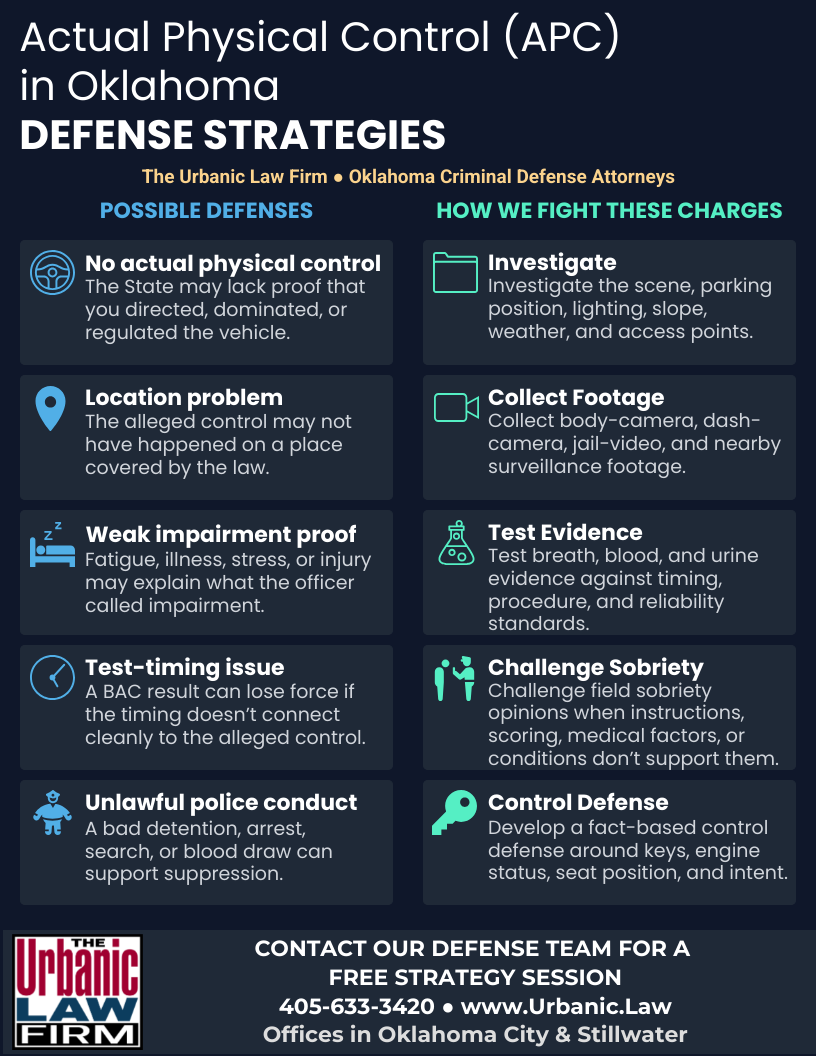
- No actual physical control: The State may lack proof that you directed, dominated, or regulated the vehicle.
- Location problem: The alleged control may not have happened on a place covered by the law.
- Weak impairment proof: Fatigue, illness, stress, or injury may explain what the officer called impairment.
- Test-timing issue: A BAC result can lose force if the timing doesn’t connect cleanly to the alleged control.
- Unlawful police conduct: A bad detention, arrest, search, or blood draw can support suppression.
How we fight these charges
- Investigate the scene, parking position, lighting, slope, weather, and access points.
- Collect body-camera, dash-camera, jail-video, and nearby surveillance footage.
- Test breath, blood, and urine evidence against timing, procedure, and reliability standards.
- Challenge field sobriety opinions when instructions, scoring, medical factors, or conditions don’t support them.
- Develop a fact-based control defense around keys, engine status, seat position, and intent.
What The Urbanic Law Firm does to help clients charged with APC
- Preserve evidence that may disappear, including video and electronically stored material.
- Review police reports against video to identify omissions, inconsistencies, and unsupported conclusions.
- Analyze chemical testing for collection, timing, maintenance, laboratory, and reliability issues.
- Litigate constitutional issues when the detention, arrest, search, warrant, or blood draw is legally defective.
- Prepare the defense theory around the facts that matter to control, location, impairment, and testing.
Questions to ask you attorney
- What evidence does the State have that I was actually in control of the vehicle?
- Is the place where police found the vehicle covered by the APC law?
- What video or electronic evidence should we preserve immediately?
- Does the breath, blood, or urine evidence match the timing of the alleged APC?
- Could prior cases change the classification or sentence in my current case?
Things you can do if you’re arrested for APC
- Save photographs, receipts, messages, ride-share records, location information, and other records connected to the incident.
- Write down where you were sitting, where the keys were, whether the engine was running, and why the vehicle was stopped.
- Identify witnesses who saw you before police arrived or who know how the vehicle got to the location.
- Avoid posting details of the allegation or your defense on social media.
- Act quickly on any separate driver’s-license notice or deadline.
What happens next in an APC case
An APC prosecution and a driver’s-license matter can move on separate tracks, so deadlines should be identified early.
- Release and bond: The first issue after arrest is often release from custody and compliance with any bond conditions.
- Arraignment: The court advises the accused of the charge and the case begins moving through the Oklahoma criminal process.
- Discovery: Police reports, video, test records, photographs, witness information, and other evidence can be obtained and reviewed.
- Motions: The defense can litigate legal issues involving detention, arrest, searches, statements, chemical testing, and admissibility.
- Negotiation or trial: The case may be resolved through dismissal, negotiation, motions, or trial depending on the evidence and legal issues.
- Driver’s-license proceedings: Administrative deadlines may arise independently of the criminal case. The driver’s-license consequences guide explains why those issues should be reviewed promptly.
APC penalties can change dramatically when the State alleges qualifying prior convictions or the November 1, 2026 one-year aggregation provision. For that reason, prior-case records and dates should be verified rather than accepted from a summary on a new charging document.
How APC compares to related Oklahoma driving charges
APC differs from related charges because the State doesn’t always need to prove that the vehicle moved. Related driving charges can carry different punishments even when they arise from the same investigation.
| Offense | Core conduct | Mental state / relationship | Classification | Common defense issue |
|---|---|---|---|---|
| Actual physical control (APC) | Control of a motor vehicle without requiring proof that it moved | Control plus a qualifying alcohol or drug condition | Misdemeanor first offense; felony variants can apply | Whether the facts show actual control, a covered location, and reliable impairment or test evidence |
| DUI | Driving or operating a motor vehicle under a listed alcohol or drug theory | Driving or operation plus the applicable alcohol or drug condition | Misdemeanor first offense; felony and aggravated variants can apply | Whether driving, impairment, testing, and the stop or arrest are supported |
| DWI | Driving with impaired ability due to alcohol or another intoxicating substance | Ability to operate affected enough to threaten public health and safety | Misdemeanor | Whether evidence proves actual impairment rather than consumption alone |
| Reckless driving | Driving in a careless or wanton manner without regard for safety | Conduct showing disregard of an unreasonable risk | Misdemeanor in ordinary case | Whether driving facts amount to reckless conduct rather than a lesser traffic violation |
Key terms
Actual physical control
Actual physical control concerns directing influence, domination, or regulation of a vehicle, whether or not the vehicle is being driven or is in motion (jury instruction 6-35). In an APC case, facts such as the person’s position, keys, engine status, and ability to use the vehicle can therefore matter.
Other intoxicating substance
An other intoxicating substance can include a controlled dangerous substance or another substance other than alcohol that can be taken into the body and adversely affect the central nervous system, vision, hearing, or other sensory or motor functions (47 O.S. § 1-140.1; jury instruction 6-35). This definition matters when an APC allegation is based on medication, drugs, or another claimed intoxicant.
Under the influence
Under the influence describes a condition in which alcohol or another intoxicating substance has affected the nervous system, brain, or muscles enough to hinder, to an appreciable degree, the person’s ability to operate a motor vehicle as an ordinarily prudent and cautious person in full possession of his or her faculties would operate it using reasonable care (jury instruction 6-35). This makes the quality of the officer’s impairment evidence important.
Frequently asked questions about APC in Oklahoma
Can an Oklahoma APC charge be reduced or dismissed?
Yes, depending on the evidence and legal issues. Problems with proof of control, the location, chemical testing, impairment evidence, police conduct, or witness credibility can affect whether the charge survives or how it is resolved.
Can an Oklahoma APC charge apply on a private driveway?
It depends on the particular location and how it fits the locations covered by the law. A private road, street, alley, or lane that provides access to qualifying dwellings may be covered, while other private-property situations can present a location defense.
Can prescription medication lead to an Oklahoma APC charge?
Yes. Lawful entitlement to use a medication does not automatically prevent a charge. The prosecution still must prove the applicable substance theory and the other requirements of APC.
Can an APC conviction in Oklahoma be expunged?
Possibly. Eligibility depends on the disposition, classification, criminal history, waiting periods, and other circumstances. The records and final court disposition should be reviewed before assuming a case qualifies.
How can a prior DUI affect an Oklahoma APC charge?
A qualifying prior DUI or related offense can change the classification and sentencing provisions that apply. The dates, disposition, completion of the prior sentence or deferred judgment, and number of qualifying prior felonies should be verified from court records.
Important cases
Oklahoma appellate decisions make clear that vehicle movement isn’t required for APC. The surrounding facts still determine whether the required actual physical control existed.
State ex rel. Department of Public Safety v. Kelley, 2007 OK CIV APP 99, 172 P.3d 231, illustrates how fact-specific an APC determination can be. Kelley was found asleep in the rear cargo area of the vehicle with the keys in the ignition and the engine off. The appellate court upheld the decision setting aside the driver’s-license revocation. The person’s location inside the vehicle and the surrounding evidence of present control mattered to the analysis.
State v. Ballenger, 2022 OK CR 11, 514 P.3d 478, involved an intoxicated person found unconscious in the driver’s seat with the vehicle off and keys under the seat. The Oklahoma Court of Criminal Appeals concluded that the circumstances could provide probable cause for actual physical control. The decision illustrates why the engine being off does not, by itself, end an APC inquiry.
This crime in the news
News reports also show why the distinction between driving and APC matters in real cases. According to KTUL’s November 12, 2025 report, Hillary Hoang was accused after officers responded to a reported intoxicated driver in Tulsa, Tulsa County. The report said a police helicopter observed the driver move from the driver’s seat to the passenger seat before officers made contact, and police booked Hoang on an APC allegation rather than DUI because officers hadn’t witnessed the driving. That distinction illustrates the core feature of an APC case: the prosecution may focus on control of the vehicle even when it cannot prove observed movement.
About the Author: Attorney Frank Urbanic

This page is for informational purposes only and is not legal advice. Every case is unique; consult an attorney about your specific situation. Law last reviewed on September 3, 2026 by attorney Frank Urbanic. Page last updated September 3, 2026. Review the statutes cited on this page for the most current version of the law.