Oklahoma Driving Under the Influence (DUI): Law, Penalties, & Defenses
 Oklahoma DUI cases can involve alcohol, drugs, or a combination, and the State may rely on driving evidence, officer observations, field sobriety tests, and chemical testing.
This guide is for people accused of driving under the influence in Oklahoma and trying to understand the DUI charge, possible punishment, and defense options before court.
What should you do after an Oklahoma DUI arrest?
Protect both sides of the case immediately: the criminal charge and any deadline affecting your driving privileges. Save your paperwork, calendar every deadline, identify possible video or witnesses, and preserve testing information before evidence disappears.
Review the stop, tests, and deadlines before your next court decision
If you’ve been charged with DUI, we can review the reason for the stop, evidence such as body-camera and dash-camera footage, field sobriety testing, breath or blood testing, and the deadlines that may affect your driving privileges.
Fill out our secure online form so our attorneys can better understand your situation before we speak. You may also call us at 405-633-3420.
Why clients trust The Urbanic Law Firm with DUI charges
SFST Instructor Training: Frank Urbanic graduated the SFST Instructor Course and is qualified to teach standardized field sobriety testing.
ARIDE Training: Frank completed the Advanced Roadside Impaired Driving Enforcement course, which addresses alcohol- and drug-impaired driving investigations.
Forensic Science Training: Frank graduated from the Oklahoma State Bureau of Investigation’s Forensic Science Academy.
Quick Links
- What is DUI in Oklahoma?
- Key elements the state must prove
- Oklahoma DUI penalties
- Collateral consequences
- How prosecutors prove DUI
- Practical guide if you’re charged with this crime
- What happens next
- How DUI compares to related Oklahoma driving charges
- Key terms
- FAQs
- Important cases
- This crime in the news
What is DUI in Oklahoma?
Driving under the influence (DUI) in Oklahoma is prohibited by 47 O.S. § 11-902. Oklahoma’s DUI law prohibits driving or operating a motor vehicle under several alternative alcohol- and drug-related theories. An Oklahoma DUI defense attorney should identify which theory the State is actually using and whether the evidence supports it.
- .08-or-more test: The State may rely on a blood or breath alcohol concentration of 0.08 or more at the time of the qualifying test.
- Alcohol influence: The State may allege that alcohol impaired your ability to operate the vehicle normally and safely.
- Schedule I substance: The statute also creates a theory based on a Schedule I chemical, controlled substance, metabolite, or analog detected in a bodily fluid.
- Other intoxicating substance: A non-alcohol substance can support DUI when it may render you incapable of safely driving. Oklahoma defines an other intoxicating substance under 47 O.S. § 1-140.1.
- Combined influence: Alcohol and another intoxicating substance may support a DUI charge when their combined influence may render you incapable of safely driving.
A lawful prescription, medical-marijuana authorization, or other lawful entitlement to use a substance doesn’t automatically defeat a DUI allegation. Testing, impairment, driving, timing, and the circumstances still matter.
This page focuses on allegations that you drove or operated the vehicle. A parked-vehicle allegation may instead involve actual physical control (APC). Cases involving statutory aggravating circumstances are addressed separately in the firm’s aggravated DUI guide.
You can also review the firm’s broader Oklahoma DUI overview and its Oklahoma drunk-driving defense resources.
Depending on the encounter, prosecutors may add related allegations. Examples include reckless driving under 47 O.S. § 11-901 or possession of a controlled dangerous substance under 63 O.S. § 2-402.
Key elements the state must prove
The required elements depend on which DUI theory prosecutors choose. Alcohol and drug DUI cases don’t always require the same proof.
- Alcohol or .08 theory: jury instruction 6-18 identifies:
- driving;
- a motor vehicle;
- a qualifying public place or qualifying private access road, street, alley, or lane;
- a blood or breath alcohol concentration of 0.08 or more, or being under the influence of alcohol; and
- where applicable, the test-related timing element.
- Other intoxicating substance or combined-influence theory: jury instruction 6-19 focuses on driving a motor vehicle in a qualifying location while under the influence of the relevant substance or combination to the required degree.
- Schedule I testing theory: The State may instead proceed on the statute’s bodily-fluid testing theory involving a Schedule I chemical, controlled substance, metabolite, or analog.
A DUI charge can weaken when the evidence doesn’t reliably establish driving, the required impairment theory, the test result, or another element that applies to the prosecution’s chosen theory.
The Two-Hour Testing Rule
Under Oklahoma DUI law, a person can violate 47 O.S. § 11-902(A)(1) by driving with a blood- or breath-alcohol concentration of 0.08 or more at the time of the test. The two-hour requirement is governed separately by 47 O.S. § 756 . Section 756 provides that chemical-test evidence must generally be qualified by establishing that the test was administered within two hours after the person’s arrest before the evidence is admissible.
That makes the two-hour rule primarily an evidentiary issue, not a separate element of the 0.08-or-more DUI offense. For a blood test, the important timing question is when the blood sample was obtained, not when a laboratory later analyzed the vial. A blood draw outside the applicable two-hour period can therefore provide a basis to challenge the admissibility of the chemical-test evidence.
Oklahoma DUI Penalties
The sentencing outcome for DUI can change sharply based on prior DUI history and the statutory route. A standalone first offense remains a misdemeanor, while qualifying repeat and aggregate DUI cases can become felonies.
Standalone first offense
- Classification: Misdemeanor
- Jail: 10 days–1 year
- Fine: Up to $1,000
- Assessment and treatment: Participation in an alcohol and drug substance-abuse assessment and evaluation, followed by the required recommendations
Two or more separate qualifying DUI violations within one year
Effective November 1, 2026, qualifying separate DUI violations committed by the same person within one year may be aggregated and prosecuted as a single Class C2 felony. The Class C2 framework appears in 21 O.S. § 20M.
- Prison: Up to 7 years under the base Class C2 tier; qualifying felony history can increase the applicable Class C2 term
- Fine: Up to $2,500
- Special conditions: Assessment, treatment, and other requirements imposed by the DUI statute
Qualifying subsequent DUI within 10 years
- Classification: Class C2 felony
- Prison: The applicable Class C2 term
- Fine: Up to $2,500
- Special conditions: Assessment and treatment requirements, ignition-interlock requirements, and a statutory minimum-incarceration condition when the required residential or inpatient treatment condition isn’t satisfied
DUI after a qualifying prior felony DUI
This route is a Class B4 felony under 21 O.S. § 20I.
- Prison: 1–10 years
- Fine: Up to $5,000
- Special conditions: Assessment and treatment, 240 hours of community service, ignition interlock, and the applicable statutory minimum-incarceration condition
DUI after two qualifying felony DUI convictions
This route is a Class B3 felony under 21 O.S. § 20H.
- Prison: 1–20 years
- Fine: Up to $5,000
- Special conditions: Assessment and treatment, at least one year of supervision and periodic testing, 480 hours of community service, ignition interlock, and the applicable minimum-incarceration condition
DUI after the qualifying prior homicide conviction described by the statute
This statutory route is a Class A2 felony under 21 O.S. § 20D.
- Prison: 5–20 years
- Fine: Up to $10,000
Prior convictions can therefore change the classification and sentencing rules dramatically. Read more about Oklahoma sentence enhancement when prior convictions may affect a felony charge.
Collateral consequences
A DUI penalty can reach beyond the courtroom because a driving under the influence case can affect driving, work, insurance, and background checks.
- Driving privileges: The criminal case and the administrative driving process aren’t the same proceeding. Service Oklahoma deadlines and IDAP issues can require separate attention. Review the firm’s driver’s-license consequences guide.
- Ignition interlock: Your record and the applicable driving-privilege process may affect whether an ignition-interlock device becomes part of keeping or restoring lawful driving privileges.
- Insurance: A DUI arrest, conviction, or driving restriction can create insurance consequences that continue after the court case ends.
- Employment and licensing: Driving jobs, commercial licenses, professional licensing, and employer background checks can make the consequences especially important for some defendants.
- Criminal record: A public court record can affect later background checks, while future expungement eligibility depends on the disposition, record, and Oklahoma expungement law.
How Prosecutors Prove DUI
Most DUI cases are built from a timeline: why the officer made contact, who was driving, what the officer observed, how field tests were administered, and what chemical testing showed.
- Driving evidence: Officer observations, witnesses, admissions, crash evidence, surveillance footage, phone records, or other evidence may be used to connect you to the vehicle.
- Officer observations: Prosecutors may rely on claimed odor, speech, balance, eye appearance, coordination, demeanor, or driving behavior.
- Field sobriety testing: Reports and video may be compared with the instructions officers gave and the conditions under which tests occurred.
- Chemical testing: Breath or blood evidence may become central. jury instruction 6-24 addresses chemical-test evidence in an impaired-driving prosecution.
- Statements and timing: What you allegedly said, when the officer first saw you, the timing of the arrest, and the timing of testing can affect the State’s theory.
The strength of that evidence can also affect which statutory penalties the State seeks.
Practical guide if you’re charged with this crime
Questions to ask your attorney
- Was there a valid reason for the stop or detention?
- Does the video match the officer’s written report?
- Were the breath or blood testing rules followed?
- What deadlines apply to my license and driving privileges?
- What outcomes fit my record, facts, job, and goals?
Things you can do if you’re arrested for driving under the influence in Oklahoma
- Save every ticket, bond paper, license notice, and court document.
- Calendar every court date and administrative deadline.
- Write down where cameras may exist before footage disappears.
- List passengers, witnesses, rideshare records, receipts, and phone-location details.
- Avoid posting about the arrest or discussing facts with people who may become witnesses.
Defenses
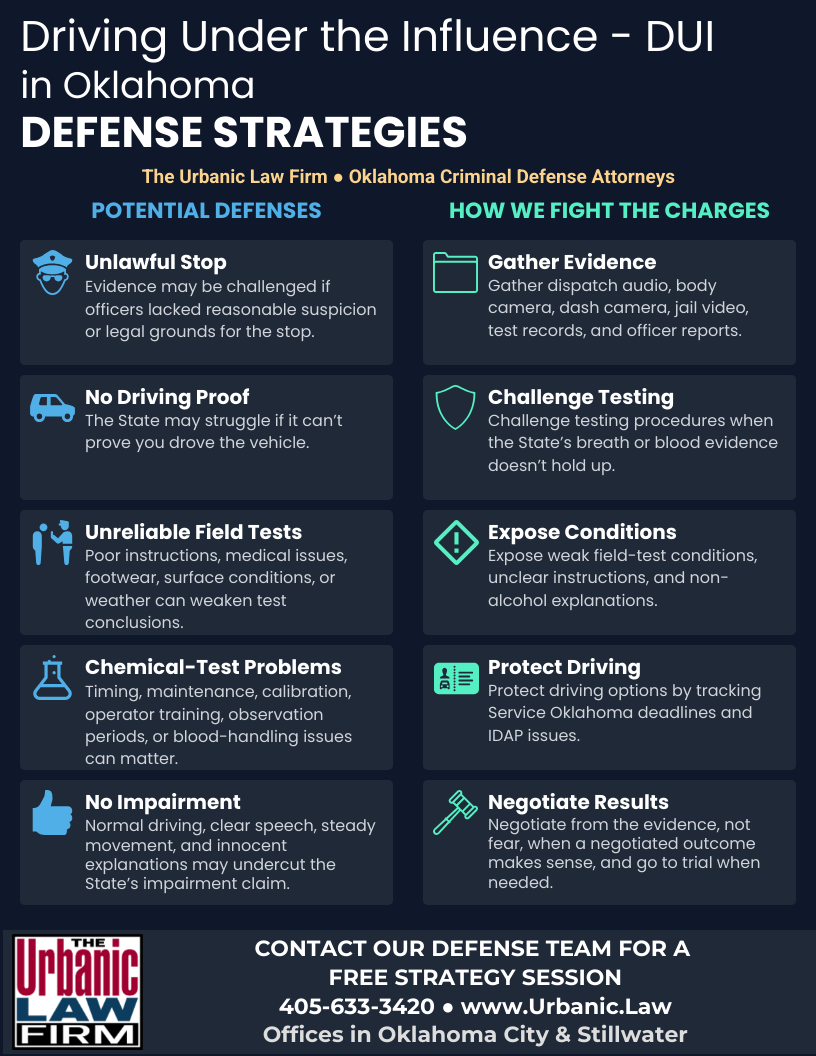
- Unlawful stop: Evidence may be challenged if officers lacked reasonable suspicion or legal grounds for the stop.
- No driving proof: The State may struggle if it can’t prove you drove the vehicle.
- Unreliable field tests: Poor instructions, medical issues, footwear, surface conditions, or weather can weaken test conclusions.
- Chemical-test problems: Timing, maintenance, calibration, operator training, observation periods, or blood-handling issues can matter.
- No impairment: Normal driving, clear speech, steady movement, and innocent explanations may undercut the State’s impairment claim.
How we fight these charges
- Gather dispatch audio, body camera, dash camera, jail video, test records, and officer reports.
- Challenge testing procedures when the State’s breath or blood evidence doesn’t hold up.
- Expose weak field-test conditions, unclear instructions, and non-alcohol explanations.
- Protect driving options by tracking Service Oklahoma deadlines and IDAP issues.
- Negotiate from the evidence, not fear, when a negotiated outcome makes sense, and go to trial when needed.
What The Urbanic Law Firm does to help
An Oklahoma DUI defense lawyer should help you understand both the courtroom case and the license consequences. That means clear planning, not guesswork.
- Explain court dates, license deadlines, plea options, trial risks, and next steps in direct terms.
- Track deadlines so your defense plan accounts for both court and driving issues.
- Prepare you for arraignment, negotiations, motion hearings, and trial decisions.
- Review videos, reports, test records, and officer claims for gaps or contradictions.
- Communicate updates so you’re not left wondering what’s happening with your case.
What happens next
Your criminal DUI case and driving-privilege issues can move on different tracks. After an arrest, the criminal case may involve an initial appearance or arraignment, discovery, negotiations, motion practice, and a trial decision.
Discovery can include reports, videos, recordings, witness information, and testing records. Your attorney can compare those materials with the charging theory and decide whether suppression or other motions make sense.
Felony DUI routes can also change the available punishments and the stages of the case. Prior convictions may affect the classification even when the new allegation arises from facts similar to a first-offense case.
The firm’s Oklahoma criminal process guide explains the major stages of a criminal case in more detail.
How DUI Compares to Related Oklahoma Driving Charges
The label on a driving charge matters because movement, impairment level, vehicle control, and prior history can change both the elements and the consequences.
| Charge | Core allegation | Classification | Common defense focus |
|---|---|---|---|
| DUI | Driving under one of the statutory alcohol or drug DUI theories | First offense misdemeanor with qualifying felony routes for repeat or aggregate cases | Stop, driving proof, impairment, field tests, chemical testing, timing, prior convictions |
| Driving while impaired (DWI) under 47 O.S. § 761 | Alcohol-related impairment below the level charged as DUI under the applicable DWI theory | Separate impaired-driving offense with a different charging and punishment framework | Observed impairment, test evidence, driving behavior, field-test conditions |
| Actual physical control (APC) | Control of a vehicle while impaired even when movement may not be proved | Uses the DUI statute’s applicable classification structure | Driver’s-seat position, keys, engine status, vehicle location, ability to control the vehicle |
| Reckless driving | Driving in a careless or wanton manner without regard for safety | Separate traffic crime that doesn’t require the State to prove DUI impairment | Actual driving conduct, road conditions, witnesses, video, innocent explanations |
Key terms
Conviction
For the DUI statute’s recidivist provisions, a conviction includes qualifying guilty pleas, nolo contendere pleas, or findings of guilt under Oklahoma DUI law or a qualifying analogous law. The statute can also treat a qualifying deferred judgment as a conviction for its specified lookback provisions. (47 O.S. § 11-902)
This matters because prior qualifying dispositions can change a later DUI charge from the first-offense misdemeanor framework to a felony route.
Driving
Driving means operating a motor vehicle while it is in motion. (jury instruction 6-35)
This distinction can make evidence of who actually moved the vehicle central to a DUI case based on driving.
Under the influence
A person is under the influence when alcohol, another intoxicating substance, or a combination has affected the person’s nervous system, brain, or muscles enough to appreciably hinder the ability to operate a vehicle as an ordinarily prudent and cautious person would under like conditions. (jury instruction 6-35)
That definition makes the quality of the State’s observations, recordings, field tests, and other impairment evidence important in a DUI prosecution.
Other intoxicating substance
An other intoxicating substance includes a controlled dangerous substance or another non-alcohol substance that can be ingested, inhaled, injected, or absorbed and can adversely affect the central nervous system, vision, hearing, or other sensory or motor function. (47 O.S. § 1-140.1 & jury instruction 6-35)
The term can therefore reach substances beyond alcoholic beverages.
Actual physical control
Actual physical control means directing influence, domination, or regulation of a motor vehicle, whether or not the vehicle is being driven or is in motion. (jury instruction 6-35)
It matters because Oklahoma can prosecute actual physical control allegations even when the State can’t prove that the vehicle moved.
FAQs
Can an Oklahoma driving under the influence case be expunged?
It can be possible, but eligibility depends on the disposition, your criminal record, waiting periods, and the version of Oklahoma expungement law that applies. A dismissal, deferred disposition, or conviction can lead to different eligibility questions. See the firm’s Oklahoma expungement guide for the broader rules.
Can a legal prescription still lead to an Oklahoma DUI charge?
Yes. Lawful entitlement to use a prescription or another intoxicating substance doesn’t automatically prevent a DUI prosecution. The State still has to establish the applicable driving under the influence theory, and the defense can challenge impairment, testing, timing, driving, and other required proof.
Does a first Oklahoma DUI conviction require an alcohol and drug assessment?
Yes. A first-offense DUI conviction requires an assessment and evaluation, followed by compliance with the recommendations required by Oklahoma DUI law.
Can an Oklahoma DUI be based on marijuana or another drug?
Yes. Oklahoma DUI law isn’t limited to alcohol. Drug DUI cases can involve the Schedule I testing theory, another intoxicating substance, or a combined alcohol-and-drug theory depending on the evidence.
Can prosecutors prove DUI in Oklahoma without a breath test?
Potentially. Not every DUI theory requires a breath-test result. Prosecutors may rely on other admissible evidence of driving and impairment, including observations, video, statements, field testing, blood evidence, or witness testimony, depending on the theory charged.
Important Cases
In State v. Silas, 2020 OK CR 10, 470 P.3d 339, the Oklahoma Court of Criminal Appeals rejected a categorical argument that DUI law didn’t apply because the incident occurred on a driveway. Under the circumstances there, the pathway from the highway to a single-family residence fell within the statute.
In Anderson v. State, 2010 OK CR 27, 252 P.3d 211, the court addressed horizontal gaze nystagmus evidence in a driving-under-the-influence-of-drugs prosecution, along with challenges involving the drug test and evidentiary foundation. The decision shows why the foundation for field-test and chemical-test evidence can become a contested issue in a DUI trial.
Oklahoma DUI in the News
Driving proof can become the center of a DUI case
On August 11, 2026, KXII reported that Ardmore police accused Justin Harris of DUI after a crash near Highway 70 and Hedges Road in Ardmore, Carter County. KXII reported that Harris denied driving, while witnesses told officers they saw him drive and leave the truck. The report illustrates a recurring DUI issue: prosecutors still need evidence connecting the accused person to driving when driving is the theory charged.
This page is for informational purposes only and is not legal advice. Every case is unique; consult an attorney about your specific situation. Law last reviewed on September 2, 2026 by attorney Frank Urbanic. Page last updated September 2, 2026. Review the statutes cited on this page for the most current version of the law.