Child Endangerment DUI in Oklahoma: Law, Penalties, & Defenses
 Child endangerment DUI in Oklahoma can apply when a child is in a vehicle with an impaired driver. The charge can reach a parent, guardian, or person with custody or control who knowingly permits the child to ride with an impaired driver. It can also apply to a person who drives, operates, or is in actual physical control of a vehicle while violating Oklahoma driving under the influence (DUI) law or while impaired with the child in the vehicle.
The presence of a child can turn an impaired-driving investigation into a separate felony child-endangerment case. The State still has to prove the particular vehicle-based theory alleged.
This guide is for people accused of child endangerment DUI in Oklahoma and trying to understand the charge, possible punishment, and defense options before court.
These cases sit at the intersection of child-endangerment law and the broader Oklahoma drunk-driving cases handled by The Urbanic Law Firm.
When can an impaired-driving incident become child endangerment DUI?
Child endangerment DUI can arise in two main vehicle situations. A person responsible for a child can be charged for knowingly allowing the child to ride with an impaired driver when that person knew or should have known about the impairment. A driver, operator, or person in physical control can also be charged when the person violates Oklahoma DUI law or is impaired while transporting or having the child in the vehicle.
We can review who had custody or control of the child, who controlled the vehicle, body-camera and dash-camera footage, breath or blood testing, field testing, and the State’s claimed impairment theory.
Fill out our secure online form so our attorneys can better understand your situation before we speak. You may also call us at 405-633-3420.
Why clients trust The Urbanic Law Firm with child endangerment DUI charges
DUI testing training: Frank Urbanic graduated the SFST Instructor Course and is qualified to teach standardized field sobriety testing.
Advanced DUI Case Analysis: Frank evaluates DUI cases with a 250+ item checklist developed from police training materials
Forensic perspective: Frank graduated from the Oklahoma State Bureau of Investigation’s Forensic Science Academy and uses that training when evaluating scientific evidence.
Quick links
- What is child endangerment DUI?
- Key elements the State must prove
- Penalties
- Collateral consequences
- How prosecutors prove child endangerment DUI
- Practical guide if you’re charged with child endangerment DUI
- What happens next
- How child endangerment DUI compares to related driving charges
- Key terms
- FAQs
- Important cases
- This crime in the news
What is child endangerment DUI?
This page reflects Oklahoma law effective January 1, 2027 and applies to conduct alleged to have occurred on or after that date. The law may be different for conduct alleged to have occurred before that date.
Under 21 O.S. § 852.1, a parent, guardian, or person having custody or control of a child can commit child endangerment DUI through two vehicle-related theories relevant here. A child for purposes of the incorporated Oklahoma Children’s Code definition is an unmarried person under 18 years old under 10A O.S. § 1-1-105(8).
Permitting an impaired driver to transport a child
The first theory focuses on knowingly permitting the child to be in the vehicle. The person must know, or reasonably should know, that the vehicle’s operator is impaired by or under the influence of alcohol or another intoxicating substance.
Driving, operating, or controlling the vehicle while impaired
The second theory focuses on the person controlling the vehicle. It applies when the driver, operator, or person in physical control violates 47 O.S. § 11-902 or is impaired while transporting or having the child in the vehicle.
The January 1, 2027 text matters because the driver branch expressly says “or impaired.” That gives the statutory language an impairment route in addition to the incorporated DUI-law route.
Our related DUI overview explains the broader framework surrounding these allegations. Prosecutors may also file a separate DUI or APC charge arising from the same incident.
Key elements of child endangerment DUI
For the vehicle theories addressed by the criminal jury instructions, jury instruction 4-40B separates the prosecution’s proof according to how the person allegedly endangered the child.
Permitting the child to ride with another impaired person
- Relationship or control: The accused was a parent, guardian, or person having custody or control of a child under 18.
- Knowing permission: The accused knowingly permitted the child to be present in the vehicle.
- Operator’s condition: The vehicle’s operator was impaired by or under the influence of alcohol or another intoxicating substance.
- Knowledge of impairment: The accused knew or reasonably should have known of the operator’s condition.
Being the impaired person controlling the vehicle
- Relationship or control: The accused was a parent, guardian, or person having custody or control of the child.
- Control of the vehicle: The accused was the driver, operator, or person in physical control of it.
- Impairment route: The current statute requires the State to establish the incorporated DUI-law violation or the statutory alternative that the person was impaired.
- Child in the vehicle: The person was transporting the child or otherwise had the child in the vehicle.
The State can’t replace one of these required facts with a general claim that the situation looked dangerous. The evidence has to fit the vehicle-based theory actually authorized by the statute.
Penalties for child endangerment DUI
Child endangerment DUI is a Class B6 felony under 21 O.S. § 20K. The base statutory punishment is the same for both vehicle-based theories covered on this page.
- Prison: Up to 4 years
- Fine: Up to $5,000
- Enhancement issues: Prior felony history can affect sentencing, so the effect of prior convictions should be evaluated under Oklahoma’s sentence-enhancement rules.
A felony classification can also affect bond decisions, plea options, sentencing strategy, and the consequences of a later criminal case.
Collateral consequences
A felony conviction can affect far more than the sentence entered in court. Some effects come from the conviction itself, while others can arise from a separate impaired-driving count based on the same event.
- Driving privileges: A related DUI or APC allegation can trigger separate driver’s-license consequences.
- Employment: A felony record can affect jobs that involve driving, children, security clearances, or background screening.
- Professional licensing: Licensing boards may require disclosure or review the circumstances of a felony conviction.
- Family consequences: Allegations involving a child can affect separate family-law or child-welfare proceedings depending on the facts.
- Firearm rights: A felony conviction can create serious restrictions on possessing firearms.
Those collateral effects can last longer than the court’s formal punishments, which makes the exact disposition important.
How prosecutors prove child endangerment DUI
Prosecutors usually build a child endangerment DUI case by combining proof about the child, the vehicle, and the alleged impairment. No single type of evidence proves every required element.
- Child and custody evidence: Birth information, witness statements, family relationships, and evidence showing who had custody or control of the child.
- Vehicle evidence: Body-camera video, dash-camera footage, keys, seating position, admissions, eyewitness accounts, and crash evidence can identify who drove or controlled the vehicle.
- Alcohol or drug evidence: Breath results, blood testing, toxicology, driving observations, speech, balance, odor, and officer observations may be used to argue impairment.
- Field testing: Prosecutors may rely on an officer’s observations during standardized field sobriety testing, but the video and testing conditions can matter as much as the officer’s written conclusions.
- Knowledge evidence: In a permission case, statements, witness accounts, prior observations, and circumstances before entering the vehicle may be used to argue that the accused knew or should have known the driver was impaired.
An Oklahoma child endangerment DUI defense attorney should test those conclusions against the recordings, laboratory records, witnesses, and the precise statutory branch.
Strong or weak testing evidence can also affect how prosecutors assess the statutory penalties and the overall case.
Practical guide if you’re charged with child endangerment DUI
What we look for first in a child endangerment DUI case
We first determine who allegedly had custody or control of the child, who actually controlled the vehicle, and what evidence supposedly proves impairment. We then compare the reports with the video, chemical-testing records, witnesses, and other objective evidence.
Defenses
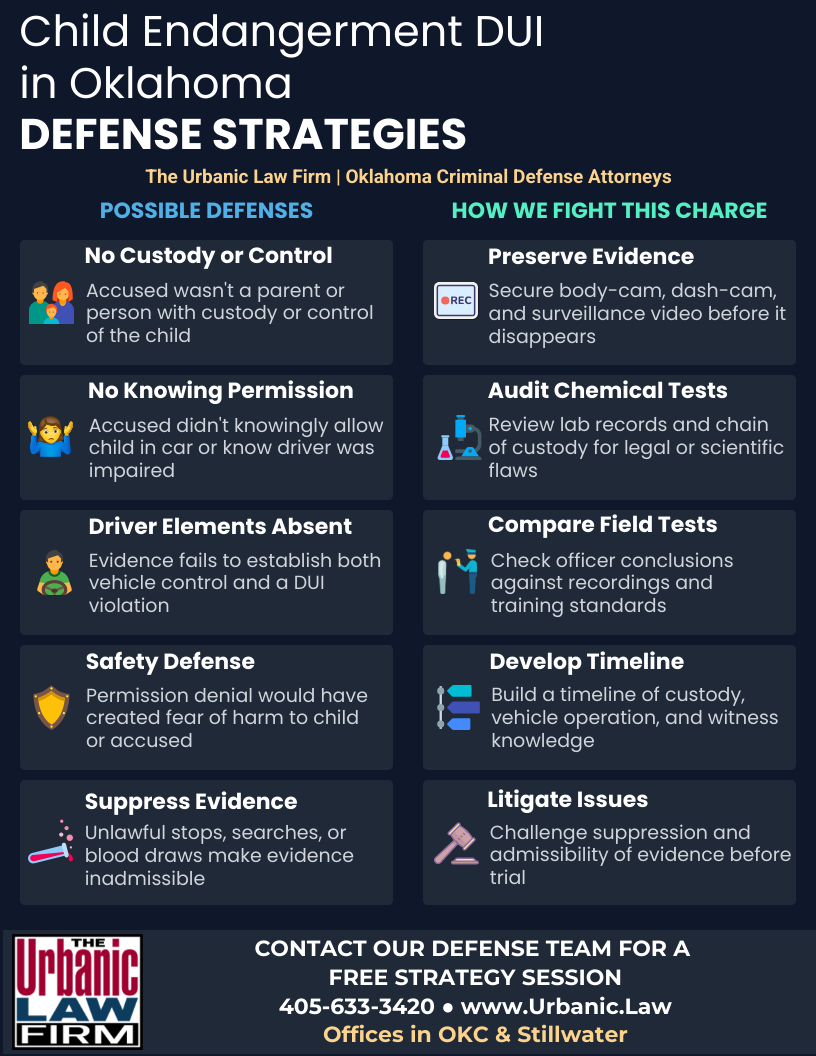
- No custody or control: The accused wasn’t a parent, guardian, or person having custody or control of the child.
- No knowing permission: The accused didn’t knowingly permit the child to be in the vehicle or didn’t know and reasonably shouldn’t have known the driver was impaired or under the influence.
- Driver-side elements absent: The evidence doesn’t establish both control of the vehicle and either a DUI-law violation or impairment.
- Statutory safety defense: This defense applies when denying permission would have created a reasonable apprehension of substantial bodily harm to the accused or the child.
- Key evidence should be suppressed: Evidence obtained through an unlawful stop, detention, search, seizure, blood draw, or interrogation is subject to suppression when the governing constitutional requirements are violated.
What The Urbanic Law Firm does to help clients charged with child endangerment DUI
- Explain the charge, court settings, major decisions, and likely next steps without leaving the client guessing about the process.
- Track filing dates, evidence requests, hearing dates, license-related deadlines, and other time-sensitive matters.
- Organize reports, videos, test records, witness information, photographs, and client-provided evidence into a usable case file.
- Prepare the client for court appearances, attorney meetings, hearings, and decisions that may affect the case.
- Communicate developments and strategy as the evidence changes so the client understands what matters and why.
An Oklahoma child endangerment DUI defense lawyer should also keep the criminal case, driving-privilege issues, and family-related risks coordinated.
Questions to ask your attorney
- Which vehicle-based child endangerment theory is the State relying on in my case?
- What evidence shows I had custody or control of the child?
- What objective evidence supports or contradicts the claimed impairment?
- Are there grounds to suppress the stop, statements, search, or chemical-test evidence?
- Could a separate proceeding involving my driving privileges or family situation affect the strategy?
Things you can do if you’re arrested for child endangerment DUI
- Save photographs, receipts, messages, location data, and other records that may help establish the timeline.
- Identify witnesses who saw who was driving, the child’s circumstances, or the events before the traffic stop.
- Don’t discuss the facts on social media or with people who may later become witnesses.
- Follow bond, no-contact, testing, and court orders exactly while the case is pending.
- Calendar every court and administrative deadline and use our criminal-process guide to understand where those events fit in the case.
What happens next
After an arrest, the case usually moves through booking, bond, an initial court appearance, charging, discovery, pretrial litigation, and either a negotiated resolution or trial. The exact sequence depends on the county and the allegations.
Discovery can include reports, recordings, photographs, chemical-test records, witness statements, and other material collected by law enforcement. Defense investigation may add evidence the State didn’t gather.
Motions may address an unlawful stop, a search, statements, chemical testing, expert evidence, or another evidentiary issue. If the case doesn’t resolve, the State must present admissible evidence supporting every required element at trial.
Any sentencing decision should be checked against the statutory penalty and the person’s prior record.
How child endangerment DUI compares to related driving charges
The charges can arise from the same traffic stop, but they don’t require identical proof. Child endangerment DUI adds requirements concerning the child and the accused person’s relationship, custody, or control.
| Offense | Core conduct | Mental state / relationship | Classification | Common defense issue |
|---|---|---|---|---|
| Child endangerment DUI | Permitting a child to ride with an impaired driver, or driving, operating, or controlling the vehicle while DUI or impaired with the child present | Parent, guardian, or person with custody or control; permission theory also requires knowledge or reason to know of the driver’s impairment | Class B6 felony; up to 4 years in prison; up to $5,000 | Custody or control, knowledge, vehicle control, child presence, and impairment proof |
| DUI | Driving or operating under one of Oklahoma’s prohibited alcohol, drug, or intoxicating-substance conditions | No child-custody relationship required | Standalone classification depends on the charged DUI theory and qualifying history | Driving, stop legality, chemical-test reliability, timing, and impairment |
| APC | Having actual physical control of a vehicle while subject to a prohibited alcohol, drug, or intoxicating-substance condition | No child-custody relationship required for the standalone offense | Classification follows the applicable impaired-driving statute and qualifying history | Whether the person actually controlled the vehicle, plus impairment and testing evidence |
Key terms
Child
A child is an unmarried person under 18 years of age. That definition matters because the offense statute incorporates the Oklahoma Children’s Code definition rather than creating a different age rule for this vehicle offense. (10A O.S. § 1-1-105(8))
Actual physical control
Actual physical control means directing influence, domination, or regulation of a motor vehicle, whether or not the vehicle is being driven or moving. This concept can make vehicle movement unnecessary for the driver-side theory. (jury instruction 6-35)
Driving
Driving means operating a motor vehicle while it is in motion. Evidence about who actually moved the vehicle can therefore matter when the State relies on driving rather than physical control. (jury instruction 6-35)
Under the influence
A person is under the influence when alcohol, an intoxicating substance, or a combination has affected the nervous system, brain, or muscles enough to appreciably hinder the person’s ability to operate as an ordinarily prudent and cautious person would under like conditions. The definition makes observable impairment evidence important. (jury instruction 6-35)
Intoxicating substance
An intoxicating substance can include a non-alcohol substance capable of entering the body and adversely affecting the central nervous system, vision, hearing, sensory functions, or motor functions. The particular substance and its demonstrated effects matter in a drug-impairment case. (jury instruction 6-35)
FAQs
Can a child endangerment DUI case be expunged in Oklahoma?
Potentially. Eligibility depends on how the case ends, the person’s criminal history, waiting periods, and the law in effect when expungement is sought. Our Oklahoma expungement guide explains the broader eligibility framework.
Can you face child endangerment in Oklahoma for letting a child ride with an impaired driver?
Yes, depending on the facts. The statute isn’t limited to the impaired driver. A parent, guardian, or another person who has custody or control of the child can be charged if that person knowingly permits the child to be in the vehicle and knew or reasonably should have known the driver was impaired or under the influence.
Can Oklahoma prosecutors file DUI and child endangerment as separate charges from the same stop?
Yes. The child-endangerment statute expressly allows prosecution under the separate impaired-driving laws, so one incident can support more than one count when the evidence satisfies each offense.
Does a child-endangerment-by-DUI case in Oklahoma require the vehicle to be moving?
Not necessarily. The driver-side language reaches a person in physical control of the vehicle, so a case can involve a vehicle that wasn’t moving when police made contact.
What happens to your driver’s license after an Oklahoma DUI arrest involving a child passenger?
The separate impaired-driving allegation can trigger driver’s-license proceedings apart from the child-endangerment prosecution. Administrative deadlines may run before the criminal case is resolved, so those issues should be evaluated early.
Important cases
State v. Vincent, 2016 OK CR 7, 371 P.3d 1127 is especially important to vehicle-based child endangerment. The Oklahoma Court of Criminal Appeals explained that the offense isn’t limited to parents or guardians and that a driver can have “control” over a child passenger for purposes of the statute.
Oxley v. State, 1997 OK CR 32, 941 P.2d 520 addressed the meaning of custody or control under the child-endangerment statute. The court explained that the phrase reaches a person who assumes responsibility for a child and isn’t confined to formal legal custody.
This crime in the news
On January 10, 2026, KXII reported that police accused Brittany Cravatt of driving while intoxicated with three children in her car in Ardmore, in Carter County. The report said Cravatt was taken to the Carter County Jail on three child-endangerment counts and a separate DUI charge. The allegations illustrate the driver-side theory of child endangerment DUI: prosecutors can pursue the felony when they claim an impaired driver had children in the vehicle.
About the Author: Attorney Frank Urbanic

This page is for informational purposes only and is not legal advice. Every case is unique; consult an attorney about your specific situation. Law last reviewed on September 10, 2026 by attorney Frank Urbanic. Page last updated September 10, 2026. Review the statutes cited on this page for the most current version of the law.