Expungements in Oklahoma: Eligibility, Record Sealing, and How the Process Works
 An old arrest or case can follow you for years. Still, Oklahoma law may let you expunge that record. That relief can change what the public sees, what you can say, and your opportunities. We have extensive experience expunging cases throughout Oklahoma. Let us help you reclaim your privacy, restore your reputation, and rebuild your future. This guide shows you who is eligible for an Oklahoma criminal record expungement, how the process works, and what we do to help our clients seeking an expungement.
If you’d like to have your case expunged, call us at 405-633-3420 or use our secure online form. We will walk you through your cases with you and discuss whether you can get them expunged.
Quick Links
- Who’s eligible
- What expungement means
- Multiple offenses and incidents
- Why location matters
- Places records can exist
- How the criminal record expungement process works
- What changes after sealing
- 991c and VPO sealing
- How we build an expungement plan
- Key legal terms
- FAQs
Who’s eligible for an expungement
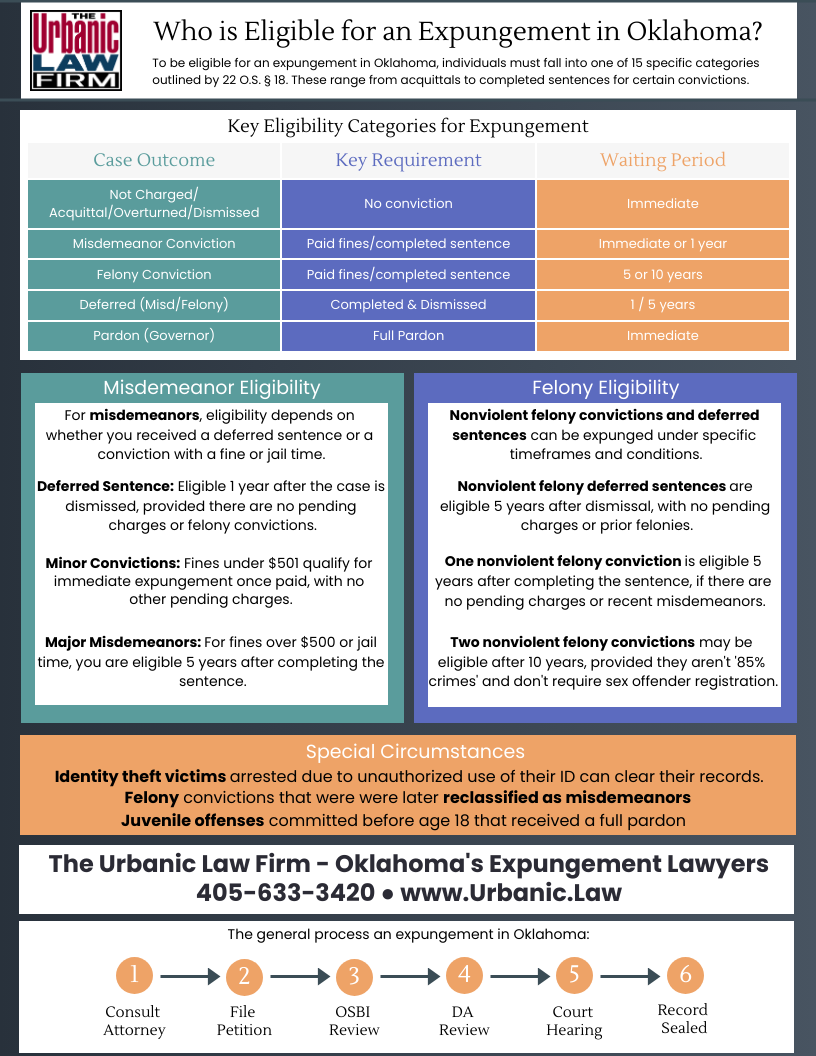
Eligibility turns on the case result, your record, and any pending charges. 22 O.S. § 18 is the main expungement statute in Oklahoma. There are currently two versions of it. Version 1 lists 16 categories. Version 2, which has the most recent effective date, lists 15. The list of expungable situations in each version match except for an additional situation in version 2.
You can expunge your case if:
Know that drug court cases can change the timing
Drug court cases need special care. In the right case, Oklahoma law lets you seek expungement right away after a drug court dismissal. So, don’t assume the ordinary waiting rule applies to every deferred dismissal.
Delayed dismissal orders of deferred sentences don’t affect eligibility date
Sometimes a person successfully completes the deferred term, but the formal dismissal order is never entered or doesn’t get signed until much later. Section 18 still measures these categories from when the charge was dismissed. However, 22 O.S. § 991c says the expungement provisions tied to successful completion of a deferred sentence are retroactive. State v. Salathiel explains that successful completion gives the defendant expungement rights by operation of law. Therefore, the Section 18 waiting period starts at the date the case was eligible for dismissal at the end of the deferred term—not when the formal dismissal actually occurred.
Watch for pending charges that can block relief
Many Section 18 categories require a clean slate from current charges. One open case can stop an otherwise strong petition. In some situations, you must finish Case A before you can expunge Case B.
What an expungement really means in Oklahoma
Section 18 and Section 19 usually mean sealing, not destruction
Oklahoma usually uses “expungement” to mean record sealing. The order can reach criminal records and related public civil records that came from the same arrest, transaction, or occurrence. So, one petition can affect more than one public file.
Distinguish fully sealed records from partially sealed records
Some expungements produce full sealing. Others produce partial sealing. With full sealing, the public and law enforcement can’t see the record. With partial sealing, the public can’t see the record, but law enforcement still can for law enforcement purposes.
Expungements that are only partially sealed
- Full pardon cases.
- Misdemeanor deferred or delayed sentence cases that ended in dismissal after successful completion.
- Nonviolent felony deferred or delayed sentence cases that ended in dismissal after successful completion.
- Misdemeanor conviction cases with only a fine under $501, no jail time, and no suspended sentence.
- Misdemeanor conviction cases with jail time, a suspended sentence, or a fine over $500.
- Cases with one qualifying nonviolent felony conviction.
- Cases with not more than two qualifying felony convictions.
- Wrongful arrest, charge, or warrant cases caused by identity misuse.
- Cases with a nonviolent felony that Oklahoma later reclassified as a misdemeanor.
- Cases with not more than two qualifying felony charges that the court dismissed after successful completion of a deferred judgment or delayed sentence (version 1 only)
Which expunged cases the State can still use later
The State can use some expunged records in a later criminal prosecution to prove a prior conviction or a prior deferred judgment. That later-use rule covers misdemeanor deferred-dismissal cases, nonviolent felony deferred-dismissal cases, certain misdemeanor convictions, one qualifying nonviolent felony conviction, cases with not more than two qualifying felony convictions, and cases with not more than two qualifying felony charges that the court dismissed after successful completion of a deferred judgment or delayed sentence (version 1 only). In those situations, the State doesn’t need a separate court order to unseal the record for that limited purpose.
Expungements that may also seal Pardon and Parole Board records
The two printed versions don’t say exactly the same thing here. Version 1 lets the court seal Pardon and Parole Board records tied to a pardon application in full pardon cases and in under-18 full pardon cases.
Version 2 covers those two situations and adds two more. It also reaches cases with one qualifying nonviolent felony conviction and cases with not more than two qualifying felony convictions. In each of those situations, the public can’t see the Pardon and Parole Board records, but the Board still can.
The case is treated like it never happened
When the court grants a qualifying sealing order, Oklahoma law says the official actions are deemed never to have occurred. That’s why expungement relief matters so much. It changes what the public sees, and it can change what you may lawfully say about the incident.
Multiple offenses
When several charges came from one incident
One arrest can produce several counts. Even so, Oklahoma doesn’t always count each count as a separate conviction for expungement purposes. For the conviction-based categories, the statute treats offenses that arose from the same transaction or occurrence as one conviction and one offense.
That rule can change the whole analysis. One incident may create several docket entries, yet still count as one event for those conviction categories.
When the cases came from different incidents
Different incidents usually require separate analysis. Once the record shows different dates, unrelated arrests, or separate events, you must evaluate each incident on its own. Then you must decide which case you should tackle first.
That step matters because one older case can block another one. One pending case can also stop the whole plan. So, filing order matters when your record spans several incidents.
Expunging one incident on one petition allows you to expunge another on the same petition
Sometimes Case A blocks Case B. Then Case A gets sealed, and Case B fits a different category.
That sequencing point can also affect how the petition is built. Oklahoma law lets related requests for relief move together in one civil action. Under 22 O.S. § 19(F), if multiple offenses in one county would qualify for expungement if processed sequentially, they may be considered under a single petition. And under 12 O.S. § 2018, Oklahoma’s joinder statute, claims may be joined even when one claim would only become legally available after the court first grants relief on another claim. Section 19(F) allows that step when each offense would qualify if the court processed the incidents in sequence.
That means one petition can ask for a favorable ruling on one incident first, then ask the court to grant expungement on a second incident that only becomes eligible because of that first ruling. Joinder can let the court handle the sequence in one case instead of forcing separate petitions over related matters in the same county.
Why the location of incidents matters
File where the arrest information sits
You file the petition in the district court for the district where the arrest information sits. So, location does more than tell you where the case started. It also controls venue, notice, and the court that hears the petition.
Handle multiple counties with a real filing sequence
Multiple counties usually mean multiple petitions. Section 19(F) helps only when the offenses sit in one county. One county’s result may change another county’s eligibility. So, map every county first, then choose the best order.
Treat municipal cases like a separate layer of the record
A city arrest or municipal court case can still require county-level analysis. You still need the right venue. You still need notice to the right agencies. So, don’t assume a city case stays only in city records.
Places records can exist
One incident can leave records in several places. That’s why a strong petition names every agency and office that still holds part of the record.
- Municipal court: A city court file may still exist.
- Municipal police department: City police may still hold reports, booking records, and arrest records.
- County district court: The court may still hold the docket, pleadings, and minute entries.
- Sheriff’s office or county jail: Booking entries, mugshots, and jail logs may still remain there.
- Service Oklahoma: Driver-license or identification records may require separate attention.
- Department of Corrections: Prison, probation, parole, or supervision records may still exist.
- Oklahoma State Bureau of Investigation: OSBI holds statewide criminal history records and plays a key role in most Section 18 and Section 19 cases.
- Oklahoma Court of Criminal Appeals: If your case went up on appeal.
You may also need to list the arresting agency, the prosecutor, and any clerk who still holds part of the file. If you leave one agency out, you may win only a partial cleanup.
In some counties, including Oklahoma County, you may first see a CPC case online before a later CF or CM case appears. ODCR/OSCN identifies CPC as a criminal probable-cause case type, and Oklahoma County dockets show later felony cases referring back to earlier CPC matters. That means one incident can sometimes create more than one public-facing case number tied to the same arrest or probable-cause filing.
That extra case number matters in expungement work. If the CPC case stays online along with the later CF or CM case, both records need attention. So, a thorough expungement review shouldn’t stop with the final filed case. It should include a careful review of your online criminal record to catch every case number, docket entry, and court record tied to the incident or incidents you want sealed.
Some Title 47 driving records don’t get expunged
A DUI incident can create more than one court case. Besides the criminal DUI case, a person may also file a separate district court challenge to a license revocation or implied-consent suspension under 47 O.S. § 6-211. Because 22 O.S. § 18 defines expungement to include public civil records arising from the same arrest, transaction, or occurrence, that district court revocation case may also be included in the expungement analysis along with the criminal DUI case. Still, that doesn’t mean every driving-related record disappears. Title 47 separately says the Motor Vehicle Report and any record or information associated with it are not subject to expungement, so the court case may be sealed even though some Service Oklahoma driving-history entries still remain.
Under 47 O.S. § 6-117(D), the Motor Vehicle Report, including any record or information associated with it, is not treated as a public civil record under Oklahoma’s expungement statutes and is not subject to expungement. That matters because the Motor Vehicle Report is the three-year driving-record summary maintained by Service Oklahoma, and it includes collisions, convictions for motor vehicle laws, and actions taken against a person’s driving privilege.
So, as a practical matter, a DUI-related revocation, an implied-consent suspension, a collision entry, or a court abstract that becomes part of the driving history maintained by Service Oklahoma usually falls inside that Title 47 carve-out rather than ordinary Section 18 expungement relief. Service Oklahoma’s own records forms also separate out open driver-history materials such as notices of suspension or revocation, officer’s affidavits, traffic conviction records, and other records related to driving history. That means you may be able to expunge the court case tied to the incident in the right situation, while a related driving-record entry or license action still remains on the motor vehicle side.
How the criminal record expungement process works in Oklahoma
Match the case to the right expungement category
At The Urbanic Law Firm, we first match the facts to the right subsection of 22 O.S. § 18. A dismissal, a deferred sentence, a drug court case, and a conviction don’t follow the same rule. So, we don’t file until the right category is clear.
Map the full record before filing
Next comes the record map. We gather the arrest date, case number, county, court, arresting agency, charge, dismissal date, sentencing date, and every agency that still holds a record. That step helps prevent half-fixes. It also helps set the best filing order when more than one case appears on the record. We pull court, arrest, and criminal records to make sure we have a clear picture of all offenses.
Choose the right court and the right sequence
Then we decide where the petition belongs. Section 18 relief moves through a new civil case, not through the old criminal case. So, we file in the district court for the district where the arrest information sits. If your record spans more than one county, we plan the sequence before the first petition goes out.
Give notice to the agencies that matter
After filing, we make sure the required parties get notice. That usually includes the prosecutor, the arresting agency, OSBI, and any other agency affected by your incident. Because the statute requires notice before the hearing, this stage matters more than many people expect.
Present the case for sealing at the hearing
If all signatures are received prior to the hearing date, the judge will sign off on the expungement order. If they are not all received by the hearing date, a hearing has to take place. At the hearing, the court weighs privacy harm and unwarranted adverse consequences against the public interest in open records. So, we don’t treat the hearing like a formality. We frame the record, the harm, and the legal fit in a way that gives the court a clear reason to grant relief.
Make sure the order reaches the right offices
A narrow order can leave part of the record behind. So, when we prepare the proposed order and review the final order, we focus on the courts, agencies, and offices that still hold the record. That step matters because a missing agency can leave a public trail in place. We submit a certified copy of the signed order to every agency that needs a copy, and we provide our clients with one or more certified copies of the order.
Follow through after the judge signs the order
We don’t stop at the signature line. We track whether the index changed, whether the docket changed, and whether the agencies processed the order. That follow-up helps confirm that the relief worked the way it should.
What happens after your record is sealed
What you can legally say
When the court grants a qualifying order, Oklahoma law says the official actions are deemed never to have occurred. In many situations, you may answer that no such action occurred and no such record exists.
What employers, schools, and agencies usually can’t require
Employers, schools, and state or local agencies generally can’t force you to disclose sealed arrest and criminal record information. They also can’t deny an application only because you refused to disclose sealed information.
Why some sealed records still matter later
Some expungements produce only partial sealing. In those situations, the public can’t see the records, but law enforcement still can for law enforcement purposes. Both versions apply that rule to full pardon cases, certain deferred-dismissal cases, certain misdemeanor conviction cases, one qualifying nonviolent felony conviction, qualifying two-felony conviction cases, wrongful-identity cases, and reclassified-felony cases. Version 1 adds the extra two-felony deferred-dismissal category.
The law also lets the State use some expunged records later to prove a prior conviction or prior deferred judgment. Both printed versions apply that later-use rule to certain deferred-dismissal cases, certain misdemeanor conviction cases, one qualifying nonviolent felony conviction, and qualifying two-felony conviction cases. Version 1 adds the extra two-felony deferred-dismissal category. The State doesn’t need a separate order to use the record for that limited purpose.
Pardon and Parole Board records follow a different split. Version 1 covers full pardon cases and under-18 full pardon cases. Version 2 covers those situations and also some qualifying conviction cases. In each covered situation, the public can’t see the Board records, but the Board still can.
When you may still need to disclose the incident
Even after a qualifying expungement, you can’t assume the answer is always “no” in every setting. Oklahoma law generally lets you say the incident never happened once the court seals the record. However, some forms and legal processes still require disclosure if they specifically ask about expunged, sealed, or dismissed matters. That issue comes up most often with federal security-clearance forms, immigration matters, and some professional licensing or admissions applications. So, the safer rule is this: if the question specifically asks about expunged or sealed cases, you shouldn’t assume Oklahoma’s general rule lets you leave it out.
Who can look at the sealed records later
The person in interest, the Attorney General, or the prosecutor can ask the court for access. If no one opens the record within ten years after the order, the law may allow destruction or obliteration.
Criminal appellate records can also need separate expungement work
A district court expungement doesn’t automatically clean up the criminal appellate record. The Oklahoma Court of Criminal Appeals has its own expungement rules for criminal appellate records. Under Rule 14.1, a person who has already obtained a district court expungement under 22 O.S. § 18 and § 19 may seek expungement of related criminal appellate records in that court. Rule 14.3 says later inspection of expunged criminal appellate records may be allowed only on application by the petitioner, the Attorney General, or the district attorney.
That means an incident may leave more than a trial-court record behind. If your case went up on appeal, or if there’s an appellate record tied to the incident you want sealed, your attorney should check for that record too. Otherwise, you can end up with a district court expungement order while a related criminal appellate record still remains open.
The process also requires a separate filing. Under Rule 14.2, the application goes to the Clerk of the Oklahoma Court of Criminal Appeals, must state the Section 18 category that made the person eligible in district court, must identify the date and scope of the district court’s expungement order, and must include a certified copy of that order. That’s important because it shows why a complete expungement review shouldn’t stop at the district court docket.
991c record update and VPO expungement
22 O.S. § 991c record update
Section 991c doesn’t give you the same relief as Section 18. It deals with the record effect of a completed deferred sentence. In these cases, the court dismisses the charge with prejudice, removes references to your name from the public docket, and clears the public index of the filing. It changes your record with OSBI from “pled guilty case deferred” to “pled not guilty case dismissed.” So think of it more as a record update rather than as an expungement.
Still, 991c doesn’t replace a Section 18 petition. Oklahoma law and case law treat 991c as narrower relief. Records sealed under 991c stay hidden from the public, but law enforcement still can see them, and the State can still use them later to prove a prior conviction or prior deferred judgment.
VPO expungement
Victim protective order records follow a separate sealing process under 22 O.S. § 60.18. That process doesn’t track the standard criminal expungement process. Instead, it focuses on sealing VPO court records from public inspection under its own rules.
Even after a VPO sealing order, the court, law enforcement, and the district attorney may still view the record. So, if you’ve got both a criminal case and a VPO case, you may need two separate plans.
How we build an expungement plan for our clients
Review the whole record
We don’t start with the case that looks easiest on the surface. We start with the whole record. Then we compare dates, counties, outcomes, and pending cases.
Our plan:
- Build a timeline for every arrest, filing, dismissal, plea, sentence, discharge date, and pardon date.
- Count cases by incident, outcome, county, and statute, not by memory or docket rumor.
- Check whether several counts came from the same transaction or occurrence.
- Plan multi-county records as one strategy, not as isolated cases.
- Make sure the final order names every court, agency, and office that still holds a record.
Why the order of filing matters
A rushed filing can waste time and leave part of the record behind. By contrast, a planned filing sequence can turn one successful expungement into the key that unlocks the next one.
Key legal terms
Expungement
“Expungement” means the sealing of criminal records, as well as any public civil record, involving actions brought by and against the State of Oklahoma arising from the same arrest, transaction or occurrence. That term is noteworthy because one expungement can reach more than one public file. (22 O.S. § 18(B)(1))
Single-source record
“Single-source record” means a criminal history record from this state that consists of an Oklahoma arrest record only. It doesn’t include an arrest from another state, a federal arrest, a National Sex Offender Registry entry, or an NCIC wanted or warrant entry. (22 O.S. § 18(B)(2))
Motor Vehicle Report
“Motor Vehicle Report” means the three-year driving record summary maintained by Service Oklahoma, and it includes motor vehicle collisions, convictions for violations of motor vehicle laws, and actions taken against a person’s privilege to operate a motor vehicle. This term matters on this page because Title 47 says the Motor Vehicle Report, and any record or information associated with it, is not subject to expungement. (47 O.S. § 6-117(B)(3), (D))
Complete Driver Record
“Complete Driver Record” means a report of all information maintained by Service Oklahoma related to the driving history of any person. This term is important because an expunged criminal case may not remove every driver-history record tied to the same incident, especially when Service Oklahoma keeps a separate driving-record file. (47 O.S. § 6-117(B)(2))
Important Oklahoma expungement cases
In re Amendment of Rules 1.260 and 1.261, 2024 OK 27
This 2024 Oklahoma Supreme Court rule amendment makes an important procedural point. After someone gets a district court expungement under 22 O.S. § 18, § 19, or § 60.18, that person may also seek expungement of related civil appellate records in the Oklahoma Supreme Court for retained cases and for cases that stand or stood assigned to the Oklahoma Court of Civil Appeals. The application must identify the district-court expungement category and include a certified copy of the motion and the district court’s expungement order. Sealing the trial-court record doesn’t always clean up every related appellate record automatically.
S.K.W. v. State, 2022 OK 39
In S.K.W., the Oklahoma Supreme Court held that when expungement rests on a full gubernatorial pardon, the plain language of 22 O.S. § 18 allows expungement of all of the pardoned convictions, not just one. That’s important because some older arguments tried to limit pardon-based expungement to a single conviction. S.K.W. makes clear that a full pardon can support expungement of multiple pardoned convictions, which matters a lot in multi-case and multi-county records.
Brassfield v. State, 2024 OK 9
In Brassfield, the Oklahoma Supreme Court held that an ongoing investigation is not the same thing as a pending misdemeanor or felony charge for Section 18 expungement purposes. The Court also held that the requirement that the prosecuting agency will not refile the charge was satisfied where Oklahoma lacked jurisdiction to refile the charge. OSBI or another party may argue that a still-open investigation blocks expungement. Brassfield shows that an investigation alone doesn’t automatically defeat eligibility.
Common questions about Oklahoma expungements
Who qualifies for an Oklahoma expungement?
Eligibility depends on the result of the case, your overall record, any pending charge, and the version of Section 18 that fits the case. Oklahoma law covers acquittals, reversals, no-file arrests, dismissals, deferred-dismissal cases, some misdemeanor convictions, some nonviolent felony convictions, some two-felony situations, identity-misuse cases, pardons, and some reclassified felonies. Version 1 also adds one extra two-felony deferred-dismissal category.
Does an Oklahoma expungement erase every record everywhere?
No. A strong order can seal court, arrest, and criminal-history records tied to the same arrest, transaction, or occurrence. Still, you must name the right agencies, and some expungements produce only partial sealing. In those cases, the public can’t see the record, but law enforcement still can.
Can I group multiple Oklahoma cases into one petition?
Sometimes. If the incidents sit in one county and each one would qualify in sequence, Oklahoma law may let you group them in one petition. If the incidents sit in different counties, you’ll usually need separate petitions.
Can one Oklahoma expungement help another case qualify?
Yes. One older case can block another one. Then the first case gets sealed, and the second case may fit a new category. So, filing order can change the result.
What’s the difference between 991c and an Oklahoma Section 18 expungement?
Section 991c gives narrower relief after a completed deferred sentence. Section 18 and Section 19 govern broader sealing of arrest, criminal, and related public records. So, 991c can help, but it doesn’t replace a true Section 18 arrest-record expungement.
This page is for informational purposes only and is not legal advice. Every case is unique; consult an attorney about your specific situation. Page last updated April 5, 2026. Consult the statutes listed above for the most up-to-date law.