Hit & Run Resulting in Death Defense in Oklahoma
 A fatal hit and run can bring police interviews, media attention, insurance pressure, license problems, and felony prosecution all at once. However, a leaving-the-scene case is not just about a crash. The State still has to prove who drove, what happened, what the driver knew, and what the driver failed to do after the accident.
This guide is for people accused of hit & run resulting in death in Oklahoma and trying to understand the charge, possible punishment, and defense options before court. Because these cases often involve grief, panic, trauma, and fast-moving investigations, early defense work matters.
Quick links
- What this charge means
- Explanation of the law
- Key elements the state must prove
- Penalties
- Collateral consequences
- How prosecutors prove fatal hit and run
- Practical guide if you’re charged with this crime
- What happens next
- Comparison to other crimes
- Key terms
- FAQs
- Important case
- Example of this crime in the news
What is hit and run resulting in death?
Hit and run resulting in death means the State claims a driver was involved in a crash where someone died and then failed to stop, return, stay, give required information, or render reasonable aid. A conviction carries a felony penalty because the crash resulted in a death.
However, the charge doesn’t automatically prove the driver caused the crash. It focuses on what happened after the accident. For the broader traffic-crime category, see our dangerous driving crimes overview.
Get help before the first court setting
If you’ve been accused of fatal hit & run in Oklahoma, reach out for a free consultation. An Oklahoma leaving the scene of an accident resulting in death defense attorney can help protect you before statements, searches, or assumptions shape the case.
Call us at 405-633-3420 or use our secure online form.
Explanation of the law
Oklahoma law requires a driver involved in an accident resulting in death to stop immediately at the scene, or as close as possible, then return and remain there until required duties are completed (47 O.S. § 10-102.1). The legal focus is the driver’s duty after a fatal accident.
Those required duties include giving identifying and insurance-related information and rendering reasonable assistance to an injured person when the situation requires it (47 O.S. § 10-104). For a broader discussion of hit-and-run and failure to stop cases, read our related guide.
Because a fatal crash can also trigger other allegations, prosecutors may file related counts such as DUI causing death, manslaughter, reckless driving, eluding, or other accident duties and reporting violations. So, the defense has to review both the crash evidence and the post-crash evidence.
Key elements the state must prove
The on-point jury instruction is jury instruction 6-25. For a death case, the State must prove the death-related version of the elements.
- You drove a vehicle.
- The vehicle was involved in an accident.
- The accident resulted in the death of a person.
- The failure was willful or malicious.
- That element can matter when panic, confusion, injury, shock, or mistaken belief affected what happened next.
- You failed to immediately stop at the scene or as close as possible and remain there until the required duties were completed.
- Those duties include giving correct identifying and vehicle information.
- They also include rendering reasonable assistance to an injured person.
Penalties
Fatal hit & run is a Class B4 felony under 21 O.S. § 20I. The punishment can include prison, fines, and license revocation.
- Prison:
- 1–10 years in prison.
- Fine:
- $1,000–$10,000.
- Driver’s license:
- Mandatory revocation of the driver’s license, permit, or nonresident operating privilege.
- Prior felony allegations:
- A prior felony conviction can raise the risk through Oklahoma’s sentence enhancement rules, including 21 O.S. § 51.1.
Because the case involves a death, the court may also address victim-impact issues, court costs, and restitution. The punishment can affect your freedom, license, job, and future record.
Collateral consequences
A conviction can follow you long after sentencing. The record, license loss, and civil fallout can create pressure outside the criminal courtroom.
- Driver’s license revocation and higher barriers to getting back on the road.
- Job problems, especially for commercial drivers, delivery workers, and anyone who drives for work.
- Insurance consequences, claim disputes, and possible civil lawsuits.
- A felony record that can affect housing, background checks, and professional licensing.
- Stress on family, finances, and immigration or military-related screening when those issues apply.
How prosecutors prove fatal hit and run
Prosecutors usually build these cases from the crash scene outward. They often try to connect the vehicle, the driver, and the post-crash conduct into one story.
- Crash-scene evidence: debris, skid marks, vehicle damage, road conditions, and final resting positions.
- Video and location evidence: surveillance footage, traffic cameras, dash cameras, phone records, and GPS data.
- Witness statements: bystanders, passengers, emergency responders, and later contact with police.
- Vehicle identification: paint transfer, broken parts, license-plate readers, repairs, and body-shop records.
- After-the-fact conduct: statements, delayed reporting, hiding the vehicle, repair attempts, or leaving the area.
Practical guide if you’re charged with this crime
What we look for first in a fatal hit & run case
The first review focuses on identity, vehicle involvement, timeline, knowledge, and what happened after the crash. An Oklahoma leaving the scene of an accident resulting in death defense lawyer can test the State’s assumptions before they become the case narrative.
Defenses
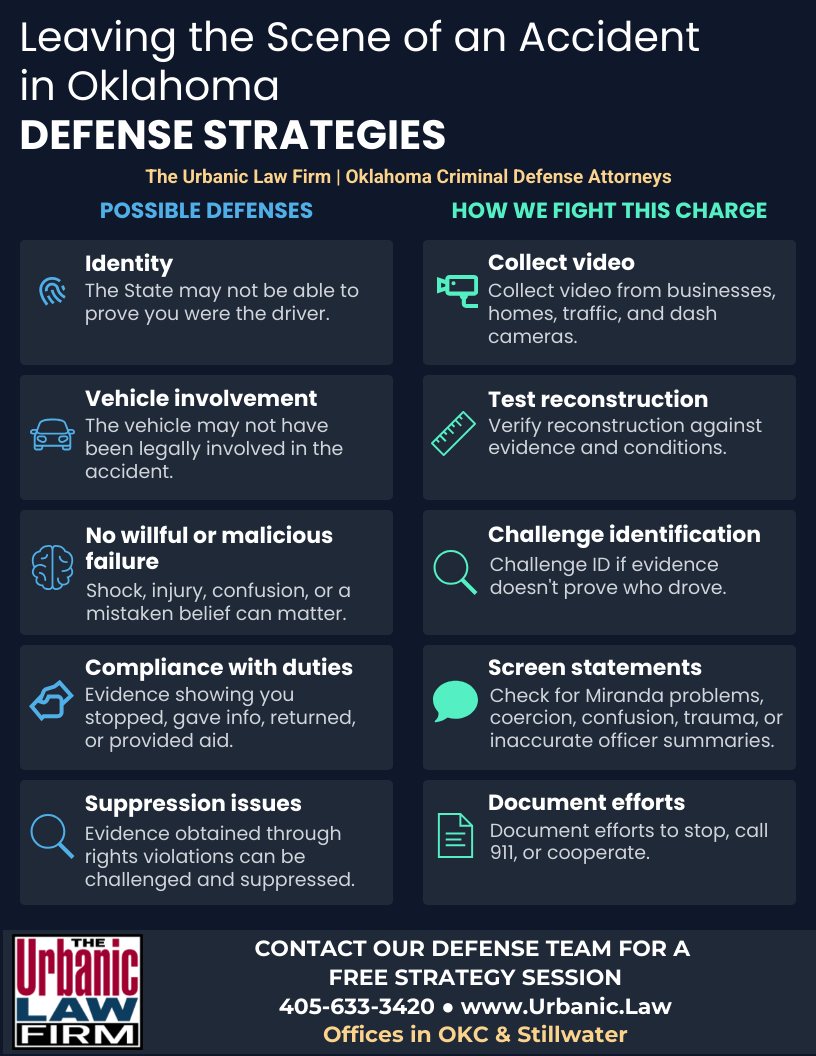
- Identity: The State may not be able to prove you were the driver.
- Vehicle involvement: The vehicle may not have been legally involved in the accident.
- No willful or malicious failure: Shock, injury, confusion, or a mistaken belief can matter.
- Compliance with duties: Evidence may show you stopped, returned, called for help, gave information, or tried to assist.
- Suppression issues: Statements, phone data, searches, or vehicle evidence may be challenged if police violated your rights.
How we fight these charges
- Collect nearby video before it disappears from businesses, homes, traffic systems, or dash cameras.
- Test the crash reconstruction against physical evidence, sight lines, lighting, road conditions, and timing.
- Challenge driver identification when witnesses, video, or vehicle ownership records don’t prove who drove.
- Screen statements for Miranda problems, coercion, confusion, trauma, or inaccurate officer summaries.
- Document any effort to stop, return, call 911, render aid, identify yourself, or cooperate after the crash.
What The Urbanic Law Firm does to help
- Explain the charge, court settings, risk points, and choices in clear language.
- Organize discovery, reports, video, photos, body-camera footage, and witness statements.
- Coordinate with investigators, reconstruction experts, and records sources when the facts require it.
- Prepare you for court, police-contact issues, media pressure, and prosecutor communications.
- Track deadlines, hearings, license issues, and evidence requests so nothing important gets missed.
Questions to ask your attorney
- What evidence does the State have that I was the driver?
- What evidence connects the vehicle to the fatal accident?
- What does the State claim I failed to do after the crash?
- Are there statement, search, phone, or vehicle-evidence suppression issues?
Things you can do if you’re arrested for this crime
- Stay respectful, but don’t try to explain the crash without counsel.
- Save photos, insurance documents, repair records, phone records, and any witness names.
- Avoid posting about the crash, the deceased person, police, or witnesses online.
- Write down a private timeline for your attorney while your memory is fresh.
- Follow every court condition and keep proof of appointments, treatment, or travel restrictions.
What happens next
After arrest or filing, the case usually moves through an initial appearance, discovery, negotiations over evidence, preliminary-hearing issues, motions, and possible trial settings. At the first setting, the judge may address bond, release conditions, and future court dates.
Different punishments may apply if prosecutors add prior felony allegations or related counts. For a more detailed overview of the criminal process in Oklahoma, you can read more in our Oklahoma criminal process guide.
Fatal hit & run compared to other crimes
Fatal crash cases can involve several different theories. The exact charge matters because each offense focuses on different conduct and creates different risk.
| Offense | What prosecutors focus on | Why classification matters | Common defense issues |
|---|---|---|---|
| Hit and run resulting in death | Whether you drove a vehicle involved in a fatal accident and failed to stop, remain, give information, or render aid. | Class B4 felony, 1–10 years in prison, $1,000–$10,000, and mandatory license revocation. | Driver identity, vehicle involvement, knowledge, willful conduct, reasonable assistance, and suppressed evidence. |
| Nonfatal injury hit-and-run | Whether the accident caused personal injury rather than death and whether the driver failed to perform scene duties. | Still a felony, but the sentencing range differs because the injury level differs. | Injury proof, timeline, stop location, medical evidence, and whether the required information was provided. |
| DUI or DUI causing death | Whether alcohol, drugs, or another intoxicating substance affected driving and whether that conduct caused death. | A DUI-related death count can carry very different sentencing risk from leaving the scene alone. | Testing accuracy, timing, driving proof, causation, officer procedures, and independent crash causes. |
| Negligent homicide or reckless driving | Whether bad driving caused the crash itself, instead of only what happened afterward. | The case may shift from post-crash duties to crash causation and driving behavior. | Accident reconstruction, road conditions, witness reliability, speed estimates, and causation. |
Key terms
Vehicle
Vehicle means a device used to transport persons or property on a highway, except devices moved by human power or used only on fixed rails or tracks. Vehicles designed and adapted exclusively for agricultural and horticultural purposes and not subject to registration are excluded. (47 O.S. § 1-186 & jury instruction 6-35)
A fatal-scene case can turn on whether the accused vehicle was actually involved in the accident. For example, cargo or a load may raise different questions than the vehicle itself.
Motor vehicle
Motor vehicle means every vehicle that is self-propelled, except motorized bicycles, electric-assisted bicycles, and electric personal assistive mobility devices. (47 O.S. § 1-134 & jury instruction 6-35)
In a fatal crash investigation, police usually connect body damage, parts, paint, repair records, or registration records to a motor vehicle. However, ownership alone doesn’t always prove who drove.
Driving
Driving means operating a motor vehicle while it’s in motion. (jury instruction 6-35)
That concept matters when the State relies on witness assumptions, vehicle ownership, or later statements. Because the element focuses on the driver, identity can become a central issue.
Elude
Elude means to avoid, escape from, or evade, as by cunning, daring, or artifice. (jury instruction 6-35)
Prosecutors sometimes look at whether a driver fled from police before or after a crash. However, leaving an accident scene and eluding an officer are different legal theories.
Great bodily injury
Great bodily injury means bodily injury that creates a substantial risk of death, causes serious permanent disfigurement, or causes protracted loss or impairment of the function of a bodily member or organ. (jury instruction 6-35)
A fatal-scene case involves death, but related dangerous-driving or eluding allegations may use injury-level definitions. In addition, medical proof can affect which alternative counts prosecutors file.
FAQs
What is hit and run resulting in death in Oklahoma?
It means the State claims a driver was involved in a fatal accident and failed to stop, return, remain, give required information, or render reasonable assistance.
Can you go to prison for fatal hit & run in Oklahoma?
Yes. The offense is a felony, and a conviction can carry 1–10 years in prison, a $1,000–$10,000 fine, or both.
Will Oklahoma revoke my driver’s license for fatal hit and run?
Yes. A conviction requires revocation of the driver’s license, permit, or nonresident operating privilege.
Can fatal hit & run in Oklahoma be expunged?
It depends on the final outcome, sentence, criminal history, waiting period, and current expungement law. You can read more in our Oklahoma expungement guide.
What defenses apply to fatal hit and run in Oklahoma?
Possible defenses include mistaken driver identity, lack of vehicle involvement, no willful or malicious failure, compliance with scene duties, and suppression of unlawfully obtained evidence.
Important case
State v. Tran, 2007 OK CR 39, 172 P.3d 199, addressed a fatal-scene prosecution where a load of rocks fell from a truck and caused a death. The Oklahoma Court of Criminal Appeals held that the term “vehicle” didn’t include the cargo being hauled, and the case shows why vehicle involvement can be a decisive defense issue.
Example of fatal hit & run in the news
In a recent report from Oklahoma City Free Press, prosecutors charged a bus driver after a pedestrian was run over and killed. The report stated that prosecutors alleged the driver didn’t call 911, render aid, or accurately report what happened, which illustrates how fatal hit and run cases often focus on post-accident duties, not just crash causation.
This page is for informational purposes only and is not legal advice. Every case is unique; consult an attorney about your specific situation. Law last reviewed on May 19, 2026 by attorney Frank Urbanic. Page last updated May 19, 2026. Review the statutes cited on this page for the most current version of the law.

Legislative Payback or Public Safety? Sara Polston’s Shocking Constitutional Fight!

Tulsa’s “Serial Defecator” Case: Legal Analysis of a Messy Situation

Oklahoma Discovery Law Changes: 2026–2027 Guide
Oklahoma Domestic Abuse Law Updates Nov. 1: Five Big Changes

Oklahoma Stalking Case Reversed: When a Post Isn’t Enough
| THIS OFFENSE IN THE NEWS |