First Degree Rape Defense in Oklahoma
 A first degree rape charge can put you in the most dangerous part of an Oklahoma sex case. You could be facing a Class A2 felony, life-changing prison exposure, 85% time, sex-offender registration, and a case built on statements, forensic testing, phone records, and credibility fights. This page explains what first degree rape means, how prosecutors try to prove it, what defenses can work, and what usually happens next.
This charge also sits inside a broader set of sex crimes that can be filed together. Depending on the facts, prosecutors may stack other allegations from the same incident, including forcible sodomy, sexual battery, lewd-act allegations, kidnapping, or digital-evidence-related counts. You can compare this charge with closely related allegations in our rape and forcible sex coverage.
Quick links
- Explanation of the law
- Key elements the state must prove
- Penalties
- Collateral consequences
- How prosecutors prove first degree rape
- Practical guide if you’re charged with this crime
- What happens next
- Key terms
- FAQs
- Important cases
- Recent example of this crime in the news
Contact an Oklahoma sex crime attorney
If you’ve been accused of first degree rape in Oklahoma, reach out for a free consultation before your version of events gets buried under the State’s paperwork. An Oklahoma first degree rape defense attorney needs to move early on statements, phones, witnesses, and medical evidence.
Call us at 405-633-3420 or use our secure online form.
Explanation of the law
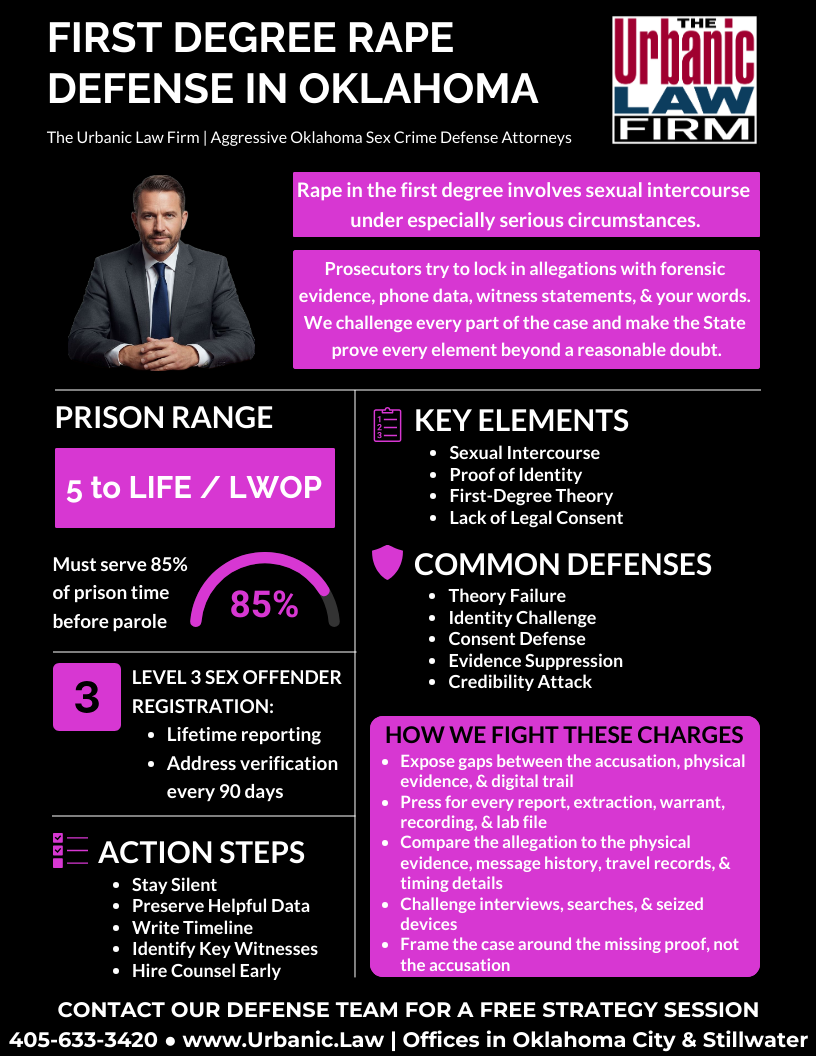
Under 21 O.S. § 1114, rape in the first degree covers sexual intercourse under especially serious circumstances. That includes allegations involving a person over 18 and a child under 14, a person who was incapable of giving legal consent because of mental illness or unsoundness of mind, a person who was drugged to force submission, a person who was unconscious of the nature of the act, or intercourse accomplished by force, violence, or threats of force or violence with apparent power to carry them out.
That means degree matters. A first degree rape case is not just about whether the State says intercourse happened. It’s also about whether prosecutors can prove the specific aggravating circumstances that push the allegation into the first-degree category.
Level 3 registration overview
Oklahoma treats this as a Level 3 sex-offense registration case. In practical terms, that means lifetime registration and address verification every 90 days. You can compare the official Oklahoma materials here: Level 3 sex crimes, DOC level assignment chart, Attorney General registry resources, and ODOC registration policy. The official chart row for rape in the first/second degree also shows aggravated treatment, so registration details can become a major part of the defense strategy.
Key elements the state must prove
- Sexual intercourse.
- The State has to prove the act itself, not just suspicion or bad conduct around the allegation.
- Identity.
- Prosecutors still have to prove you were the person involved.
- A first-degree theory.
- They must prove one of the aggravating circumstances that makes the allegation first degree.
- That could be force, threats with apparent power, incapacity, age, drugging, or unconsciousness of the nature of the act.
- Lack of legal consent when the theory requires it.
- Some theories turn on whether the alleged victim could legally consent or whether consent was absent under the evidence.
- Proof beyond a reasonable doubt.
- If the State’s theory shifts, the timeline breaks down, or the physical evidence does not match the accusation, that can create reasonable doubt.
Penalties
- Charge level: First degree rape is a Class A2 felony under 21 O.S. § 20D.
- First conviction:
- Under 21 O.S. § 1115, the statute allows death or imprisonment for not less than 5 years, and life or life without parole are also on the table.
- 85% rule:
- Because first degree rape is listed in 21 O.S. § 13.1, it’s an 85% crime. That means you must serve at least 85% of the sentence before parole consideration. You can read more in our 85% crimes guide.
- Repeat convictions:
- A second or subsequent first degree rape conviction can expose you to life or life without parole, and the statute removes probation eligibility for that repeat-conviction situation.
- A third or subsequent qualifying conviction can also expose you to life or life without parole.
- Fine issues:
- The punishment statute does not set out a standalone fine range for this offense. When a felony statute leaves fines open, 21 O.S. § 64 can still matter.
If prosecutors also allege a prior penitentiary felony, enhancement issues under 21 O.S. § 51.1 can change the risk and the leverage in plea talks. For a fuller overview, read our sentence enhancement guide.
Collateral consequences
- Sex-offender registration: Level 3 registration can mean lifetime reporting burdens.
- Violent-crime status: Because first degree rape is listed in 57 O.S. § 571, it is also treated as a violent crime. You can read more in our violent crimes guide.
- Long supervision exposure: prison can be followed by supervision, strict reporting rules, and lasting restrictions.
- Work and housing damage: felony and registry consequences can shut down jobs, housing, licenses, and school access.
- Family-court fallout: no-contact conditions, custody problems, and a related protective order can change daily life fast.
How prosecutors prove first degree rape
Prosecutors usually build these cases from the inside out. They start with the allegation, then try to lock it in with forensic evidence, phone data, witness statements, and your own words. An Oklahoma first degree rape defense lawyer should be testing every one of those layers, not just arguing about the accusation in the abstract.
- Statement evidence: the State often leans hard on the reporting statement, later interviews, and any claimed outcry witness.
- Medical and forensic evidence: SANE records, DNA, injury photos, toxicology, and timing issues can become central.
- Digital records: texts, calls, app messages, location data, search warrants, and social media can help or hurt either side.
- Relationship evidence: prosecutors often try to use prior contact, ride history, or prior messages to explain access and opportunity.
- Degree-specific proof: to keep the case in first degree, the State must also prove the aggravating theory it picked, such as force, incapacity, age, unconsciousness, or drugging.
Practical guide if you’re charged with this crime
Questions to ask your attorney
- What exact first-degree theory is the State using, and where is the weak point in that theory?
- What statements, phone data, or forensic evidence should be challenged first?
- Is the allegation supported by physical evidence, or does the proof mainly rise or fall on credibility?
- What suppression issues exist for interviews, searches, seizures, or warrants?
- What are the realistic paths to dismissal, reduction, plea negotiation, or trial?
Things you can do if you’re arrested for this crime
- Stay quiet about the facts and do not try to talk your way out of it with police.
- Preserve phones, messages, photos, and app data without deleting anything.
- Write down a private timeline while memories are still fresh.
- Identify witnesses, rides, locations, and surveillance cameras as early as possible.
- Get counsel involved before more interviews, device extractions, or consent searches happen.
Defenses
- Failure of proof on the first-degree theory. If the State can’t prove force, incapacity, age, drugging, or unconsciousness the way it charged the case, the degree can become the fight.
- Identity challenge. DNA gaps, witness mistakes, bad photo procedures, or digital inconsistencies can undercut who actually committed the act.
- Consent-based defense where legally available. In some fact patterns, the State still has to prove lack of consent beyond a reasonable doubt.
- Suppression of statements or searches. If police got a statement, phone, or biological evidence through an unlawful process, key proof may be excluded.
- Credibility and timeline attack. Contradictions, delayed reporting issues, missing corroboration, and motive problems can create reasonable doubt.
How we fight these charges
- Expose gaps between the accusation, the physical evidence, and the digital trail.
- Press for every report, extraction, warrant, recording, and lab file before the prosecution’s narrative hardens.
- Compare the allegation to the physical evidence, message history, travel records, and timing details.
- Challenge interviews, searches, and seized devices when police cut corners.
- Frame the case around the missing proof, not the accusation alone.
What The Urbanic Law Firm does to help clients charged with this crime
- Explain the charge, the real sentencing risk, and the likely court path in plain, usable terms.
- Track deadlines, hearings, discovery, and motion issues so the case does not control you.
- Prepare you for interviews, court appearances, bond conditions, and hard decisions about silence and evidence.
- Communicate with the prosecutor and court while keeping the defense theory focused.
- Protect the record for motions, trial, and appeal issues when the case has to be fought all the way through.
An Oklahoma sex crime defense lawyer should be reviewing consent issues, device evidence, and the State’s degree theory before the case gets presented as settled fact.
What happens next
After arrest, the case usually moves through a bond setting, filing review, discovery, motions, and a preliminary-hearing track. If the case survives those stages, it may move toward plea talks or trial. An Oklahoma first degree rape defense lawyer should be focused on the theory of the charge from the start, because that theory controls everything from discovery to jury instructions.
You can read more about the bigger timeline in our Oklahoma criminal process guide. If you’re also dealing with no-contact conditions, family-court issues, or a protective-order problem, those side issues need to be handled without creating new damage in the criminal case.
Key terms
Force
“Force” means any force, no matter how slight, necessary to accomplish the act without the consent of the victim, and fear, fright, or coercion may take the place of actual physical force. That can matter a lot in a first degree rape case because prosecutors often try to prove force through circumstances, not just through visible injury. (21 O.S. § 111 & jury instruction 4-139)
Sexual assault
“Sexual assault” is any type of sexual contact or behavior that occurs without explicit consent of the recipient, including forced sexual intercourse, forcible sodomy, child molestation, child sexual abuse, incest, fondling, and attempts to complete those acts. That broad definition helps explain why a first degree rape investigation often brings in other related sex-offense allegations. (21 O.S. § 112)
Consent
“Consent” means the affirmative, unambiguous, and voluntary agreement to engage in a specific sexual activity during a sexual encounter, and it can be revoked at any time. In a first degree rape case, the consent issue can shape whether the State can prove force, incapacity, or the absence of legal consent under the chosen theory. (21 O.S. § 113 & jury instruction 4-138)
Sexual intercourse
Sexual intercourse is the actual penetration of the vagina or anus by the penis, and any sexual penetration, however slight, is sufficient to complete the crime of rape. That definition matters because the State still has to prove the act itself before it can win on the first-degree aggravating theory. (jury instruction 4-122)
Rape
Rape is an act of sexual intercourse involving vaginal or anal penetration accomplished under one of the circumstances the statute lists. That definition matters because the first-degree analysis starts with the base rape definition before the State adds the aggravating facts it says push the case into the first-degree category. (21 O.S. § 1111)
FAQs
What makes first degree rape a first degree rape charge in Oklahoma?
In Oklahoma, the State has to prove sexual intercourse plus one of the aggravating circumstances that make the case first degree, such as force, threats with apparent power, very young age, incapacity, drugging, or unconsciousness of the nature of the act. If the State can’t prove that aggravating theory, the degree issue becomes a major defense fight.
What are the penalties for first degree rape in Oklahoma?
In Oklahoma, first degree rape carries some of the harshest penalties in the criminal code. The risk can include a sentence starting at 5 years, life, or life without parole, and repeat-conviction situations can become even more severe.
Is first degree rape in Oklahoma an 85% crime?
Yes. In Oklahoma, first degree rape is an 85% crime, which means a person convicted of it must serve at least 85% of the sentence before parole consideration. That rule changes plea decisions, trial risk, and sentencing strategy.
Can a first degree rape charge in Oklahoma be dismissed or reduced?
Yes, but it depends on the proof. In Oklahoma, first degree rape cases can break down over identity problems, bad forensic timing, weak proof on force or incapacity, suppression issues, credibility conflicts, or a failure to prove the specific first-degree theory charged.
Can a first degree rape conviction be expunged in Oklahoma?
A first degree rape conviction is one of the hardest kinds of Oklahoma convictions to clear, and many people charged with it will not have a realistic expungement path. For a broader overview, read our Oklahoma expungement law guide.
Important cases
In State v. Stadler, 1996 OK CR 23, 919 P.2d 439, the Oklahoma Court of Criminal Appeals said an unconscious victim does not automatically fit the “unsoundness of mind” theory the way the State argued there. That case still matters because the prosecution has to prove the specific first-degree theory it picked, not just a general accusation.
In Highsaw v. State, 1988 OK CR 128, 758 P.2d 336, the court explained that Oklahoma’s rape-statute revisions allowed persons under 18 who use force to be prosecuted for first degree rape. That case matters because age, charging posture, and the State’s exact statutory theory can all affect how the case is tried.
Recent example of this crime in the news
A recent KTUL report about a Tulsa first degree rape charge paired with child-sexual-abuse-material allegations shows how these cases often expand beyond one count. In that story, police tied the accusation to a minor, a search warrant, DNA evidence, and phone evidence. That is exactly why early defense work matters in this kind of case. The fight is rarely just about one statement. It is usually about how the State tries to connect the allegation to devices, timing, forensic testing, and other stacked charges.
Serving Clients Statewide
Oklahoma County, Payne County, Cleveland County, Canadian County, Tulsa County, Logan County, Lincoln County, Pottawatomie County, and all others
Oklahoma City, Stillwater, Moore, Norman, Del City, Edmond, Mustang, El Reno, Lawton, Kingfisher, Valley Brook, Guthrie, Tulsa, Yukon, Midwest City, Bethany, Choctaw, and all others
This page is for informational purposes only and is not legal advice. Every case is unique; consult an attorney about your specific situation. Page last updated April 21, 2026. Consult the statutes listed above for the most up-to-date law.

Oklahoma Bird Law Attorneys: The Urbanic Law Firm v. Charlie Kelly

Banging More Than the Gavel! Another Judge Sex Scandal Raises Oklahoma Criminal Law Questions

Stick a fork in him! Brent Swadley convicted: Oklahoma post-trial sentencing procedure explained

When Workplace Retaliation Leads To Harm

Brent Swadley Trial Analysis: False Claims & Conspiracy to Defraud State Explained
| THIS OFFENSE IN THE NEWS |
| RELATED OFFENSES |