Lewd or Indecent Proposals or Acts Defense in Oklahoma
 A lewd or indecent proposals or acts case can put you in deep legal trouble. The State may claim there was a message, a proposal, a meeting setup, or hands-on conduct. In other files, prosecutors may try to tie the allegation to broader rape or forcible sex accusations. This page also fits within our broader Oklahoma sex crimes coverage because these cases often turn on digital records, interviews, age proof, and the exact words the State says were used.
If you’re facing this charge, the first fight is usually about precision. What exactly did you say, send, ask, or do? Did the State charge a proposal theory, a touching theory, or more than one theory at once? Those details matter because the statute covers several different kinds of conduct, and a weak proof problem on one theory doesn’t automatically fix another. This is also a felony that can bring a long prison range, violent-crime treatment, 85% time, and Level 3 sex-offender registration consequences.
Quick Links
- Explanation of the Law
- Key Elements the State Must Prove
- Penalties
- Collateral Consequences
- How Prosecutors Prove Lewd or Indecent Proposals or Acts
- Practical Guide if You’re Charged with Lewd or Indecent Proposals or Acts
- What Happens Next
- Key Terms
- FAQs
- Important Cases
- Recent Example of This Crime in the News
Contact a Sex Crimes Attorney
If you’ve been accused of lewd or indecent proposals or acts in Oklahoma, get legal advice before you try to explain the facts away. A recorded interview, a consent search, or a rushed apology can make a hard case harder. An Oklahoma lewd or indecent proposals or acts defense attorney should be looking at the wording of the charge, the messages, the age proof, and the suppression issues from the start.
Call us at 405-633-3420 or use our secure online form.
Explanation of the Law
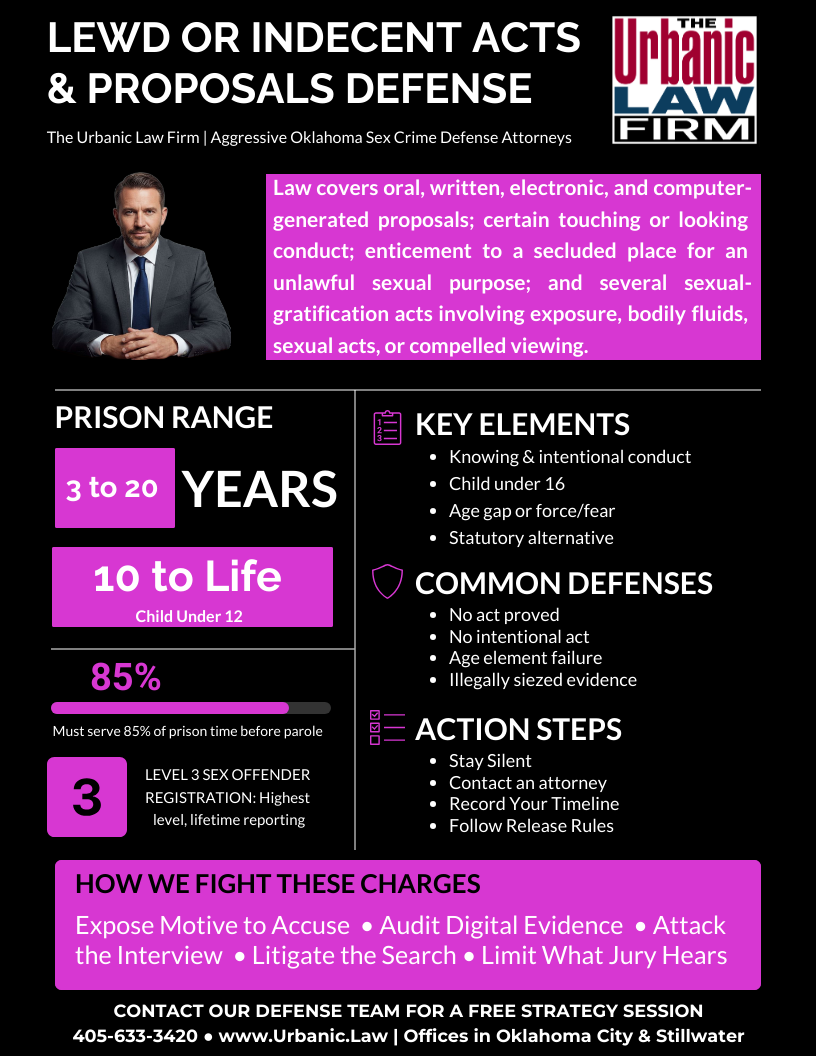
Under 21 O.S. § 1123, Oklahoma makes it a felony to knowingly and intentionally commit certain lewd or indecent proposals or acts involving a child under 16, or a person the accused believes is under 16. The statute reaches far more than hands-on touching. It covers oral, written, electronic, and computer-generated proposals, certain touching or looking conduct, enticement to a secluded place for an unlawful sexual purpose, and several sexual-gratification acts involving exposure, bodily fluids, sexual acts, or compelled viewing.
That matters because the statute is broader than many people think. It can be charged from messages alone. It can also be charged from alleged touching, looking, asking a child to go somewhere alone, or forcing a child to view sexualized material. In the compelled-viewing part of the statute, Oklahoma cross-references definitions found in 21 O.S. § 1024.1 and 21 O.S. § 1040.75. So the exact theory the State chose still matters.
What Level 3 means for this charge
Oklahoma treats this as a Level 3 registerable sex offense. That is the highest registration level. In practice, that usually means lifetime registration. The official state level chart lists Section 1123 at Level 3, and the state materials also treat it as an aggravated registerable offense. You can compare it with other Level 3 sex crimes and review the state’s own materials here: registration level chart, Attorney General registration resource, and DOC registration policy.
Because registration consequences can outlast the criminal sentence by decades or for life, an Oklahoma sex crime defense lawyer should be evaluating both trial issues and long-range consequences at the same time.
Key Elements the State Must Prove
- Knowing and intentional conduct. The State must prove the act was knowing and intentional, not accidental, mistaken, or wrongly attributed.
- A child under 16, or a person believed to be under 16. Some cases involve a real minor. Others involve an undercover operation.
- The required age difference. For subsection A charges, the State must prove the accused was at least three years older than the child unless it is relying on force or fear.
- At least one charged statutory alternative. The State does not have to prove every act listed in the statute. It has to prove the specific alternative or alternatives actually charged beyond a reasonable doubt, such as:
- Proposal theory. Making an oral, written, electronic, or computer-generated lewd or indecent proposal for the child to have unlawful sexual relations or sexual intercourse with any person.
- Lewd touching or lewd looking theory. Looking upon, touching, mauling, or feeling the body or private parts of a child in a lewd or lascivious manner by acts against public decency and morality.
- Secluded-place enticement theory. Asking, inviting, enticing, or persuading a child to go alone to a secluded, remote, or secret place with the unlawful and willful intent to commit a crime against public decency and morality with the child.
- Indecent sexual-interest theory. Lewdly or lasciviously looking upon, touching, mauling, or feeling the body or private parts of a child in an indecent manner or in a manner relating to sexual matters or sexual interest.
- Sexual-gratification acts theory. In a lewd and lascivious manner and for the purpose of sexual gratification:
- urinating or defecating on a child, or forcing or requiring a child to urinate or defecate on another person’s body or private parts,
- ejaculating on or in the presence of a child,
- causing, exposing, forcing, or requiring a child to look on the body or private parts of another person,
- forcing or requiring a child to view obscene materials, child sexual abuse material, or materials harmful to minors,
- causing, exposing, forcing, or requiring a child to look on sexual acts performed in the child’s presence, or
- forcing or requiring a child to touch or feel the body or private parts of the child or another person.
- Statutory fit and sexual purpose. The State must prove the evidence fits the charged statutory language, not just that the facts look suspicious or inappropriate.
Penalties
- Basic charge.
- Felony class: Class A3 felony under 21 O.S. § 20E.
- Prison range: not less than 3 years and not more than 20 years.
- If the child was under 12.
- The statute raises the punishment to death, or imprisonment for not less than 10 years, life, or life without parole.
- Repeat convictions.
- A second or later conviction under this subsection is still punished under the same statute, but except as provided in 21 O.S. § 51.1a, probation, suspended sentencing, and deferred sentencing are off the table.
- A third or later conviction can bring life or life without parole.
- If the accused already has two prior convictions involving first-degree rape, forcible sodomy, sexual abuse of a child, attempt versions of those offenses, or combinations of those offenses, this statute can also reach life or life without parole.
- 85% rule.
- This offense is listed in 21 O.S. § 13.1, so a prison sentence is treated as an 85% sentence. That means you must serve at least 85% of the prison term before parole eligibility. You can read more in our 85% crimes guide.
- Violent-crime classification.
- This offense is also listed as a violent crime under 57 O.S. § 571. That can affect parole treatment and prison-credit rules. You can read more in our violent crimes guide.
- Fines.
- The main penalty language in this offense focuses on prison. Oklahoma courts can also look to 21 O.S. § 64 on fines in addition to imprisonment.
Separate prior-felony enhancement issues can also matter. Prosecutors sometimes try to increase exposure through prior-record allegations or by relying on repeat-offense language. Our sentence enhancement guide gives the bigger picture, and Oklahoma’s general repeat-offender statute is 21 O.S. § 51.1.
Collateral Consequences
- Sex-offender registration. A conviction can trigger Level 3 registration and long-term reporting duties.
- No-contact restrictions. The sentencing court can issue a no-contact order under 22 O.S. § 991h.
- Work and licensing damage. Teaching, coaching, childcare, medical, and licensed work can become much harder.
- Family-court fallout. Custody, visitation, and guardianship disputes can get worse fast.
- Housing, immigration, and reputation problems. A conviction can affect where you can live, how the public sees you, and in some cases whether you can stay in the country.
How Prosecutors Prove Lewd or Indecent Proposals or Acts
Most of these cases are built with digital evidence, child statements, adult-witness testimony, and surrounding circumstances. Prosecutors often focus on messages, chats, screenshots, deleted-content recovery, call logs, social media records, school or family timelines, and interviews by police or forensic examiners. In proposal cases, the exact words matter. In act cases, the exact conduct matters.
The State also tries to prove age, identity, and statutory fit. Because of that, these cases can turn on who controlled a device, who wrote a message, whether an account was spoofed, whether an interview changed over time, and whether the conduct really matches the charged paragraph. Prosecutors also sometimes file separate counts for each message, each child, or each date they claim was involved.
Practical Guide if You’re Charged with Lewd or Indecent Proposals or Acts
Questions to Ask Your Attorney
- Which paragraph or theory did the State actually charge: proposal, touching, enticement, compelled viewing, or more than one?
- What evidence puts the alleged words, images, or acts on me instead of someone else?
- Is there a suppression issue involving my phone, my statement, or a search of my home or accounts?
- Does the proof really match the charged statutory alternative, or is the State stretching the facts?
- How do the 85% rule, violent-crime treatment, and registration consequences change the decision to negotiate or fight?
Things You Can Do if You’re Arrested for This Crime
- Stay silent about the facts until counsel is in place.
- Contact an attorney
- Write down the timeline while it is still fresh.
- Make a clean list of devices, accounts, witnesses, and places tied to the accusation.
- Follow release conditions and no-contact rules exactly.
Defenses
- No charged act or proposal proved. The State still has to prove the specific statutory alternative it charged, not just generally suspicious conduct.
- No knowing or intentional act. A mistaken send, hacked account, shared device, or identity problem can break the State’s proof.
- No proven age element. The State must prove the child’s age, or in an undercover case the defendant’s belief about age, beyond a reasonable doubt.
- No qualifying age gap. The State must also prove the required age difference unless it is relying on force or fear.
- Suppression of evidence. A bad interrogation, unlawful search, or defective warrant can knock out key proof.
How We Fight These Charges
- Expose motive to accuse. We look for custody fights, family pressure, retaliation, panic, or other reasons someone may have shaped the allegation.
- Audit the devices. Test authorship, access, deletion claims, and whether the State can really connect the account or device to you.
- Attack the interview. Compare every statement, retelling, and timeline shift for reliability problems.
- Litigate the search. Challenge warrants, consent, scope, and forensic overreach when police went beyond the law.
- Limit what the jury gets to hear. We move to exclude unfair, inflammatory, cumulative, or legally improper evidence before it shapes the case.
What The Urbanic Law Firm Does to Help Clients Charged with This Crime
- Explain the charge, the theory, and the realistic pressure points early.
- Track deadlines, court dates, bond conditions, and no-contact terms so small mistakes do not create bigger problems.
- Gather timelines, records, digital history, and defense witnesses in a usable form.
- Communicate clearly about risk, negotiation posture, and trial decisions as the evidence develops.
- Prepare the case for suppression litigation, negotiation, or trial from the start instead of waiting for the State to define the whole record.
An Oklahoma lewd or indecent proposals or acts defense lawyer should be testing the State’s words, dates, devices, age proof, and charging choices from day one.
What Happens Next
Most cases move through booking, an initial appearance, bond, conditions of release, discovery, and then either a preliminary hearing, negotiations, or trial settings. In sex-crime cases, no-contact conditions and device issues often become important right away. Those early steps can shape the rest of the case.
For a more detailed overview of how a felony case moves through the courts, you can read more in our Oklahoma criminal process guide.
Key Terms
Lewd Act or Proposal
“Lewd act or proposal” means making a lewd or indecent proposal to a child for unlawful sexual relations or sexual intercourse, lewdly touching or looking on a child, enticing a child to a secluded place for a lewd or lascivious purpose, or engaging in the listed sexual-gratification acts involving bodily fluids, exposure, compelled viewing, or compelled touching. (21 O.S. § 843.5) This term matters because it gives you a cleaner definition of the conduct cluster prosecutors often try to fold into a Section 1123 case.
Sexual Intercourse
“Sexual intercourse” means the actual penetration, however slight, of the vagina or anus by the penis. (21 O.S. § 843.5 & OUJI-CR 4-122) This comes up because one proposal theory under Section 1123 focuses on proposing unlawful sexual relations or sexual intercourse.
Child Sexual Abuse Material
“Child sexual abuse material” means any visual depiction of a child engaged in sexually explicit conduct, any adapted or altered visual depiction making the child appear so engaged, or any obscene visual depiction that appears to be a child engaged in sexually explicit conduct. (21 O.S. § 1024.1) This matters because Section 1123 reaches forcing or requiring a child to view this kind of material.
Harmful to Minors
“Harmful to minors” means material or a performance involving nudity, sexual conduct, sexual excitement, sadomasochistic abuse, or inappropriate violence that meets the statute’s prurient-interest, patent-offensiveness, and lack-of-serious-value standards for minors. (21 O.S. § 1040.75) This term matters because Section 1123 expressly reaches forcing or requiring a child to view materials harmful to minors.
Willfully
“Willfully,” when applied to the intent with which an act is done or omitted, implies simply a purpose or willingness to commit the act or omission referred to, and it does not require any intent to violate the law, injure another, or gain an advantage. (21 O.S. § 92) That can matter in a secluded-place theory because the statute uses unlawful and willful intent and purpose language there.
FAQs
Can lewd or indecent proposals or acts charges be filed in Oklahoma even if there was no physical touching?
Yes. Oklahoma’s statute covers more than physical touching. A proposal, message, invitation, enticement, or compelled-viewing allegation can be enough if the State can prove the charged theory and the required statutory fit.
Are lewd or indecent proposals or acts an 85% crime in Oklahoma?
Yes. This offense is treated as an 85% crime in Oklahoma. That means a prison sentence usually requires service of at least 85% of the term before parole eligibility.
What happens if the child was under 12 in an Oklahoma lewd or indecent proposals or acts case?
The punishment gets much harsher. Under the current statute, the range can move to death, or imprisonment for not less than 10 years, life, or life without parole. That issue can become a major litigation point because age has to be proved correctly.
Can lewd or indecent proposals or acts charges be expunged in Oklahoma?
Sometimes, but not easily. Expungement depends on the exact outcome, the exact conviction history, and the statute that applies. A good starting point is our guide to Oklahoma expungement law, and the main expungement statute is 22 O.S. § 18.
How do prosecutors prove lewd or indecent proposals or acts in Oklahoma?
They usually rely on chats, texts, social media, phone data, forensic downloads, child statements, adult witnesses, and surrounding circumstances. The defense often turns on whether that proof really matches the charged paragraph of the statute.
Important Cases
Barnard v. State, 2012 OK CR 15, 290 P.3d 759. This case is useful because it shows how prosecutors can try to stack a proposal count with another technology-based count from the same conduct. The Court of Criminal Appeals found a double-punishment problem when both counts rested on the same act.
Chadwell v. State, 2019 OK CR 14, 446 P.3d 1244. This case matters because it shows that enhanced punishment tied to the child’s age has to be handled correctly. If the State wants the harsher under-12 punishment, that age issue must be properly submitted and proved.
Recent Example of This Crime in the News
In this KTUL report, Tulsa police said a defendant faced charges that included lewd or indecent proposal to a child. That story shows how these cases are often not built around one fact alone. Police may claim there was a proposal, a pattern, or more than one child. It also shows why the defense has to sort out exactly which acts the State can really prove, and whether prosecutors are trying to broaden the case beyond what the evidence can support.
Serving Clients Statewide
Oklahoma County, Payne County, Cleveland County, Canadian County, Tulsa County, Logan County, Lincoln County, Pottawatomie County, and all others
Oklahoma City, Stillwater, Moore, Norman, Del City, Edmond, Mustang, El Reno, Lawton, Kingfisher, Valley Brook, Guthrie, Tulsa, Yukon, Midwest City, Bethany, Choctaw, and all others
This page is for informational purposes only and is not legal advice. Every case is unique; consult an attorney about your specific situation. Page last updated April 20, 2026. Consult the statutes listed above for the most up-to-date law.

Oklahoma Bird Law Attorneys: The Urbanic Law Firm v. Charlie Kelly
Banging More Than the Gavel! Another Judge Sex Scandal Raises Oklahoma Criminal Law Questions

Stick a fork in him! Brent Swadley convicted: Oklahoma post-trial sentencing procedure explained

When Workplace Retaliation Leads To Harm

Brent Swadley Trial Analysis: False Claims & Conspiracy to Defraud State Explained
| THIS OFFENSE IN THE NEWS |
| RELATED OFFENSES |