Trafficking in Children Defense in Oklahoma
 A trafficking-in-children accusation can feel overwhelming from the start. However, the case becomes even more serious when the State claims the offense involved sexual abuse or sexual exploitation. At that point, you’re not only dealing with a felony accusation. You’re also dealing with possible sex-offender registration, digital evidence, agency records, witness statements, and related sex-crime allegations.
This page focuses on the sex-crime side of trafficking in children. Because these cases can involve adoption-related allegations, foster-care issues, money transfers, online ads, child sexual abuse material, or commercial-sex allegations, the details matter. For broader context, see our Oklahoma sex crimes overview.
Quick links
Talk through the accusation before you decide what to do
If you’ve been accused of Trafficking in Children in Oklahoma, reach out for a free consultation. An Oklahoma Trafficking in Children defense attorney can evaluate the charge, the alleged sex-crime trigger, and the evidence before you make a decision that affects your future.
An Oklahoma sex crime defense attorney can also help you understand registration exposure, device searches, and related counts. Call us at 405-633-3420 or use our secure online form.
Explanation of the law
What Trafficking in Children means
Oklahoma’s trafficking-in-children law, 21 O.S. § 866, covers several different acts involving the acquisition, transfer, placement, foster-care placement, or adoption of a minor child. The law also covers certain compensation, solicitation, advertising, and disclosure violations tied to those placements.
However, this page focuses on the version that becomes a sex-crime problem. That can happen when prosecutors claim the trafficking-in-children conduct involved sexual abuse or sexual exploitation. In that setting, the State may use messages, photos, videos, payment records, foster-care records, interviews, and agency documents to build the case.
Why the sex-crime allegation changes everything
21 O.S. § 843.5 defines child sexual exploitation to include trafficking in children when the offense was committed for the sexual gratification of any person. Because of that link, a trafficking-in-children case can move from a placement-related felony into a registration-level sex-crime case.
That’s why the defense can’t stop at the label on the charge. Instead, the work has to focus on what the State says happened, what the records actually show, and whether the sex-offense consequences legally fit the proof.
Where this charge fits on the site
When the allegations involve sexual abuse or exploitation, this charge fits within Oklahoma’s abduction and trafficking sex-crime cluster. Related allegations may also involve child sexual abuse material or human trafficking theories. Those related counts can change the risk, even when they come from the same investigation.
Key elements the state must prove
The exact elements depend on the subsection charged. Still, prosecutors usually have to prove a specific act, a child-related placement or custody connection, and the required mental state. In the sex-crime version, they also need facts connecting the case to sexual abuse or exploitation.
- A child was involved.
- The State must connect the allegation to a person who fits Oklahoma’s child definition.
- Age, emancipation, custody, and placement records can become key evidence.
- A prohibited act occurred.
- The allegation may involve money, property, or something of value tied to custody, adoption, placement, or foster care.
- In other cases, prosecutors focus on advertising, solicitation, or placement-related services.
- The act was done knowingly.
- The State must prove more than a misunderstanding or messy paperwork.
- Intent, knowledge, and context matter when payments or messages have innocent explanations.
- No legal exception applies.
- Court-approved adoption expenses can matter.
- Licensed child-placing agencies, DHS, and authorized attorneys may fit exceptions in specific situations.
- The alleged sex-crime trigger fits the facts.
- For Level 3 consequences, the State needs facts showing sexual abuse or sexual exploitation.
- The judgment, sentence, information, and court record may control the registration issue.
Penalties
Main felony penalties
The main felony form is serious. It can also carry sex-offender registration when the case involves sexual abuse or sexual exploitation.
- Class B2 felony: Trafficking in children is listed as a Class B2 felony under 21 O.S. § 20G.
- Prison: up to 10 years in the custody of the Department of Corrections.
- Fine: up to $10,000 per violation.
- Both: the court can impose imprisonment and a fine.
- Some limited misdemeanor forms: Certain prospective adoptive-parent or publication-related violations can carry fines up to $5,000 per violation.
- Financial consequences: You may also face court costs, fees, supervision costs, and other case-related expenses.
Level 3 sex-crime consequences
When trafficking in children involved sexual abuse or sexual exploitation, Oklahoma assigns it as a Level 3 sex crime. The official level-assignment form lists trafficking in children with that sexual-abuse or sexual-exploitation condition as Level 3. The same form says a Level 3 offender must register for life with address verification every 90 days.
You can review the official sex offender registration level assignment, the Oklahoma Attorney General’s sex offender registry resource, and the Department of Corrections registration policy. An Oklahoma sex crime defense lawyer should also review whether the registration trigger actually fits the judgment and sentence.
The 85% issue can depend on the charges
This charge isn’t listed by its trafficking-in-children citation in 21 O.S. § 13.1. However, the same case can still create an 85% sentencing issue if prosecutors add and prove a listed count, such as human trafficking of a minor or child sex trafficking, based on the same facts.
Prior convictions and enhancement risk
Because this is a felony, prior felony convictions can affect punishment exposure. Oklahoma’s sentence enhancement rules may apply through 21 O.S. § 51.1. Also, even a probation outcome can still leave registration consequences if the case fits the registration rules.
Collateral consequences
A conviction can affect far more than the sentence. Because the sex-crime version can bring lifetime registration, you need to think about every downstream effect.
- Lifetime registration: A Level 3 assignment can require lifetime registration and 90-day address verification.
- Public registry exposure: Registry information can affect housing, employment, reputation, and family life.
- Employment and licensing damage: Work involving children, health care, schools, foster care, or transportation can become difficult or impossible.
- Family and custody fallout: A conviction can affect visitation, foster-care issues, adoption matters, and child-contact conditions.
- Financial pressure: Fines, fees, treatment costs, monitoring costs, and restitution can create long-term financial strain.
How prosecutors prove Trafficking in Children
Prosecutors usually build these cases through records. However, the meaning of those records can be disputed. A payment, message, photo, or placement document may look different once the full context is known.
- Digital records: phones, cloud accounts, chats, social media, online ads, and deleted files.
- Money trails: cash apps, bank records, receipts, gifts, travel costs, and alleged compensation.
- Agency records: foster-care, adoption, DHS, school, medical, or placement records.
- Witness statements: interviews from children, caregivers, investigators, foster families, and alleged intermediaries.
- Forensic evidence: device downloads, metadata, IP logs, account ownership, and image-location evidence.
Practical guide if you’re charged with this crime
Questions to ask your attorney
- Which subsection does the filed charge rely on?
- What facts does the State claim make this a registerable sex offense?
- What devices, accounts, and cloud data did investigators search?
- Do any licensed-agency, attorney, parent, guardian, or court-approved expense issues apply?
- What outcomes would reduce prison, registration, or public-record exposure?
Things you can do if you’re arrested for this crime
- Stop discussing the case with anyone except your defense team.
- Save messages, receipts, timelines, travel records, and court or agency paperwork.
- Avoid contact with alleged witnesses, minors, foster families, or agency staff unless counsel clears it.
- Preserve phones, computers, cloud credentials, and account-access information.
- Follow release conditions carefully, even when they feel broad or unfair.
Defenses
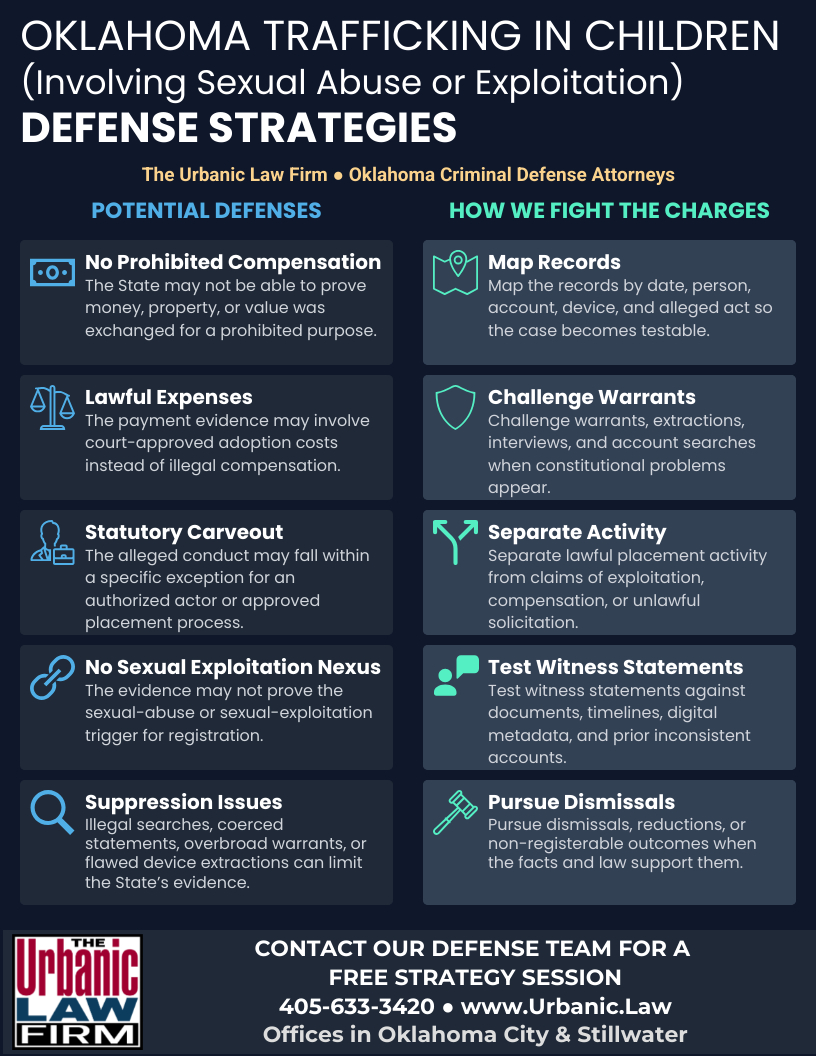
- No prohibited compensation: The State may not be able to prove money, property, or value was exchanged for a prohibited purpose.
- Lawful expenses: The payment evidence may involve court-approved adoption costs instead of illegal compensation.
- Statutory carveout: The alleged conduct may fall within a specific exception for an authorized actor or approved placement process.
- No sexual exploitation nexus: The evidence may not prove the sexual-abuse or sexual-exploitation trigger for registration.
- Suppression issues: Illegal searches, coerced statements, overbroad warrants, or flawed device extractions can limit the State’s evidence.
How we fight these charges
- Map the records by date, person, account, device, and alleged act so the case becomes testable.
- Challenge warrants, extractions, interviews, and account searches when constitutional problems appear.
- Separate lawful placement activity from claims of exploitation, compensation, or unlawful solicitation.
- Test witness statements against documents, timelines, digital metadata, and prior inconsistent accounts.
- Pursue dismissals, reductions, or non-registerable outcomes when the facts and law support them.
What The Urbanic Law Firm does to help clients charged with this crime
- Build a clear case plan around court dates, discovery deadlines, release terms, and investigation needs.
- Explain what’s happening in direct language so you’re not guessing between hearings.
- Review digital evidence, financial records, agency paperwork, and witness statements with defense goals in mind.
- Assess registration, sentencing, and collateral risks before plea talks or trial decisions.
- Prepare you for hearings, negotiations, and trial decisions with a practical timeline.
What happens next
The early court settings matter. The judge may set bond, no-contact terms, device limits, travel limits, or child-contact restrictions. An Oklahoma Trafficking in Children defense lawyer can help you prepare before those conditions create new problems.
- Arrest or warrant: You may be booked, processed, and given court dates.
- First appearance: The court can address release conditions and basic case scheduling.
- Preliminary hearing: The State must present enough evidence to move the felony forward.
- Discovery and motions: The defense reviews records and files motions when evidence should be excluded.
- Resolution or trial: The case may end through dismissal, reduction, plea, sentencing, or trial.
For a more detailed overview of the criminal process in Oklahoma, you can read more in our Oklahoma criminal process guide.
Key terms
Advertising or advertisement
“Advertising” or “Advertisement” means any communication that originates within this state by newspaper, periodical, telephone book listing, outdoor advertising sign, radio, television, or any communication disseminated through a computer or related electronic device, including email, websites, weblogs, search engines, banner messages, pop-up messages, chat rooms, list servers, instant messaging, or other Internet presences and related attachments or links. (21 O.S. § 865) This term matters when prosecutors claim an online ad, post, or message helped arrange unlawful placement or exploitation.
Child
“Child” means an unmarried or unemancipated person under the age of eighteen years. (21 O.S. § 865) This definition controls whether the alleged victim fits the trafficking-in-children law.
Child-placing agency
“Child-placing agency” means any child welfare agency licensed pursuant to the Oklahoma Child Care Facilities Licensing Act and authorized to place minors for adoption. (21 O.S. § 865) This term can affect whether an exception or lawful-placement defense applies.
Child sexual exploitation
“Child sexual exploitation” means the willful or malicious sexual exploitation of a child under eighteen years of age by another and includes trafficking in children if the offense was committed for the sexual gratification of any person. (21 O.S. § 843.5) This definition is the bridge between the trafficking accusation and the sex-crime consequences.
Criminal intent
“Criminal intent” means a design to commit a crime or to commit acts the probable consequences of which are criminal. (jury instruction 2-9) This definition can matter when the State claims another person helped, facilitated, or participated in the alleged conduct.
FAQs
What is Trafficking in Children in Oklahoma?
Trafficking in Children in Oklahoma generally involves prohibited compensation, solicitation, advertising, transfer, placement, foster-care placement, or adoption-related conduct involving a minor child. When prosecutors claim the case involved sexual abuse or sexual exploitation, the case can also create sex-offender registration exposure.
Is Trafficking in Children in Oklahoma a sex crime?
It can be. The sex-crime consequence depends on whether the offense involved sexual abuse or sexual exploitation. If that condition applies, Oklahoma treats the offense as a Level 3 registration offense.
What are the penalties for Trafficking in Children in Oklahoma?
The main felony form is a Class B2 felony punishable by up to 10 years in prison, a fine up to $10,000 per violation, or both. If the case involved sexual abuse or sexual exploitation, lifetime Level 3 sex-offender registration may also apply.
Can Trafficking in Children in Oklahoma be expunged?
Expungement depends on the outcome, sentence, time passed, criminal history, and registration status. A sex-offense conviction can create major barriers, so review Oklahoma eligibility carefully through our Oklahoma expungement guide.
Recent example of this crime in the news
A KXII report about a Bryan County arrest described a case involving child sexual abuse material allegations, trafficking in children, distribution allegations, and a computer-crime count. That report shows how a trafficking-in-children case can overlap with digital evidence, foster-care history, alleged sexual exploitation, and multiple felony counts from one investigation.
Serving Clients Statewide
Oklahoma County, Payne County, Cleveland County, Canadian County, Tulsa County, Logan County, Lincoln County, Pottawatomie County, and all others
Oklahoma City, Stillwater, Moore, Norman, Del City, Edmond, Mustang, El Reno, Lawton, Kingfisher, Valley Brook, Guthrie, Tulsa, Yukon, Midwest City, Bethany, Choctaw, and all others
This page is for informational purposes only and is not legal advice. Every case is unique; consult an attorney about your specific situation. Page last updated April 25, 2026. Consult the statutes listed above for the most up-to-date law.

Legislative Payback or Public Safety? Sara Polston’s Shocking Constitutional Fight!

Tulsa’s “Serial Defecator” Case: Legal Analysis of a Messy Situation

Oklahoma Discovery Law Changes: 2026–2027 Guide

Oklahoma Domestic Abuse Law Updates Nov. 1: Five Big Changes

Oklahoma Stalking Case Reversed: When a Post Isn’t Enough
| THIS OFFENSE IN THE NEWS |
| RELATED OFFENSES |