Underage DUI in Oklahoma: Law, Penalties, & Defenses

Oklahoma has a separate underage DUI law for drivers under 21. Unlike ordinary per se DUI, you can face an underage DUI charge even when your alcohol concentration is below .08. For the alcohol-based version of the offense, a qualifying test showing an alcohol concentration of .02 or more can be enough.
This guide is for people accused of underage DUI in Oklahoma who want to understand why a BAC below .08 can still lead to a criminal charge, the possible punishment, and the defenses that may apply.
This page reflects Oklahoma law current for conduct alleged on or after November 1, 2026. The under-21 DUI rules discussed here already existed before that date. However, a related general DUI statute changed on November 1, 2026, so related law may differ for earlier conduct.
Can I get a DUI in Oklahoma if I’m under .08 BAC?
Yes. If you’re under 21, Oklahoma’s underage DUI law can apply even when your alcohol concentration is below .08. For the alcohol theory, a qualifying blood or breath test showing an “any measurable quantity of alcohol” result can support the charge. That threshold as an alcohol concentration of .02 or more.
If you’re facing an underage DUI accusation, The Urbanic Law Firm can review your stop, driving or control evidence, chemical-test timing, device records, video, and statements before your next court setting.
Fill out our secure online form so our attorneys can better understand your situation before we speak. You may also call us at 405-633-3420.
Why clients trust The Urbanic Law Firm with underage DUI charges
Advanced DUI Case Analysis: Frank evaluates DUI cases with a 200+ item checklist developed from police training materials
ARIDE Trained: Frank completed the same training officers go through
Forensic Science Training: Graduate of the OSBI Forensic Science Academy
Quick Links
What is underage DUI in Oklahoma?
The most important difference between underage DUI and ordinary alcohol-based DUI is the alcohol threshold. A driver under 21 doesn’t have to reach .08 to fall within the underage DUI statute.
Alcohol theory: the State may rely on a blood or breath test showing an “any measurable quantity of alcohol” result. The Board of Tests defines that level as .02 or more. For this theory, the qualifying chemical test must be administered within two hours after arrest. When blood testing supplies the alcohol result, the timing of the blood draw and testing process can become a critical issue.
Other-intoxicating-substance theory: prosecutors may rely on qualifying specimen evidence of another intoxicating substance. Oklahoma defines an “other intoxicating substance” through 47 O.S. § 1-140.1.
Combined-influence theory: the State may instead claim evidence of alcohol together with another intoxicating substance.
The alcohol theory is why someone can be surprised by an under 21 DUI arrest. A result of .03, .04, .05, .06, or .07 is below the ordinary .08 per se DUI level but can still fall within Oklahoma’s underage DUI law.
This offense sits within Oklahoma’s drunk-driving laws. Being under 21 doesn’t force prosecutors to use the separate underage law. When the facts warrant, the State may instead file driving while impaired under 47 O.S. § 761, regardless of age. It may also file general DUI under 47 O.S. § 11-902.
Depending on the alleged driving and what officers find, prosecutors may also stack reckless driving under 47 O.S. § 11-901 or transporting an open container under 21 O.S. § 1220.
An Oklahoma underage DUI defense attorney can assess whether the State actually has evidence satisfying the specific theory it charged.
Key elements the State must prove
For DUI under 21, the required facts depend on the theory prosecutors choose.
- Age: you were under 21
- Vehicle control: you drove, operated, or were in actual physical control of a motor vehicle within Oklahoma
- A qualifying substance theory:
- Alcohol: a qualifying test showed at least .02 alcohol, with the test administered within two hours after arrest
- Other intoxicating substance: qualifying specimen analysis showed evidence of another intoxicating substance
- Combined influence: the evidence showed a combination of alcohol and another intoxicating substance
For the alcohol theory, the State doesn’t need a .08 result. A valid result of .02 or more can potentially satisfy the alcohol element of Oklahoma’s underage DUI law.
A weakness in age, driving or control, chemical-test timing, test reliability, or the claimed substance evidence can undermine the charged theory.
Underage DUI penalties in Oklahoma
An underage DUI under 47 O.S. § 11-906.4 is a misdemeanor at each conviction tier. Because the offense itself doesn’t specify confinement, 47 O.S. § 17-101 allows up to one day in jail in the court’s discretion.
First conviction
- Jail: Up to 1 day, in the court’s discretion
- Fine: $100–$500
- Community service: At least 20 hours
- Treatment: Completion of a treatment program may be ordered as part of the statutory options
- Driving privileges: License seizure and other driver’s-license consequences can apply
Second conviction
- Jail: Up to 1 day, in the court’s discretion
- Fine: $100–$1,000 and/or treatment recommended through the required assessment
- Community service: At least 240 hours
- Ignition interlock: At least 30 days after the mandatory revocation period
- Assessment: Assessment of the degree of alcohol abuse can lead to treatment
A second conviction increases the required community service. The statutory sanctions also permit a higher fine and more treatment-related conditions.
Third or subsequent conviction
- Jail: Up to 1 day, in the court’s discretion
- Fine: $100–$2,000 and/or treatment recommended through the required assessment
- Community service: At least 480 hours
- Ignition interlock: At least 30 days after the mandatory revocation period
- Assessment: Assessment and treatment consequences can continue
Later convictions remain misdemeanors under this specific under-21 statute, but the required sanctions become substantially heavier.
Why an underage DUI conviction can matter strategically
A conviction under Oklahoma’s underage DUI statute doesn’t become a felony just because the person has prior underage DUI convictions. Someone who remains eligible for 47 O.S. § 11-906.4 can be charged under that statute multiple times, and the offense remains a misdemeanor each time. The fines, community service, treatment, ignition-interlock requirements, and other consequences increase for later convictions, but the statute doesn’t create a felony version of underage DUI.
A conviction or plea under § 11-906.4 also isn’t itself a conviction for general DUI under 47 O.S. § 11-902. That distinction can be important later because Oklahoma’s repeat-DUI felony provisions depend on qualifying prior DUI-related convictions or pleas. We keep that future consequence in mind when representing clients under 21 because resolving a case under § 11-906.4 instead of § 11-902 can reduce the risk that the disposition will later be treated like a prior general DUI if the client is arrested again.
That can also make underage DUI an important plea-bargaining option for an eligible client originally charged with § 11-902 DUI. For example, a driver under 21 whose BAC was .08 or higher may initially qualify for the general DUI charge. Depending on the facts and the prosecutor, reducing that charge to § 11-906.4 can preserve a misdemeanor disposition while reducing some of the long-term consequences that can come with a § 11-902 DUI conviction or plea.
Collateral consequences
The consequences can extend beyond the criminal judgment, especially for a young driver.
- Driving privileges: cancellation, denial, revocation, and ignition-interlock requirements can affect school or work transportation
- Auto insurance: a conviction or related driving action can affect premiums and coverage decisions
- School or college: disciplinary codes, scholarships, athletics, or campus programs may create separate concerns
- Employment: background checks and jobs involving driving may create practical problems
- Military or professional plans: disclosure rules and credentialing decisions can create additional consequences
License and insurance effects can outlast the court’s formal punishments. Because those consequences depend on your circumstances, they should be reviewed separately.
How prosecutors prove an underage DUI charge
Prosecutors usually build an underage DUI case from several pieces of evidence rather than one roadside observation.
- Age records: identification and other records may establish that you were under 21
- Driving or control evidence: officer observations, video, witnesses, keys, vehicle position, and your statements may matter
- Chemical testing: prosecutors may rely on a breath or blood result of .02 or more for the alcohol theory, even when the result is below .08
- Test timing: the alcohol test must satisfy the statute’s two-hour-after-arrest requirement
- Toxicology: drug and combined-influence allegations may depend on laboratory analysis and specimen handling
- Roadside observations: video, statements, driving behavior, and field sobriety testing may become part of the State’s proof
Our SFST overview explains the roadside framework officers use. The SFST training and DUI defense strategy page focuses on officer training. The ultimate SFST guide breaks down the testing process in greater detail.
Practical guide if you’re charged with this crime
What we look for first in an underage DUI case
We first examine why police stopped you, whether you drove or controlled the vehicle, and what chemical test was used. In a below-.08 alcohol case, the exact reported concentration and whether the test satisfied the statutory timing requirement can be especially important. We then compare device records, video, specimen records, and statements against the State’s theory.
An Oklahoma DUI under 21 defense lawyer should connect those facts to the specific alcohol, drug, or combined-influence theory.
Defenses to an underage DUI charge
An underage DUI accusation can be challenged at several points, from the reason for the traffic stop to whether the State has a reliable .02-or-higher alcohol result or trustworthy evidence of another intoxicating substance.
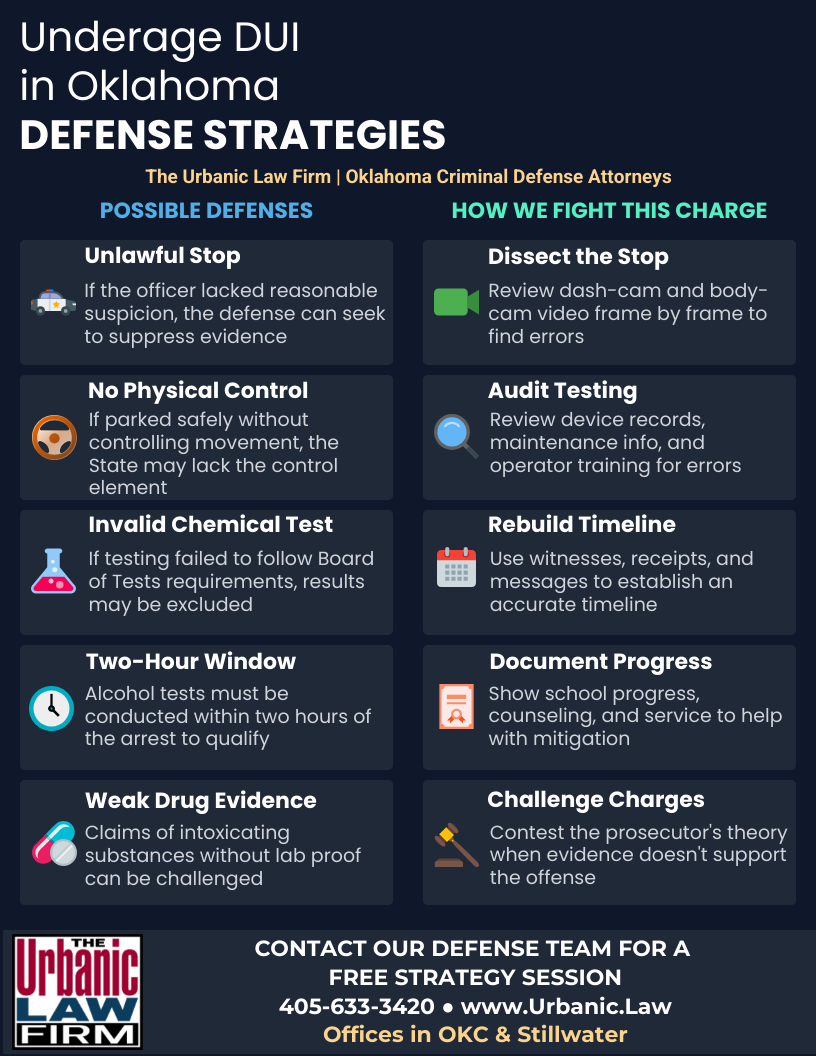
- Unlawful stop: If the officer lacked reasonable suspicion for the stop, the defense can seek to suppress evidence that followed
- No actual physical control: When you were parked safely and weren’t controlling the car’s movement, the State may not meet the control element
- Invalid chemical test: If breath or blood testing didn’t follow Board of Tests requirements, the reading may face exclusion or a strong reliability attack
- Test outside the two-hour window: For the alcohol theory, the qualifying blood or breath test must satisfy the statute’s two-hour-after-arrest requirement
- No proof of any measurable quantity: Without a valid test reliably showing at least .02, the State may not prove the alcohol theory
- Weak drug evidence: If prosecutors claim another intoxicating substance without trustworthy laboratory evidence, the substance theory can be challenged
How we fight these charges
- Dissect the stop and roadside contact by reviewing available dash-camera and body-camera video frame by frame
- Audit chemical testing through device records, maintenance information, specimen records, and operator training
- Rebuild the drinking timeline with available witnesses, receipts, messages, and other time evidence
- Document counseling, community service, and school progress when those facts can help present mitigation and sentencing readiness
- Challenge charging decisions when the evidence doesn’t support the offense theory prosecutors selected
What The Urbanic Law Firm does to help clients charged with this crime
- Explain the criminal case and separate driver’s-license issues in understandable terms
- Organize police reports, recordings, test records, notices, and other case materials
- Update you as evidence arrives and court dates change
- Prepare you for court settings, major decisions, and testimony when testimony becomes relevant
- Coordinate case demands with practical school, work, transportation, and scheduling concerns
Questions to ask your attorney
- What evidence should we preserve before it disappears?
- What deadlines affect the criminal case and my driving privileges?
- What was the exact reported alcohol concentration?
- Was the chemical test completed within the required two-hour period?
- Which device, maintenance, or laboratory records should be requested?
- How will you evaluate actual physical control versus driving?
Things you can do if you’re arrested for this crime
- Save your citation, release paperwork, testing paperwork, and court notices
- Write a private timeline for your attorney while events are still fresh
- Preserve receipts, messages, photographs, and location data that may establish timing
- Don’t discuss the allegations on social media or with people who don’t need the facts
- Track every court notice and driver’s-license notice you receive
What happens after an underage DUI arrest in Oklahoma?
After the arrest, you’ll usually receive a court date while the defense starts gathering reports, recordings, and testing records. In a DUI under 21 case involving alcohol below .08, the defense should pay particular attention to the exact result, test timing, testing procedure, and whether the State can establish a valid .02-or-higher reading.
If the stop, detention, statement, or chemical testing creates a legal problem, motion practice may follow. If the case remains contested, preparation can shift toward trial and evidentiary issues. For a more detailed overview of the stages, our Oklahoma criminal process guide explains how a state criminal case can move through court.
Related driving penalties can be much higher if prosecutors file a different offense instead. That makes the exact charge and the evidence supporting it important from the beginning.
Underage DUI compared with other driving charges
The biggest distinction is that Oklahoma’s underage DUI alcohol theory can apply below .08. The classification and required proof also change depending on which driving offense prosecutors file.
| Offense | Core conduct | Mental state / relationship | Classification | Common defense issue |
|---|---|---|---|---|
| Underage DUI / DUI under 21 | Under 21 plus driving, operating, or actual physical control with qualifying alcohol, other-intoxicant, or combined-influence evidence | Under-21 status is required; the alcohol theory can apply at .02 or higher even when the result is below .08 | Misdemeanor with up to 1 day discretionary jail plus conviction-tier sanctions | Test result, two-hour timing, testing reliability, stop legality, actual physical control, or toxicology |
| General DUI | Driving, operating, or actual physical control under one of the general alcohol or intoxicating-substance theories | No under-21 age requirement | First offense can be a misdemeanor; qualifying later or aggregated routes can be felonies | Testing, impairment, actual physical control, stop legality, or statutory charging route |
| Driving while impaired | Driving with impaired ability caused by alcohol or another intoxicating substance | No under-21 age requirement; the offense focuses on driving rather than actual physical control | Misdemeanor | Whether the evidence actually proves impaired driving ability |
| Reckless driving | Driving in a careless or wanton manner under the statutory safety or speed conditions | No alcohol, drug, or under-21 requirement | Misdemeanor | Whether the driving actually rises to the careless-or-wanton standard |
Key terms
Actual physical control
Actual physical control means directing influence, domination, or regulation of a motor vehicle, whether or not the vehicle is being driven or is in motion. (jury instruction 6-35)
A parked-car case can therefore require a close look at the vehicle’s location, keys, your position, and whether you could control its movement.
Other intoxicating substance
This includes a controlled dangerous substance or another non-alcohol substance capable of entering the body and adversely affecting the central nervous system, vision, hearing, or other sensory or motor functions. (47 O.S. § 1-140.1 & jury instruction 6-35)
Drug-based under-21 allegations therefore aren’t limited to alcohol or to one narrow category of substances.
Motor vehicle
A motor vehicle generally means a device in, upon, or by which a person or property may be transported or drawn on a highway, subject to stated exclusions. (jury instruction 6-35)
The kind of device involved can matter when unusual vehicles or equipment appear in the facts.
FAQs
Can an underage DUI in Oklahoma be expunged?
Possibly. Eligibility depends on the final disposition, your record, applicable waiting rules, and the law in effect when you seek relief. Our Oklahoma expungement guide explains the general record-clearing framework.
Does a DUI under 21 in Oklahoma go away when you turn 21?
No. Turning 21 later doesn’t erase an allegation, case disposition, or qualifying prior adjudication that arose while you were under 21.
Can an under 21 DUI in Oklahoma count a juvenile case as a prior?
Yes, when the prior matter is a juvenile delinquency adjudication covered by the offense statute’s definition of conviction. That can affect which repeat-conviction tier applies.
Does an underage DUI in Oklahoma require the car to be moving?
No. The statute also covers operation and actual physical control, so a vehicle doesn’t always have to be moving. The exact control evidence still matters.
Can an underage DUI in Oklahoma involve drugs instead of alcohol?
Yes. Oklahoma’s under-21 statute contains an other-intoxicating-substance theory and a combined alcohol-and-other-substance theory. Those cases can turn heavily on specimen analysis and the reliability of the claimed substance evidence.
This crime in the news
On July 11, 2024, KOCO 5 reported that Ollie Gordon II, then 20, was accused after a traffic stop in Moore, Cleveland County, of under-21 DUI and transporting an open container. KOCO reported that jail breath samples were .11 and .10.
The report illustrates that the separate underage charge can be filed even when the reported alcohol result also exceeds .08. Being under 21 doesn’t require prosecutors to choose only general DUI.
About the Author: Attorney Frank Urbanic

This page is for informational purposes only and is not legal advice. Every case is unique; consult an attorney about your specific situation. Law last reviewed on September 8, 2026 by attorney Frank Urbanic. Page last updated September 8, 2026. Review the statutes cited on this page for the most current version of the law.