Child Endangerment in Oklahoma: Law, Penalties, & Defenses
 Child endangerment can turn a family crisis into a felony case. Prosecutors may claim you allowed a child to face physical abuse, drug-production danger, or another serious risk. However, this page focuses only on the non-sexual and non-DUI version of child endangerment.
This guide is for people accused of child endangerment in Oklahoma and trying to understand the charge, possible punishment, and defense options before court. Because these cases often overlap with family stress, DHS involvement, and police interviews, early defense work matters.
If your case involves sexual conduct, DUI, or a child in a vehicle with an impaired driver, the legal issues change. For broader context, you can also review our crimes affecting children defense page.
Talk to a defense team before the case gets ahead of you
If you’ve been accused of child endangerment in Oklahoma, reach out for a free consultation before you make statements, respond to DHS, or guess about court. An Oklahoma child endangerment defense attorney can review the charging theory, caregiver role, police reports, and evidence issues early.
Call us at 405-633-3420 or use our secure online form.
What is child endangerment in Oklahoma?
Child endangerment usually means the State claims you knowingly allowed a child to be exposed to a legally recognized danger. For this page, that means an accusation that you allowed physical abuse or allowed a child to be present where a controlled dangerous substance was being made or attempted.
The core penalty is up to 4 years in prison, up to a $5,000 fine, or both. However, the details decide the case. Prosecutors still need proof that you had the right kind of relationship to the child, knew enough, and permitted the dangerous situation.
Explanation of the law
Under 21 O.S. § 852.1, a parent, guardian, or person with custody or control over a child can commit child endangerment by knowingly permitting certain dangers. The State must connect you to both the child and the alleged danger.
For this non-sex, non-DUI page, the two key theories are simple to state. Prosecutors may claim you knowingly permitted physical abuse. Or, they may claim you knowingly permitted the child to be present where a controlled dangerous substance was being manufactured or attempted.
However, the statute also covers other situations that belong on different pages. If the accusation involves an impaired driver or a child passenger in a DUI situation, read our child endangerment DUI page. If the allegation involves sexual touching, feeling, observation, or indecent exposure for sexual gratification, read our child endangerment with sexual abuse page. If the allegation involves oral, anal, or vaginal penetration, review our level three child sexual abuse and caretaker exploitation page.
Also, prosecutors sometimes stack this charge with manufacturing a controlled dangerous substance, possession of CDS with intent to distribute, drug trafficking, or domestic abuse in the presence of a child. So, the defense has to look beyond the label on the first count.
Key elements the state must prove
The on-point elements come from jury instruction 4-40B. The State has to prove the exact theory it charged, not just that the situation looked bad.
- Parent, guardian, or person with custody or control.
- The child must be under 18.
- The State must show you had the required relationship or control role.
- Knowingly.
- The State must show you knew facts that made the situation dangerous under the charged theory.
- A mistake, bad judgment, or lack of perfect supervision may not be enough.
- Permitted.
- The State must prove you allowed the situation to happen or continue.
- However, the defense may challenge whether you had real power to stop it.
- Physical-abuse theory.
- The State may claim you knowingly permitted physical abuse of the child.
- Medical records, witness statements, and timing often become key evidence.
- Drug-location theory.
- The State may claim you knowingly permitted the child to be present where a controlled dangerous substance was being made.
- The State may also rely on an alleged attempt to manufacture.
Penalties
For sentencing purposes, child endangerment is a Class B6 felony under 21 O.S. § 20K. A felony record can affect your freedom, parenting life, work, and reputation long after court.
- Prison
- 0–4 years
- Fine
- $0–$5,000
- Prior convictions
- Because this is a felony, prior convictions can raise sentence enhancement issues under 21 O.S. § 51.1
However, sentencing is only part of the fight. A defense plan may also focus on dismissal, reduction, a deferred sentence, probation, treatment, or another outcome that limits long-term damage.
Collateral consequences
The case can affect more than jail, prison, or fines. Because the allegation involves a child, employers, agencies, schools, and family courts may react before the criminal case ends.
- A felony record that appears on background checks
- Job problems in childcare, healthcare, education, security, or licensed work
- Family-court, visitation, or DHS complications
- Housing and lease issues when landlords screen criminal records
- Firearm, immigration, military, or professional-license consequences in some cases
These penalties can shape your life even when you avoid the worst sentencing outcome. So, your defense should address both the courtroom and the practical fallout.
How prosecutors prove child endangerment
Most child endangerment cases rely on circumstantial evidence. Prosecutors often try to build a story from reports, photos, medical records, and what adults said under stress.
- Proof that you were a parent, guardian, babysitter, household adult, or person with real control
- Birth records, school records, or witness statements showing the child was under 18
- Texts, calls, prior warnings, admissions, or witness claims about what you knew
- Evidence that you allowed the situation to continue after you allegedly knew the danger
- Photos, medical records, interviews, or scene evidence tied to physical abuse allegations
- Search-warrant returns, lab results, equipment, chemicals, scales, baggies, or officer testimony in drug-location cases
Practical guide if you’re charged with this crime
What we look for first in a child endangerment case
The first review focuses on your actual role, what you knew, and whether you had a real chance to stop the alleged danger. The best defense often starts with separating proof from assumptions.
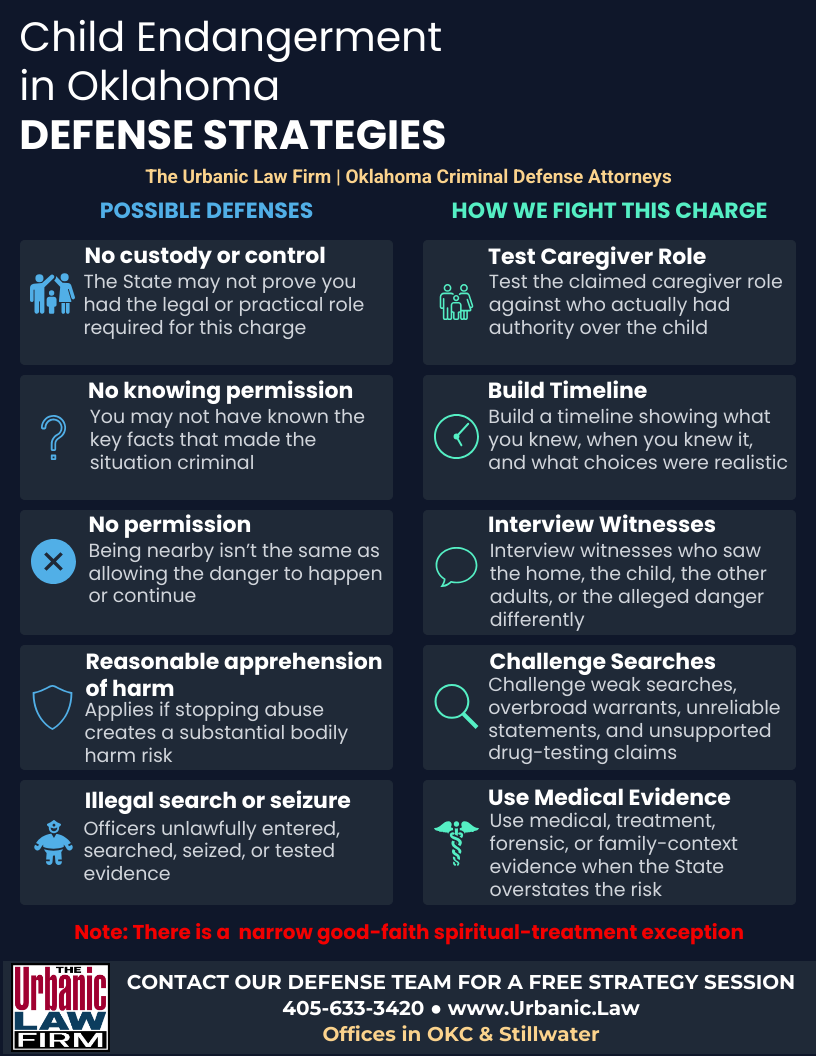
Defenses
- No custody or control. The State may not prove you had the legal or practical role required for this charge.
- No knowing permission. You may not have known the key facts that made the situation criminal.
- No permission. Being nearby isn’t the same as allowing the danger to happen or continue.
- Reasonable apprehension of harm. Under jury instruction 4-40C, this defense may apply when action to stop the physical abuse would have created substantial bodily harm risk.
- Illegal search or seizure. Drug-location cases can turn on whether officers lawfully entered, searched, seized, and tested evidence.
In addition, the same law has a narrow good-faith spiritual-treatment exception. However, that issue depends heavily on the facts and shouldn’t be guessed at without careful review.
How we fight these charges
- Test the claimed caregiver role against who actually had authority over the child.
- Build a timeline showing what you knew, when you knew it, and what choices were realistic.
- Interview witnesses who saw the home, the child, the other adults, or the alleged danger differently.
- Challenge weak searches, overbroad warrants, unreliable statements, and unsupported drug-testing claims.
- Use medical, treatment, forensic, or family-context evidence when the State overstates the risk.
What The Urbanic Law Firm does to help clients charged with this crime
- Explain the charge, court settings, possible outcomes, and short-term risks in direct language.
- Organize police reports, DHS materials, witness names, photos, messages, and medical records.
- Communicate with you about deadlines, court dates, discovery, and strategy changes.
- Prepare you for hearings, interviews, and decisions before pressure builds.
- Focus on your goals, your family situation, and the long-term record consequences.
Questions to ask your attorney
- What exact child endangerment theory has the State charged?
- What proof shows I had custody or control over the child?
- What evidence does the State claim proves I knowingly permitted the danger?
- Are there search, seizure, statement, or testing issues that support suppression?
- What outcomes could protect my record, my family, and my future?
Things you can do if you’re arrested for this crime
- Stay calm and don’t explain the case to police without legal advice.
- Save texts, photos, call logs, medical paperwork, and proof of where people were.
- Write down witness names before memories fade or people move on.
- Follow court orders, DHS safety plans, and no-contact terms while your lawyer reviews them.
- Contact a defense firm before making statements, signing forms, or accepting conditions you don’t understand.
An Oklahoma child endangerment defense lawyer can also help you avoid mistakes that create new evidence. Because these cases often involve family members, casual conversations can become exhibits.
What happens next
After arrest, the court may address booking, release terms, bond, and your first appearance. Then the case usually moves into discovery, conferences, and a preliminary hearing if the felony stays on track.
The possible punishment gives your attorney a reason to prepare early. For a more detailed overview of the criminal process in Oklahoma, you can read more in our Oklahoma criminal process guide.
Depending on your history and the facts, state court options may include motions, trial, dismissal, reduction, treatment, or state court diversion programs. However, every option depends on the evidence and the prosecutor’s charging choices.
Comparison to other crimes
Related charges can look similar but punish very different conduct. This comparison helps you see why the exact charge matters.
| Charge | What prosecutors focus on | Why the difference matters | Common defense issues |
|---|---|---|---|
| Child endangerment | Whether you knowingly permitted physical abuse or a drug-production danger involving a child | Felony charge with up to 4 years in prison and major family consequences | Custody or control, knowledge, permission, actual danger, search issues |
| Manufacturing a controlled dangerous substance | Production, processing, equipment, chemicals, plants, or attempted production | Drug-production proof may drive the child endangerment theory too | Ownership, access, intent, lab testing, warrant scope |
| Domestic abuse in the presence of a child | An alleged domestic assault where a child could see or hear the incident | The child’s presence can raise the stakes even when the child wasn’t the direct target | Relationship status, location of the child, credibility, injury proof |
| Child endangerment DUI | A child in a vehicle with an impaired driver or an adult allowing that situation | The case often includes separate DUI proof and vehicle evidence | Driving proof, impairment proof, chemical testing, passenger facts |
Key terms
Knowingly
Knowingly imports only knowledge that the facts exist which bring the act or omission within the code; it does not require knowledge of the unlawfulness of the act or omission. Personal awareness of the facts is central to this idea. Awareness often becomes the fight when the State claims you allowed danger but the proof shows confusion, distance, or limited information. (21 O.S. § 96 & jury instruction 4-40D)
Child
Child means any person under eighteen years of age. Age can decide whether the State may use this charge at all. (jury instruction 4-40D)
Child abuse
Child abuse includes willful or malicious harm, threatened harm, failure to protect from harm or threatened harm to the health, safety, or welfare of a child by a person responsible for the child’s health, safety, or welfare. It also includes willfully or maliciously injuring, torturing, or maiming a child under eighteen. Physical-abuse-based child endangerment cases often turn on whether the State can prove you knowingly allowed that kind of harm. (21 O.S. § 843.5 & jury instruction 4-40D)
Controlled dangerous substance
Controlled dangerous substance means a drug, substance, or immediate precursor in Schedules I through V of the Uniform Controlled Dangerous Substances Act, a substance temporarily or permanently designated by federal law, or a substance the State Board of Pharmacy brings under state control. Drug-location child endangerment cases often depend on what the substance was and whether reliable testing supports that claim. (63 O.S. § 2-101)
Manufacturing
Manufacturing means production, preparation, propagation, compounding, or processing of a controlled dangerous substance, either directly or indirectly, by extraction, chemical synthesis, or a combination of extraction and chemical synthesis. It includes packaging or repackaging, and labeling or relabeling, except for certain practitioner-related activities. In a child endangerment case, manufacturing proof can decide whether the location theory survives. (63 O.S. § 2-101 & jury instruction 6-16)
FAQs
What is child endangerment in Oklahoma when the case doesn’t involve sex or DUI?
Child endangerment in Oklahoma can mean prosecutors claim you knowingly allowed physical abuse of a child or allowed a child to be present where a controlled dangerous substance was being made or attempted. This page focuses on those non-sexual and non-DUI theories.
Is child endangerment in Oklahoma a felony?
Yes. Child endangerment in Oklahoma is a felony for the version covered on this page. A conviction can mean up to 4 years in prison, a fine up to $5,000, or both.
What does the State have to prove in an Oklahoma child endangerment case?
The State must prove you were a parent, guardian, or person with custody or control of a child under 18. It also must prove you knowingly permitted the specific danger charged, such as physical abuse or a drug-manufacturing location.
Can an Oklahoma child endangerment case be expunged?
Sometimes. Expungement depends on the outcome, timing, your history, and the exact type of record. You can learn more in our Oklahoma expungement law guide.
Can child endangerment in Oklahoma be charged with other crimes?
Yes. Depending on the facts, prosecutors may add drug, domestic, or child-related counts. The defense should review each count separately because each one may require different proof.
Important cases
Oxley v. State, 1997 OK CR 32, 941 P.2d 520, explained that custody or control can include someone standing in the place of a parent or guardian. So, an overnight caregiver may face a child endangerment accusation even without formal guardianship papers.
State v. Vincent, 2016 OK CR 7, 371 P.3d 1127, addressed control over a child in the child endangerment context. The decision shows why the defense should examine the accused person’s actual role, not just their title or relationship.
Example of this crime in the news
In a May 15, 2026 KFOR report republished by AOL, authorities described allegations against three people after a narcotics investigation at a home in Chickasha, Grady County. According to the report, officers said they found methamphetamine, drug paraphernalia, and equipment connected to drug activity, along with child endangerment concerns. The story illustrates how child endangerment allegations can grow out of drug-location facts, caregiver responsibility, and what adults allegedly allowed a child to be around.
This page is for informational purposes only and is not legal advice. Every case is unique; consult an attorney about your specific situation. Law last reviewed on May 28, 2026 by attorney Frank Urbanic. Page last updated May 28, 2026. Review the statutes cited on this page for the most current version of the law.

Legislative Payback or Public Safety? Sara Polston’s Shocking Constitutional Fight!

Tulsa’s “Serial Defecator” Case: Legal Analysis of a Messy Situation

Oklahoma Discovery Law Changes: 2026–2027 Guide

Oklahoma Domestic Abuse Law Updates Nov. 1: Five Big Changes

Oklahoma Stalking Case Reversed: When a Post Isn’t Enough
| THIS OFFENSE IN THE NEWS |