Possession of CDS With Intent to Distribute in Oklahoma: Law, Penalties, & Defenses
 A possession with intent case is about more than drugs being nearby. Prosecutors usually claim the surrounding facts show a plan to distribute. However, the State still has to prove knowing possession and intent.
This guide is for people accused of possession of CDS with intent to distribute in Oklahoma and trying to understand the charge, possible punishment, and defense options before court.
Because the alleged substance matters, the class and sentencing range can shift. So, the first questions are usually simple. What substance is alleged? Where was it found? What facts supposedly show distribution?
Quick links
- Introduction
- What is possession of CDS with intent to distribute?
- Explanation of the law
- Key elements the state must prove
- Penalties
- Collateral consequences
- How prosecutors prove possession of CDS with intent to distribute
- Practical guide if you’re charged with this crime
- What happens next
- Comparison to other crimes
- Key terms
- FAQs
- Important cases
- Example of this crime in the news
What is possession of CDS with intent to distribute?
Possession of CDS with intent to distribute means the State claims you knowingly possessed a controlled dangerous substance and intended to distribute it. Oklahoma law defines controlled dangerous substance in 63 O.S. § 2-101.
However, prosecutors don’t always need proof of a completed sale. They often argue intent from packaging, scales, cash, messages, baggies, location, or quantity. Still, intent can’t be guessed from suspicion alone.
For a broader view of related drug crimes, you can review the firm’s main drug-offense guide. For other intent-based CDS allegations, see the firm’s CDS intent crimes overview.
Talk with us early
If you’ve been accused of possession of CDS with intent to distribute in Oklahoma, reach out for a free consultation. An Oklahoma possession with intent to distribute defense attorney can help you understand the alleged drug schedule, search issues, and intent evidence before the case hardens.
Call us at 405-633-3420 or use our secure online form.
Explanation of the law
Oklahoma’s main law makes it unlawful to distribute, dispense, transport with intent to distribute or dispense, or possess with intent to manufacture, distribute, or dispense a controlled dangerous substance (63 O.S. § 2-401(A)(1)). So, the charge usually turns on possession plus intent.
The State may also focus on whether the alleged substance is in Schedule I or II, or whether it falls into Schedule III, IV, V, or marijuana. Because that classification changes the sentencing grid, the exact substance matters from day one.
These cases also tend to overlap with other allegations. For example, prosecutors may add possession of drug paraphernalia, drug trafficking, possession of CDS without a tax stamp, or conspiracy if they think the facts support it.
Key elements the state must prove
Under jury instruction 6-4, the State must prove the core elements of possession with intent. Weak proof on either possession or intent can change the whole case.
- Knowing and intentional conduct.
- The State must show you knew the substance was there.
- However, being near drugs isn’t the same as knowingly possessing them.
- Possession.
- Possession can mean actual physical custody.
- It can also mean knowledge of the substance plus power and intent to control it.
- A specific controlled dangerous substance.
- The State must identify the alleged substance.
- Also, lab results and chain of custody can matter.
- Intent to distribute.
- This is often the fight.
- Because intent is usually circumstantial, the facts around packaging, money, and messages matter.
Penalties
The penalty depends on the alleged substance, prior record, and enhancement facts. First, prosecutors have to identify the substance and schedule. These penalties can change if the State alleges a protected location, minor, or prior-conviction enhancement.
Schedule I or II substances, except marijuana
- Felony class: Class C2 felony under 21 O.S. § 20M.
- Prison:
- First conviction: 0–7 years in prison.
- One or two prior Class C or D felony convictions: 2–10 years in prison.
- Three prior Class C or D felony convictions, or any prior Class Y, A, or B felony conviction: 2–12 years in prison.
- Fine: Up to $100,000.
- Minimum service rule: 20% or 40% before release to electronic monitoring, depending on the prior-conviction category.
Schedule III, IV, V substances, or marijuana
- Felony class: Class D1 felony under 21 O.S. § 20N.
- Prison:
- First conviction: 0–5 years in prison.
- One or two prior Class C or D felony convictions: 1–7 years in prison.
- Three prior Class C or D felony convictions, or any prior Class Y, A, or B felony conviction: 2–10 years in prison.
- Fine: Up to $20,000.
- Minimum service rule: 20% or 30% before release to electronic monitoring, depending on the prior-conviction category.
Enhancements and special allegations
- Minor-related allegation:
- First conviction: 2–10 years in prison.
- Second conviction: 4–20 years in prison.
- Third or subsequent conviction: 10 years to life in prison.
- Protected-location allegation: Class C1 felony sentencing under 21 O.S. § 20L can apply if the alleged conduct happened in, on, or within 2,000 feet of listed places like schools, parks, public housing, or child care facilities.
- Prior felony allegations: Some repeat felony drug allegations can trigger sentence enhancement analysis under 21 O.S. § 51.1.
- Additional assessments: The court may impose drug-enforcement and treatment-related assessments in addition to the fine.
- Sentence options: Some cases may involve probation, a suspended sentence, or a deferred sentence, but enhancement facts can limit those options.
Because punishment depends on details, a defense review should start with the exact substance, weight, schedule, prior convictions, and enhancement language.
Collateral consequences
A conviction can affect you long after the court announces punishment. However, the practical fallout often depends on your work, immigration status, record, and career plans.
- Felony record: Employers, landlords, schools, and licensing boards may treat the conviction seriously.
- Career licensing: Health care, teaching, transportation, security, and public-trust jobs may be affected.
- Immigration risk: Noncitizens can face severe consequences from controlled-substance convictions.
- Housing and education: Some housing programs, campus discipline systems, and scholarships may be affected.
- Money and property issues: Cash, vehicles, phones, or other property may become part of the investigation.
How prosecutors prove possession of CDS with intent to distribute
Prosecutors usually build these cases from many small facts. The goal is to make personal possession look like distribution.
- Quantity: Larger amounts can support an intent argument, but quantity alone doesn’t always settle it.
- Packaging: Multiple baggies, labels, containers, or separated amounts may become important.
- Cash: Officers may treat cash as sales evidence, especially when it appears with packaging.
- Phone data: Texts, location data, photos, and app messages may be used to argue distribution.
- Statements: Admissions, nervous explanations, or inconsistent answers can become central evidence.
In some cases, prosecutors also add simple possession of CDS as an alternative, or they add bringing contraband into a penal institution when the facts involve a jail or prison.
Practical guide if you’re charged with this crime
What we look for first in a possession with intent to distribute case
An Oklahoma possession with intent to distribute defense lawyer starts with the stop, the search, the alleged substance, and the intent facts. Because the State needs more than a hunch, the details around control and distribution matter.
Defenses
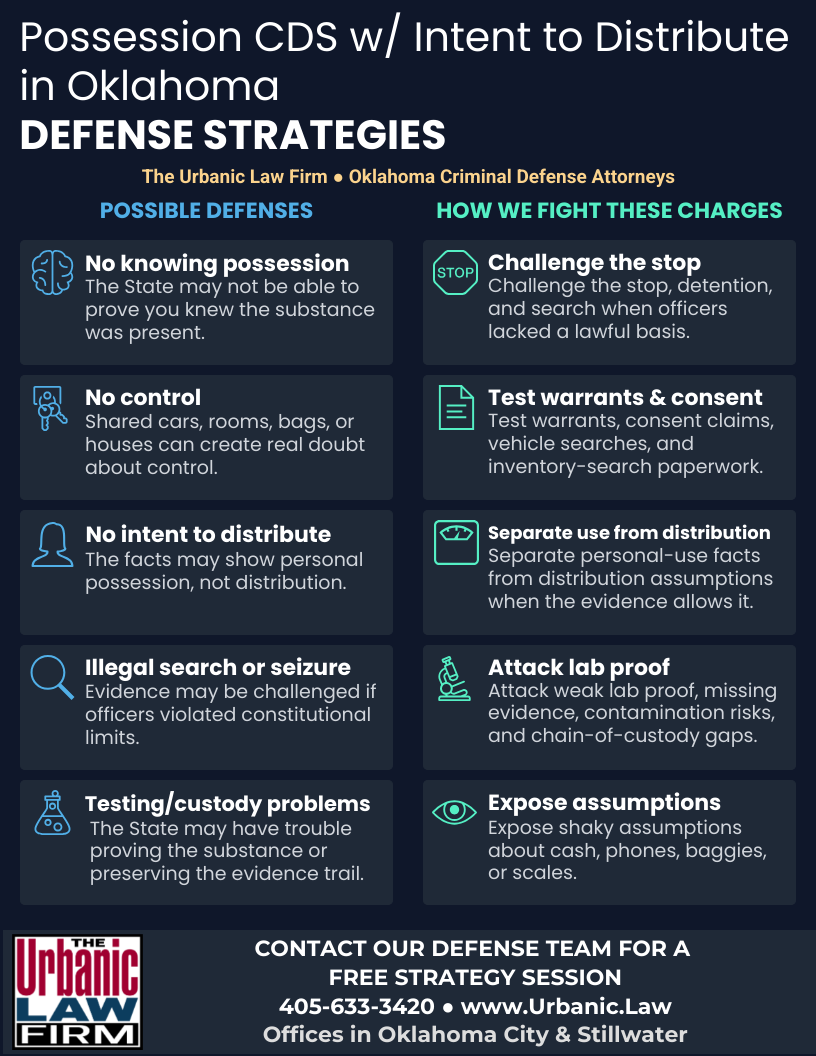
- No knowing possession: The State may not be able to prove you knew the substance was present.
- No control: Shared cars, rooms, bags, or houses can create real doubt about control.
- No intent to distribute: The facts may show personal possession, not distribution.
- Illegal search or seizure: Evidence may be challenged if officers violated constitutional limits.
- Testing or chain-of-custody problems: The State may have trouble proving the substance or preserving the evidence trail.
How we fight these charges
- Challenge the stop, detention, and search when officers lacked a lawful basis.
- Test warrants, consent claims, vehicle searches, and inventory-search paperwork.
- Separate personal-use facts from distribution assumptions when the evidence allows it.
- Attack weak lab proof, missing evidence, contamination risks, and chain-of-custody gaps.
- Expose shaky assumptions about cash, phones, baggies, or scales.
What The Urbanic Law Firm does to help clients charged with this crime
- Review reports, body-camera video, lab documents, search paperwork, and charging language.
- Explain the court process, possible outcomes, and decisions you’ll need to make.
- Track deadlines, hearings, discovery, motions, and client communication.
- Prepare suppression issues, preliminary-hearing strategy, and trial themes early.
- Keep you updated so you know what’s happening and why it matters.
Questions to ask your attorney
- What drug schedule is the State alleging?
- What facts supposedly show distribution instead of possession?
- Was the stop, detention, or search legally valid?
- Will any prior convictions change the felony class or range?
- Does the evidence need independent testing or expert review?
Things you can do if you’re arrested for this crime
- Stay quiet about the facts until you’ve talked with counsel.
- Save all paperwork from jail, court, officers, and bonding agents.
- Write a private timeline while your memory is fresh.
- Preserve messages, photos, receipts, and location information without deleting anything.
- Avoid talking about the facts on recorded jail calls or social media.
What happens next
After arrest, the case may move through booking, bond, filing, arraignment, discovery, preliminary hearing, motions, and trial settings. However, the biggest early choices often involve evidence preservation and search challenges.
Because punishments can depend on prior felony classes, bring old case numbers and judgment documents if you have them. Also, keep track of every court date and every condition of release.
For a more detailed overview of the criminal process in Oklahoma, you can read more in our Oklahoma criminal process guide.
Comparison to other crimes
These related offenses can sound similar. However, the difference usually affects felony class, leverage, and defense strategy.
| Offense | What the State tries to prove | Classification and practical risk | Common defense issues |
|---|---|---|---|
| Possession of CDS with intent to distribute | Knowing possession plus an intent to distribute, usually from surrounding facts. | Usually Class C2 or Class D1, depending on the substance. Enhancements can raise the risk. | Knowledge, control, search legality, lab proof, and whether facts really show distribution. |
| Simple possession of CDS | Knowing and intentional possession of a controlled substance. | Often less serious than an intent-to-distribute allegation, but it can still damage your record. | Possession, knowledge, search legality, and whether the substance was properly tested. |
| Distribution of CDS | A transfer, attempted transfer, or delivery-related act involving a controlled substance. | The State may argue a completed transfer, not just possession with future intent. | Informant credibility, recorded buys, surveillance gaps, and whether a real transfer occurred. |
| Drug trafficking | A listed controlled substance in a threshold amount. | Often more serious because weight can drive the charge. | Weight, mixture, lab testing, ownership, search legality, and chain of custody. |
Key terms
Controlled dangerous substance
Controlled dangerous substance means a drug, substance, or immediate precursor in Schedules I through V of the Uniform Controlled Dangerous Substances Act, or any drug, substance, or immediate precursor listed temporarily or permanently as a federally controlled substance. Any conflict between state and federal law about the schedule is resolved in favor of state law. (63 O.S. § 2-101)
For this charge, the substance’s schedule can change the felony class and fine. Also, the lab result can become a major fight.
Deliver or delivery
Deliver or delivery means the actual, constructive, or attempted transfer from one person to another of a controlled dangerous substance or drug paraphernalia, whether or not there is an agency relationship. (63 O.S. § 2-101)
Because distribution depends on delivery concepts, the State may focus on texts, handoffs, or alleged planned transfers. However, an alleged plan still needs proof.
Distribute
Distribute means to deliver other than by administering or dispensing a controlled dangerous substance. (63 O.S. § 2-101 & jury instruction 6-16)
In an intent case, prosecutors often try to prove future distribution from circumstantial facts. Still, personal-use facts may point the other way.
Dispense
Dispense means to deliver a controlled dangerous substance to an ultimate user or human research subject by or pursuant to the lawful order of a practitioner. It includes the prescribing, administering, packaging, labeling, or compounding necessary to prepare the substance for distribution. (63 O.S. § 2-101 & jury instruction 6-16)
Although many street-level cases focus on distribution, the statute also covers intent to dispense. Therefore, the charging language needs careful review.
Possession
Possession means actual physical custody, or knowledge of the substance’s presence, as well as power and intent to control its use or disposition. (jury instruction 6-16)
Shared spaces can make this element difficult for the State. For example, a car, bedroom, backpack, or house may involve more than one possible controller.
FAQs
What does possession with intent to distribute mean in Oklahoma?
It means prosecutors claim you knowingly possessed a controlled dangerous substance and intended to distribute it. The intent part often comes from facts like packaging, cash, quantity, phones, or statements.
What evidence proves possession with intent to distribute in Oklahoma?
Common evidence includes drug quantity, individual packaging, scales, cash, messages, surveillance, informant claims, and statements. However, each fact has to be tested against the full case.
Can police use texts to prove possession with intent to distribute in Oklahoma?
Yes, prosecutors may use texts or app messages if they can connect them to you and the alleged substance. Defense issues can include search legality, context, identity, and missing messages.
Is possession with intent to distribute in Oklahoma eligible for expungement?
It can depend on the outcome, sentence, time since completion, prior record, and the exact statute used. You can read more in our Oklahoma expungement guide.
How is possession with intent to distribute punished in Oklahoma?
The sentencing range depends on the alleged substance, felony class, prior record, and enhancement facts. Schedule I or II substances usually carry higher exposure than marijuana or Schedule III, IV, or V substances.
Important cases
McIntosh v. State, 2010 OK CR 17, 237 P.3d 800, shows why drug classification matters. The court explained that the substance category controlled the correct sentencing range, and the wrong range required sentence modification.
Carolina v. State, 1992 OK CR 65, 839 P.2d 663, addressed proof of knowing possession in a drug case. The court looked at circumstantial evidence and whether independent facts showed knowledge and control.
Example of this crime in the news
A KTUL report described a Tulsa traffic stop where deputies said they found multiple marijuana products, separate packages, and cash. That kind of report illustrates how officers often build an intent case from packaging, quantity, and money instead of a witnessed sale.
This page is for informational purposes only and is not legal advice. Every case is unique; consult an attorney about your specific situation. Law last reviewed on May 18, 2026 by attorney Frank Urbanic. Page last updated May 18, 2026. Review the statutes cited on this page for the most current version of the law.

Legislative Payback or Public Safety? Sara Polston’s Shocking Constitutional Fight!

Tulsa’s “Serial Defecator” Case: Legal Analysis of a Messy Situation

Oklahoma Discovery Law Changes: 2026–2027 Guide

Oklahoma Domestic Abuse Law Updates Nov. 1: Five Big Changes

Oklahoma Stalking Case Reversed: When a Post Isn’t Enough
| THIS OFFENSE IN THE NEWS |