Assault, Battery, or Assault and Battery with a Dangerous Weapon Defense in Oklahoma
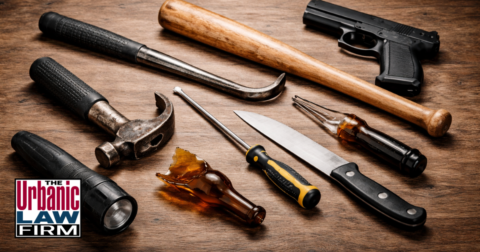 A charge like this gets serious fast. What started as a fight, a threat, a tool in your hand, or an object used the wrong way can turn into a felony case with real prison exposure. So the key issues usually become intent, the weapon claim, and whether you acted without legal justification.
This page explains what prosecutors have to prove, what the penalty range looks like, what defenses may apply, and what usually happens next. It also fits within our weapons & intent-based assault crimes section and our broader assault, battery & domestic abuse crimes guide.
Quick links
- What this charge means
- What the State must prove
- Penalties
- Collateral consequences
- How prosecutors try to prove it
- Practical guide
- What happens next
- Key terms
- FAQs
- Important cases
Talk to a defense lawyer early
If you’ve been accused of assault, battery, or assault and battery with a dangerous weapon in Oklahoma, reach out for a free consultation before you lock yourself into a bad statement or a bad strategy. Early moves matter in these cases because video, witness memories, scene photos, and phone records can change the whole story. Call us at 405-633-3420 or use our secure online form.
What this charge means
Oklahoma’s dangerous-weapon assault law, 21 O.S. § 645, covers two main paths. First, it covers an assault, a battery, or both when the State says you used a sharp or dangerous weapon and meant to do bodily harm. Second, it covers shooting at another person with a firearm, air gun, conductive energy weapon, or similar means when the State says you meant to injure, but not kill.
That distinction matters. This charge is not the same as a simple assault or battery case. It is also not the same as a case where prosecutors claim you meant to kill. So the fight often turns on whether the facts show mere anger, reckless conduct, self-defense, accident, or a real intent to injure with a dangerous weapon.
How prosecutors usually frame it
Most filings under this law use one of two theories. One says you used a knife, broken bottle, tool, blunt object, or another item in a way that made it dangerous. The other says you shot at someone but did not act with an intent to kill. Because of that split, the exact facts matter more than the label on the booking sheet.
In addition, prosecutors sometimes stack related counts when the facts support them. If they think you meant to kill, they may file a more serious intent-to-kill or deadly-weapon count instead. If the alleged victim is a domestic partner, officer, EMT, or protected person, they may add relationship-based, victim-status, firearm-possession, or protective-order allegations too.
What the State must prove
Dangerous-weapon theory
- There was an assault, a battery, or both.
- The act was against another person.
- The object used was a sharp or dangerous weapon under the facts of the case.
- You acted without justifiable or excusable cause.
- You acted with intent to do bodily harm.
Shooting-at-another theory
- There was an assault, a battery, or both.
- The act was against another person.
- You shot at another person with a firearm, air gun, conductive energy weapon, or similar means.
- You acted without justifiable or excusable cause.
- You intended to injure, not merely scare, and not kill.
So the State does not win just by showing a fight happened. Prosecutors still need proof of intent. They also need proof that the object counts as dangerous on these facts, or that the shooting theory truly fits what happened. That gives the defense several real pressure points.
Penalties in Oklahoma
For sentencing, this offense is a Class B4 felony under 21 O.S. § 20I. Also, because this law does not set its own fine, the court or jury may add a felony fine under 21 O.S. § 64.
- Felony level: Class B4 felony.
- Prison or jail exposure:
- Up to 10 years in the State Penitentiary.
- Or up to 1 year in county jail.
- Fine exposure:
- Up to $10,000 if a fine is imposed.
- Repeat-felony risk:
- A prior felony record can raise your sentencing exposure if the State files an enhancement.
- Other direct costs:
- Court costs, supervision fees, treatment conditions, no-contact terms, and restitution can follow a conviction or plea.
In real life, the sentencing fight often starts long before sentencing. The filing decision, the injury proof, the weapon issue, your record, and the alleged victim all shape leverage. Because of that, strong early case work can matter as much as anything that happens at the end.
Collateral consequences
- Violent-crime label: This offense appears on Oklahoma’s violent-crime list in 57 O.S. § 571. So judges, prosecutors, and supervision agencies may treat the case as higher risk. You can also read more in our violent crimes guide.
- Felony record: A conviction can affect background checks, future charging decisions, and the way later cases get handled.
- Firearm problems: A felony conviction can create serious limits on possessing or handling firearms later.
- Work and licensing issues: Employers, boards, and landlords may treat a violent felony conviction differently than a low-level case.
- Immigration risk: If you are not a United States citizen, this kind of conviction can trigger severe immigration consequences.
How prosecutors try to prove it
- Witness statements from the alleged victim, bystanders, or responding officers.
- Body-camera video, surveillance video, 911 audio, and phone recordings.
- Photos, medical records, and injury evidence used to argue the object was dangerous in the way it was used.
- The object itself, scene evidence, shell casings, damage patterns, or trajectory evidence.
- Your own words, texts, threats, admissions, or social media posts used to argue intent to injure.
However, those proof categories often have gaps. Witnesses miss details. Video starts late. Injuries can look worse than the actual legal theory supports. And sometimes the State overreads a normal object as a dangerous weapon without enough proof about how it was actually used.
Practical guide for people facing these charges
Questions to ask your attorney
- Does the evidence really show intent to injure, or does it fit anger, recklessness, or accident better?
- Can the object in this case legally be treated as a dangerous weapon on these facts?
- Is there a self-defense, defense-of-others, or defense-of-property issue here?
- Can any stop, search, seizure, or statement be challenged or suppressed?
- Is the strongest goal dismissal, reduction, a better filing decision, or trial?
Things you can do if you’re arrested for this crime
- Stop talking about the facts on calls, texts, and social media.
- Save photos, videos, messages, and location data before they disappear.
- Write out a clean timeline while your memory is still fresh.
- Identify witnesses and preserve their contact information.
- Follow every bond condition, especially no-contact and weapon restrictions.
Defenses
- Lack of intent to injure: The State must prove more than a heated moment or careless act.
- No dangerous weapon: Some objects are not dangerous by themselves, so the State must prove the manner of use made them dangerous.
- Self-defense or defense of another: A justified use of force can defeat the charge when the facts support it.
- Accident or lack of volitional act: An unintended discharge or unintended contact can undermine the required mental state.
- Constitutional suppression issues: Illegal stops, searches, seizures, or questioning can weaken or remove key State evidence.
How we fight these charges
- Pin down the theory by forcing the State to choose whether it claims a dangerous-weapon use, a shooting-at-another theory, or a more serious intent theory.
- Attack the weapon claim with photos, measurements, scene facts, and common-sense use-of-object analysis.
- Reconstruct the encounter through video, medical records, witness order, and timing to expose overcharging or missing context.
- Litigate suppression issues when the police stop, search, or statement process broke constitutional rules.
- Pressure the filing decision by showing the evidence supports a lesser charge, a justified act, or no filing at all.
What The Urbanic Law Firm does to help clients charged with this crime
- Explains the charge, the range, and the real pressure points early.
- Builds a defense file around video, witness statements, scene proof, and medical evidence.
- Tracks bond rules, court dates, and no-contact issues so avoidable mistakes do not make things worse.
- Pushes for reduction, dismissal, or a better filing decision before the case hardens.
- Prepares the case for hearing or trial from the start, not at the last minute.
What happens next
After the arrest
First comes booking, bond, and release terms. Then the case usually turns into a paper fight fast. The State reviews reports, video, injury proof, and your record. Because this is a felony filing, the next stages can include arraignment, discovery, motions, and a preliminary hearing path before the case ever gets close to trial.
As the case develops
Prosecutors may try to hold the higher filing if they think the facts show a true dangerous-weapon use and a clear intent to injure. Still, those points are often contestable. A case may move toward dismissal, reduction, negotiation, or trial depending on the proof. So what you do early can shape almost every later choice.
If the case does not resolve early
Then the defense pressure usually shifts to witness credibility, weapon classification, intent, justification, and suppression issues. Some cases break on video. Others turn on one sentence in a statement, one medical detail, or one missing witness. That’s why a dangerous-weapon case should never be treated like a routine fight case.
Key terms
Assault
An assault is any willful and unlawful attempt or offer to do a bodily hurt to another with force or violence. That matters here because prosecutors do not always need actual contact to build one version of this charge. (21 O.S. § 641; jury instruction 4-2)
Battery
A battery is any willful and unlawful use of force or violence upon the person of another. So even slight contact can matter if the State says a dangerous object was used during that contact. (21 O.S. § 642; jury instruction 4-3)
Dangerous weapon
A dangerous weapon is any implement likely to produce death or great bodily harm in the manner it is used or attempted to be used. Because of that, the same object can look harmless in one case and dangerous in another. (jury instruction 4-28)
Firearm
A firearm is a weapon from which a shot or projectile is discharged by force of a chemical explosive such as gunpowder. This definition matters because the shooting-at-another theory depends on the type of device the State says was used. (jury instruction 6-45)
Willful
Willful means purposeful. It does not require any intent to violate the law or gain an advantage. So the defense often looks hard at whether the act was deliberate at all, or instead accidental, reflexive, or misread. (21 O.S. § 92)
FAQs about this charge in Oklahoma
What makes assault with a dangerous weapon different from simple assault in Oklahoma?
The difference usually comes down to the object used, the way it was used, and the State’s claim about intent. A simple assault case does not require the same dangerous-weapon proof. This felony charge does.
Does the State have to prove intent in an Oklahoma dangerous weapon assault case?
Yes. The State still has to prove an intent to do bodily harm or an intent to injure, depending on the theory charged. That is often one of the strongest defense issues in the case.
Can a normal object count as a dangerous weapon in Oklahoma?
Yes, sometimes. An everyday object can become a dangerous weapon if the State can show the manner of use made it likely to cause death or great bodily harm. That issue is very fact specific.
What happens after an Oklahoma assault with a dangerous weapon arrest?
You can expect bond conditions, a formal felony filing path, discovery, and motion practice. Depending on the evidence, the case may move toward dismissal, reduction, negotiation, or trial.
Can self-defense beat an Oklahoma assault with a dangerous weapon charge?
Yes, it can. If the force was legally justified under the facts, self-defense or defense of another may defeat the charge. Still, the exact level of force and the surrounding danger matter a lot.
Important cases
Douglas v. State, 1990 OK CR 47, 795 P.2d 1070, held that the evidence was enough for this charge when the defendant raised an object toward an officer, even though he never swung it. The case shows that an assault can be proved by conduct moving toward a battery, not only by actual contact.
Luster v. State, 1987 OK CR 261, 746 P.2d 1159, held that this charge does not fit an intoxicated-driving injury case unless the State can prove specific intent. That case matters because prosecutors still have to prove intent to injure, not just careless or reckless conduct.
This page is for informational purposes only and is not legal advice. Every case is unique; consult an attorney about your specific situation. Page last updated March 30, 2026. Consult the statutes listed above for the most up-to-date law.