Aggravated DUI Defense in Oklahoma
 An aggravated DUI accusation now covers more than a high BAC. Now, prosecutors can use several aggravating facts. Those facts may include a crash, lane violation, eluding allegation, extreme speed, a child passenger, or reckless driving.
Because of that, the case often turns on details. The State still has to prove the DUI. Then it has to prove at least one aggravating factor. However, a police report doesn’t decide either issue.
This page focuses on aggravated DUI. It doesn’t analyze a standalone APC – Actual Physical Control charge. For the main DUI defense overview, start there. For the broader category, see our drunk driving guide.
Quick links
Talk through the charge before court deadlines stack up
If you’ve been accused of aggravated DUI in Oklahoma, reach out for a free consultation. An Oklahoma aggravated DUI defense attorney can review the stop, test, crash report, videos, and license deadlines.
Call us at 405-633-3420 or use our secure online form.
What aggravated DUI means
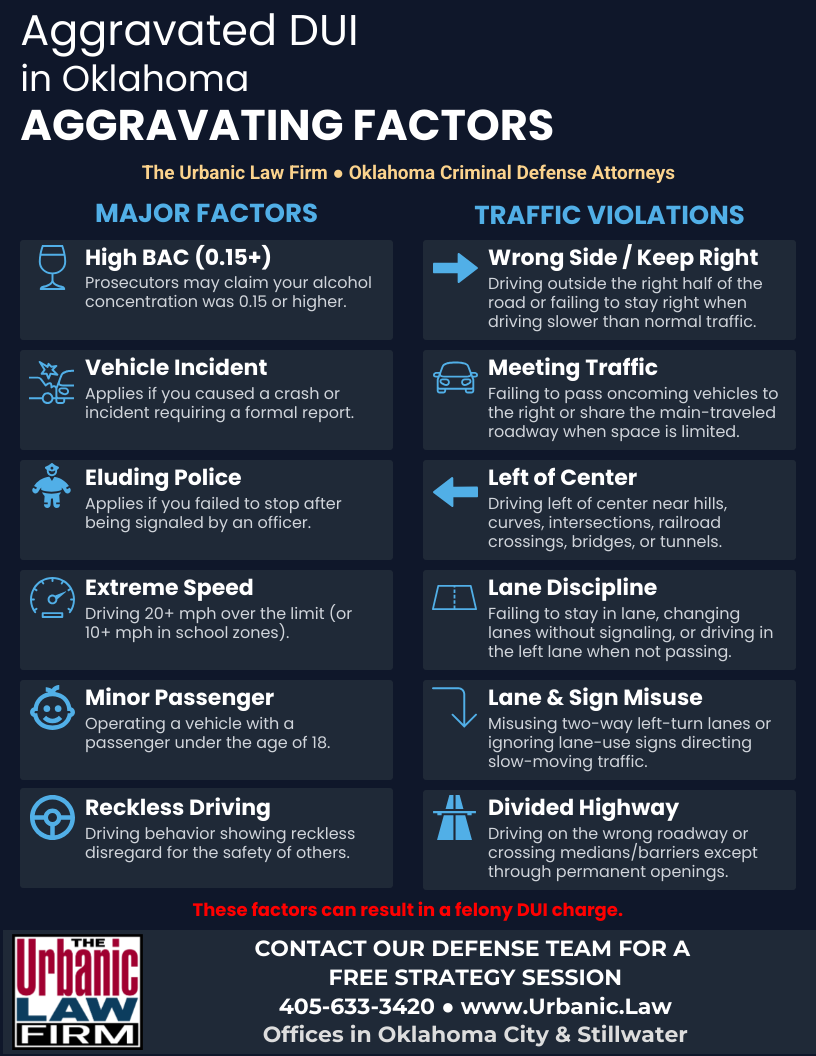
Under 47 O.S. § 11-902, aggravated DUI means the State claims you committed DUI and also committed one or more listed aggravating acts. The aggravated version is a usually a felony offense.
So, the case has two layers. First, prosecutors must prove the DUI itself. Then, they must prove at least one aggravating factor.
The seven aggravating factors
- 0.15 or higher alcohol concentration: Prosecutors may claim your blood or breath test showed 0.15 or more. This is the high-BAC version.
- Reportable motor vehicle incident: Prosecutors may claim you caused a motor vehicle incident involving one or more vehicles that required a report under 47 O.S. § 40-102. In practice, this usually means a crash or incident serious enough to trigger reporting duties.
- Specified road-rule violations: Prosecutors may claim your DUI became aggravated because your driving violated one of these listed roadway rules:
- Wrong side of the road or failing to keep right: Under 47 O.S. § 11-301, the State may rely on conduct such as:
- Driving outside the right half of the roadway when the road is wide enough and no legal exception applies.
- Driving slower than normal traffic without staying right when the right-hand lane is available, unless you’re passing or preparing for a left turn.
- Driving left of the center line on a four-lane, two-way roadway unless traffic-control devices or a lawful obstruction exception allow it.
- Improperly meeting oncoming traffic: Under 47 O.S. § 11-302, the State may rely on conduct such as:
- Failing to pass an oncoming vehicle to the right.
- Failing to give the oncoming driver at least one-half of the main-traveled roadway when the road has room for only one line of traffic in each direction.
- Driving left of center in especially risky places: Under 47 O.S. § 11-306, the State may rely on conduct such as:
- Driving left of center near a hillcrest or curve when the view is blocked enough to create a hazard if another vehicle approaches.
- Driving left of center within 100 feet of, or while crossing, an intersection or railroad grade crossing unless traffic-control devices say otherwise.
- Driving left of center when the view is blocked within 100 feet of a bridge, viaduct, or tunnel.
- Important limits: These left-of-center limits don’t apply on one-way roads, when the obstruction exception applies, or when the driver is turning left into or from an alley, private road, or driveway.
- Unsafe lane use on marked roadways: Under 47 O.S. § 11-309, the State may rely on conduct such as:
- Failing to stay as nearly as practicable within one lane.
- Changing lanes before making sure it’s safe and without signaling for at least the last 100 feet traveled.
- Misusing a two-way left-turn lane, such as driving in it when you’re not preparing for or making a left turn.
- Driving more than 200 feet in a two-way left-turn lane while preparing for and making a left turn from the roadway.
- Making a left turn from another lane when a two-way left-turn lane has been designated, unless the statute’s service-drive exception applies.
- Driving in the left lane when you’re not passing, unless traffic conditions, road design, city-limit rules, county-road rules, or other statutory exceptions apply.
- Ignoring lane-use signs, including signs directing slow-moving traffic or assigning lanes for traffic moving in a particular direction.
- Improper driving on a divided highway: Under 47 O.S. § 11-311, the State may rely on conduct such as:
- Driving on the wrong roadway of a divided highway instead of the right-hand roadway, unless signs or an officer direct otherwise.
- Driving over, across, or within the dividing space, barrier, or median except through a permanent opening, crossover, or intersection when allowed.
- Using a temporary opening or temporary crossover unless a public authority specifically authorizes it or a peace officer directs it.
- Wrong side of the road or failing to keep right: Under 47 O.S. § 11-301, the State may rely on conduct such as:
- Eluding peace officers: Prosecutors may claim you drove while eluding officers under 21 O.S. § 540A. This usually means the State says an officer signaled you to stop and you didn’t lawfully stop.
- Extreme speed: Prosecutors may claim you drove more than 20 miles per hour over the speed limit. In an active school zone, they only need to claim more than 10 miles per hour over.
- Passenger younger than 18: Prosecutors may claim you operated the vehicle with a minor passenger. This factor can also overlap with Child Endangerment DUI.
- Reckless driving: Prosecutors may claim your driving fit 47 O.S. § 11-901. This factor focuses on driving behavior that shows reckless disregard for safety.
Other DUI and related pages
- Non-aggravating DUI covers DUI without one of these aggravating factors.
- Personal Injury DUI focuses on injury allegations.
- Great Bodily Injury DUI involves more serious injury allegations.
- Death Resulting from DUI applies when prosecutors claim impaired driving caused a death.
- Child Endangerment DUI focuses on driving under the influence with a child involved.
- APC – Actual Physical Control is different because driving may not be required.
- DUI Drugs focuses on drug or combined-substance impairment.
Key elements the state must prove
The State has to prove the DUI first. Then it has to prove at least one aggravating factor. So, the case isn’t complete just because an officer uses the words “aggravated DUI.”
- Driving or operating a motor vehicle: For this DUI page, the State must prove you drove or operated a motor vehicle.
- If the State’s theory is only actual physical control, that’s a different issue covered on the APC page.
- Video, witness statements, officer observations, and vehicle location can all matter.
- Qualifying location: The State must prove the alleged conduct happened on a roadway, highway, turnpike, public place, or private-access road included in the DUI law.
- Underlying DUI: The State must prove the DUI part of the charge.
- Alcohol theory: Prosecutors may rely on impairment, a test result, or both.
- Drug or combined-substance theory: Prosecutors may claim alcohol, drugs, or another intoxicating substance affected your ability to drive.
- Behavior evidence: Officers may point to driving, speech, odor, balance, eyes, admissions, or field sobriety testing.
- At least one aggravating factor: The State must prove one or more of the listed aggravating facts.
- High BAC: A blood or breath alcohol concentration of 0.15 or more.
- Reportable incident: A motor vehicle incident involving one or more vehicles that triggered a reporting duty.
- Specified roadway violation: Driving that violates one of the listed road-position, passing, lane-use, left-of-center, or divided-highway rules.
- Eluding: Driving while eluding peace officers.
- Extreme speed: More than 20 miles per hour over the speed limit, or more than 10 miles per hour over in an active school zone.
- Minor passenger: Operating with a passenger younger than 18.
- Reckless driving: Driving conduct that fits the reckless-driving definition.
- Causation for the incident factor: If prosecutors rely on a reportable incident, they must connect you to causing that incident.
- Reliable proof: The State must use evidence that holds up under legal and factual challenge.
- For BAC cases, that includes test timing, machine records, operator compliance, lab records, and chain of custody.
- For driving-conduct cases, that includes video, radar, pacing, measurements, signage, lane markings, and witness accounts.
- For passenger cases, that includes proof of the passenger’s age.
Penalties for aggravated DUI

Aggravated DUI has a confusing punishment structure. The aggravated-DUI subsection labels the offense as a Class B3 felony under 21 O.S. § 20H. However, the same law sends imprisonment and fines to the DUI-history paragraph that applies to your case.
Because of that, the classification and punishment analysis has two layers. Prosecutors may rely on the Class B3 aggravated-DUI label. However, the defense may argue the court must still apply the misdemeanor or felony punishment path that matches the DUI-history paragraph. Check out our blog post for in-depth analysis on this issue.
- Classification dispute: The aggravated-DUI subsection creates tension between the Class B3 felony label and the DUI-history sentencing scheme.
- State’s argument: Prosecutors may argue the Class B3 felony label controls the offense classification.
- Defense argument: The defense may argue that subsection E sends punishment back to the applicable DUI-history paragraph.
- Rule-of-lenity issue: If the court finds real ambiguity, the defense may argue the statute should be read in favor of the accused.
- Practical point: A first-time aggravated DUI shouldn’t be analyzed as though the felony-versus-misdemeanor issue is fully settled.
- First aggravated DUI sentencing path: For a first-time aggravated DUI, the sentencing cross-reference points to the first-offense DUI punishment range.
- Classification issue: The aggravated-DUI subsection says Class B3 felony, but the first-offense DUI paragraph uses misdemeanor punishment.
- Jail: 10 days to 1 year in the county jail.
- Fine: Up to $1,000.
- Mandatory portion: The first 10 days aren’t subject to probation, suspension, or deferral.
- Night or weekend incarceration: The court may allow that mandatory time to be served at night or on weekends.
- Misdemeanor-treatment argument: Because this punishment range matches first-offense misdemeanor DUI, the defense may argue for misdemeanor treatment or at least misdemeanor punishment.
- Aggravated DUI with one qualifying prior DUI: If the case follows the second-offense DUI-history path, the related DUI-history classification is a Class C2 felony under 21 O.S. § 20M.
- Prison: 1 to 5 years in the custody of the Department of Corrections.
- Fine: Up to $2,500.
- Treatment option: The statute may allow treatment, imprisonment, and fine terms within the listed limits.
- Mandatory portion: The first 30 days aren’t subject to probation, suspension, or deferral.
- County jail condition: The mandatory minimum must be served in the county jail if the sentence is suspended or deferred.
- Aggravated DUI after a prior felony DUI: If the case follows the prior-felony-DUI sentencing path, the related DUI-history classification is a Class B4 felony under 21 O.S. § 20I.
- Prison: 1 to 10 years in the custody of the Department of Corrections.
- Fine: Up to $5,000.
- Community service: The treatment-based sentencing option may include 240 hours of community service.
- Ignition interlock: The treatment-based option can also include ignition-interlock requirements.
- Mandatory custody risk: If residential or inpatient treatment doesn’t apply, a minimum jail term can apply.
- Aggravated DUI after two prior felony DUIs: If the case follows the two-prior-felony-DUI sentencing path, the related DUI-history classification is also a Class B3 felony under 21 O.S. § 20H.
- Prison: 1 to 20 years in the custody of the Department of Corrections.
- Fine: Up to $5,000.
- Community service: The treatment-based sentencing option may include 480 hours of community service.
- Mandatory portion: The nonsuspendable portion increases by 30 days for each conviction after the second offense.
- Aggravated DUI after a prior DUI-related homicide conviction: If the prior conviction involved DUI-related second-degree murder or first-degree manslaughter, the related DUI-history classification is a Class A2 felony under 21 O.S. § 20D.
- Prison: 5 to 20 years in the custody of the Department of Corrections.
- Fine: Up to $10,000.
- Required aggravated-DUI terms: A conviction also carries extra requirements beyond the jail or prison range.
- Assessment and treatment: The court must require an alcohol and drug assessment, plus compliance with treatment recommendations.
- Supervision and testing: The court must impose at least 1 year of supervision and periodic testing at your expense.
- Ignition interlock: The court must require an ignition-interlock device for at least 90 days.
- Child-passenger fine enhancement: If you’re 18 or older and convicted while transporting a passenger under 18, the fine can double. This fact can also overlap with Child Endangerment DUI.
- Probation conditions: Any suspended sentence, deferred sentence, or probation term can include treatment, testing, interlock rules, community service, and strict compliance deadlines.
- Sentence enhancement: Prior convictions can change punishment exposure. For more detail, see our guide to Oklahoma sentence enhancement.
Collateral consequences
The court sentence isn’t the only problem. In addition, an aggravated DUI case can affect your license, job, insurance, and record.
- Driver’s license consequences: A DUI arrest can trigger Service Oklahoma deadlines, possible revocation, IDAP decisions, reinstatement fees, and ignition-interlock rules. Read our Oklahoma DUI driver’s license guide for more detail.
- Employment problems: A felony record can affect background checks, professional licensing, and workplace reporting rules.
- Insurance costs: A DUI can raise insurance costs and create proof-of-insurance issues.
- Commercial driving issues: A CDL holder may face disqualification rules separate from the criminal case.
- Military and clearance issues: A DUI can create command, clearance, and career concerns. Our military DUI page explains those risks.
- Young-driver consequences: An under-21 DUI issue can create separate license and record concerns.
How prosecutors prove aggravated DUI
Prosecutors usually build the case from the stop forward. However, the aggravating factor determines which proof matters most.
- Driving pattern: Officers may describe speeding, lane travel, wrong-way driving, delayed stops, crashes, or near misses.
- Officer observations: Reports often mention odor, speech, balance, eyes, admissions, and divided-attention tasks.
- Field sobriety evidence: Prosecutors may use standardized field sobriety tests to argue impairment.
- Blood or breath records: For high-BAC cases, the State uses the test result, timing, machine records, and operator paperwork.
- Crash or incident reports: For reportable-incident cases, prosecutors may use collision reports, witness statements, photos, and repair evidence.
- Speed evidence: Radar, pacing, lidar, dashcam, and school-zone signs may become important.
- Passenger age: For a minor-passenger allegation, prosecutors may use birth dates, IDs, school records, or family statements.
Practical guide if you’re charged with this crime
Questions to ask your attorney
- Which aggravating factor is the State relying on?
- What evidence supports the underlying DUI allegation?
- What test, machine, lab, and maintenance records should be requested?
- What bodycam, dashcam, intersection, school-zone, or business video may exist?
- What driver’s license deadline applies after the arrest?
Things you can do if you’re arrested for this crime
- Save every citation, notice, bond paper, tow sheet, and court document.
- Write a private timeline while the details are still fresh.
- Preserve rideshare records, receipts, texts, location data, and call logs.
- Avoid posting about the arrest, the officer, the test, the crash, or the passenger online.
- Track court dates, license deadlines, evaluation dates, and interlock requirements.
Defenses
- No lawful stop: Evidence may be challenged if the officer lacked a valid basis to stop or detain you.
- DUI not proven: The State may fail if it can’t prove impairment, a valid per se test, or another DUI basis.
- Aggravating factor not proven: Prosecutors may prove DUI but fail to prove the crash, lane violation, speed, eluding, child-passenger, or reckless-driving allegation.
- Test reliability problem: Breath machines, blood draws, lab work, and paperwork can create proof issues.
- Video conflict: Bodycam, dashcam, or outside video may contradict the report.
How we fight these charges
- Investigate the stop, detention, arrest, test request, and sample timeline.
- Expose weak field-test conditions, unclear instructions, and non-alcohol explanations
- Demand bodycam, dashcam, booking video, crash materials, calibration records, and lab files.
- Test the aggravating fact against video, measurements, timing, signage, and witness accounts.
- Build a mitigation record with treatment, compliance, interlock progress, and license steps without conceding guilt or weakening the legal defenses.
What The Urbanic Law Firm does to help clients charged with this crime
- Explain court deadlines, license issues, treatment steps, and possible outcomes in clear terms.
- Organize reports, videos, crash documents, test records, and client documents.
- Communicate case updates so you know what happened and what comes next.
- Prepare you for court appearances, negotiations, motion hearings, and trial decisions.
- Coordinate evaluation, treatment, interlock, and compliance actions when those steps help the case strategy.
What happens next
After an arrest, you may deal with booking, bail, arraignment, discovery, license deadlines, and negotiations. In addition, the court may order testing, evaluation, or interlock steps while the case is pending.
Next, The Urbanic Law Firm reviews the State’s DUI proof and the aggravating-factor proof. An Oklahoma aggravated DUI defense lawyer can also help you understand whether the felony label matches the evidence.
Finally, the case may move toward dismissal, reduction, plea negotiation, motion hearings, trial, or sentencing. For a more detailed overview of the criminal process in Oklahoma, read our Oklahoma criminal process guide.
Key terms
Alcohol concentration
Alcohol concentration means grams of alcohol per one hundred milliliters of blood if blood was tested, or grams of alcohol per two hundred ten liters of breath if breath was tested. This term matters because one aggravated factor uses a 0.15 threshold. (47 O.S. § 756)
Driving
Driving means operating a motor vehicle while it’s in motion. This term matters because several aggravating factors focus on how the vehicle moved. (jury instruction 6-35)
Motor vehicle
Motor vehicle means every vehicle that’s self-propelled and every vehicle propelled by electric power obtained from overhead trolley wires, but not operated upon rails. This term matters because aggravated DUI must connect the allegation to a covered vehicle. (47 O.S. § 1-134 & jury instruction 6-35)
Other intoxicating substance
Other intoxicating substance means any substance other than alcohol that can be ingested, inhaled, injected, or absorbed into the human body and can adversely affect the central nervous system, vision, hearing, or other sensory or motor functions. This term matters when the State claims alcohol plus another substance affected driving. (47 O.S. § 1-140.1 & jury instruction 6-35)
Under the influence
Under the influence means alcohol, an intoxicating substance, or a combination has affected the driver’s nervous system, brain, or muscles enough to hinder, to an appreciable degree, the ability to operate a motor vehicle as an ordinary prudent and cautious person would under like conditions. This term matters because prosecutors must still prove DUI, not just an aggravating fact. (jury instruction 6-35)
FAQs
What makes a DUI aggravated in Oklahoma?
A DUI can become aggravated when the State claims DUI plus at least one aggravating factor. Those factors include a 0.15 BAC, a reportable incident, listed road-rule violations, eluding, extreme speed, a minor passenger, or reckless driving.
Is aggravated DUI in Oklahoma a felony?
Maybe. Under the 2026 aggravated-DUI wording, a first-time aggravated DUI could be either a misdemeanor or a felony. We will argue that it’s a misdemeanor.
Can Oklahoma aggravated DUI be based on a crash or reckless driving?
Yes. A reportable motor vehicle incident or reckless driving can be an aggravating factor. However, prosecutors still have to prove the DUI and the aggravating fact beyond a reasonable doubt.
What defenses help in an Oklahoma aggravated DUI case?
Common defenses include challenging the stop, the DUI proof, the test reliability, the aggravating factor, the officer’s observations, and conflicts between the report and the video evidence.
Can an Oklahoma aggravated DUI be expunged?
Possibly, but expungement depends on the final disposition, sentence, waiting period, prior record, and Oklahoma expungement law. You can read more in our Oklahoma expungement guide.
Recent example of this crime in the news
A recent KOKH report described an Oklahoma case involving an alleged crash, a high BAC, and children in the vehicle. That kind of report shows why the updated aggravated-DUI law matters. One case can involve several aggravating-factor theories at once.
Important cases
Newlun v. State, 2015 OK CR 7, 348 P.3d 209, addressed aggravated driving under the influence after a former felony DUI under earlier statutory wording. Although the law has changed, the case shows why DUI history and the exact sentencing provision matter.
State v. Keefe, 2017 OK CR 3, 394 P.3d 1272, involved an aggravated DUI prosecution and a suppression ruling. The Court reversed the suppression order, which shows how stop, detention, and public-safety facts can shape DUI evidence fights.
Serving Clients Statewide
Oklahoma County, Payne County, Cleveland County, Canadian County, Tulsa County, Logan County, Lincoln County, Pottawatomie County, and all others
Oklahoma City, Stillwater, Moore, Norman, Del City, Edmond, Mustang, El Reno, Lawton, Kingfisher, Valley Brook, Guthrie, Tulsa, Yukon, Midwest City, Bethany, Choctaw, and all others
This page is for informational purposes only and is not legal advice. Every case is unique; consult an attorney about your specific situation. Page last updated April 28, 2026. Consult the statutes listed above for the most up-to-date law.

Oklahoma Bird Law Attorneys: The Urbanic Law Firm v. Charlie Kelly

Banging More Than the Gavel! Another Judge Sex Scandal Raises Oklahoma Criminal Law Questions

Stick a fork in him! Brent Swadley convicted: Oklahoma post-trial sentencing procedure explained

When Workplace Retaliation Leads To Harm

Brent Swadley Trial Analysis: False Claims & Conspiracy to Defraud State Explained
| THIS OFFENSE IN THE NEWS |