Driving Under the Influence (DUI) Defense in Oklahoma
 A DUI arrest can hit several parts of your life at once. You may be worried about jail, court dates, your license, your job, your insurance, and what shows up on your record.
However, an arrest doesn’t decide the case. The State still has to prove driving, impairment, a covered location, and reliable evidence. Because driving under the influence cases often turn on details, those details matter.
Quick links
Talk with us before the case gets ahead of you
If you’ve been accused of driving under the influence in Oklahoma, reach out for a free consultation. An Oklahoma DUI defense attorney can review the stop, the arrest, the testing, and the license issues before you make a court decision.
Call us at 405-633-3420 or use our secure online form.
Explanation of the law
Oklahoma’s alcohol-DUI law appears in 47 O.S. § 11-902. In general, DUI means driving a motor vehicle while under the influence of alcohol or while your alcohol concentration is is 0.08 or more.
This page focuses on DUI based on driving. It doesn’t focus on APC – actual physical control, which can apply when the State claims you controlled a vehicle even without driving it.
For a broader look at alcohol-related driving cases, you can read our DUI defense overview. In addition, our Oklahoma drunk driving defense guide explains the larger drunk-driving category.
Key elements the state must prove
The alcohol-DUI elements come from jury instruction 6-18. In a typical case, prosecutors must prove each required element beyond a reasonable doubt.
- Driving: The State must prove you drove, not just that you were near a vehicle or inside one.
- Video, witness testimony, officer observations, and admissions may become important.
- Motor vehicle: The case must involve a motor vehicle under the law.
- Covered location: The alleged driving must occur on a public road, street, highway, turnpike, public parking lot, or another covered place.
- Alcohol influence or 0.08 BAC: The State usually tries to prove alcohol affected your ability to drive safely or that your blood or breath alcohol concentration was 0.08 or more.
- Proof beyond a reasonable doubt: If the evidence leaves reasonable doubt about driving, testing, timing, or impairment, the State hasn’t met its burden.
Penalties
A first-offense DUI is a misdemeanor. However, prior DUI history can raise later cases to felony charges. So the penalty range depends heavily on your record and the specific allegation.
First-offense DUI
- Jail:
- At least 10 days and up to 1 year in county jail.
- Fine:
- Up to $1,000, plus court costs and other financial obligations.
- Court conditions:
- The court may require an alcohol assessment, treatment, community service, victim-impact programming, or probation conditions.
Later DUI cases and felony exposure
- Second DUI within 10 years:
- This can be charged as a Class C2 felony, a felony class listed in 21 O.S. § 20M.
- The punishment can include up to 7 years in prison and a fine up to $2,500.
- DUI after a prior felony DUI:
- This can be charged as a Class B4 felony, a felony class listed in 21 O.S. § 20I.
- The punishment can include 1 to 10 years in prison and a fine up to $5,000.
- DUI after two prior felony DUI-related convictions:
- This can be charged as a Class B3 felony, a felony class listed in 21 O.S. § 20H.
- The punishment can include 1 to 20 years in prison and a fine up to $5,000.
- DUI after a prior second-degree murder or first-degree manslaughter conviction involving DUI:
- This can be charged as a Class A2 felony, a felony class listed in 21 O.S. § 20D.
- The punishment can include 5 to 20 years in prison and a fine up to $10,000.
Because prior convictions can change the felony class, sentence range, and negotiation strategy, felony DUI cases often involve sentence enhancement issues.
Driver’s license consequences
A DUI arrest can also trigger driver’s license suspension or revocation issues with Service Oklahoma. In addition, IDAP, ignition interlock, testing rules, and appeal deadlines may matter. For more detail, read our driver’s license consequences guide.
Collateral consequences
- License problems: You may face restricted driving, interlock costs, or Service Oklahoma deadlines.
- Insurance increases: A DUI can raise premiums or create coverage problems.
- Employment issues: Jobs involving driving, background checks, or professional licensing may become harder to keep.
- CDL consequences: If you hold a commercial license, review our CDL holder DUI guide because the risk can be severe.
- Military consequences: If you serve in the military, DUI can affect command issues, clearance concerns, and career planning. Our military DUI guide covers those concerns.
How prosecutors prove DUI
Prosecutors usually build DUI cases from several pieces of evidence. However, each piece can have context, limits, or problems.
- Driving evidence: They may use officer observations, witness statements, crash evidence, video, or your own statements.
- The traffic stop: They may point to speeding, lane movement, equipment issues, a crash, or another reason for contact.
- Officer observations: They often cite odor of alcohol, red eyes, slurred speech, balance issues, or admissions.
- Field sobriety tests: They may rely on walk-and-turn, one-leg stand, and HGN clues. Our SFSTs guide explains why those tests need careful review.
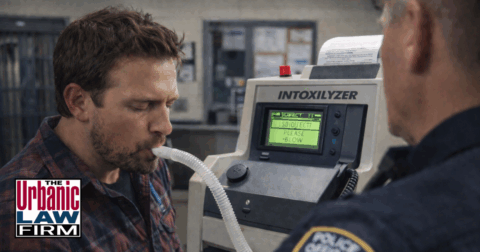
- Chemical testing: They may use breath or blood results, timing, maintenance records, and operator testimony.
Practical guide if you’re charged with this crime
Questions to ask your attorney
- Was there a valid reason for the stop or detention?
- Does the video match the officer’s written report?
- Were the breath or blood testing rules followed?
- What deadlines apply to my license and driving privileges?
- What outcomes fit my record, facts, job, and goals?
Things you can do if you’re arrested for driving under the influence in Oklahoma
- Save every ticket, bond paper, license notice, and court document.
- Calendar every court date and administrative deadline.
- Write down where cameras may exist before footage disappears.
- List passengers, witnesses, rideshare records, receipts, and phone-location details.
- Avoid posting about the arrest or discussing facts with people who may become witnesses.
Defenses
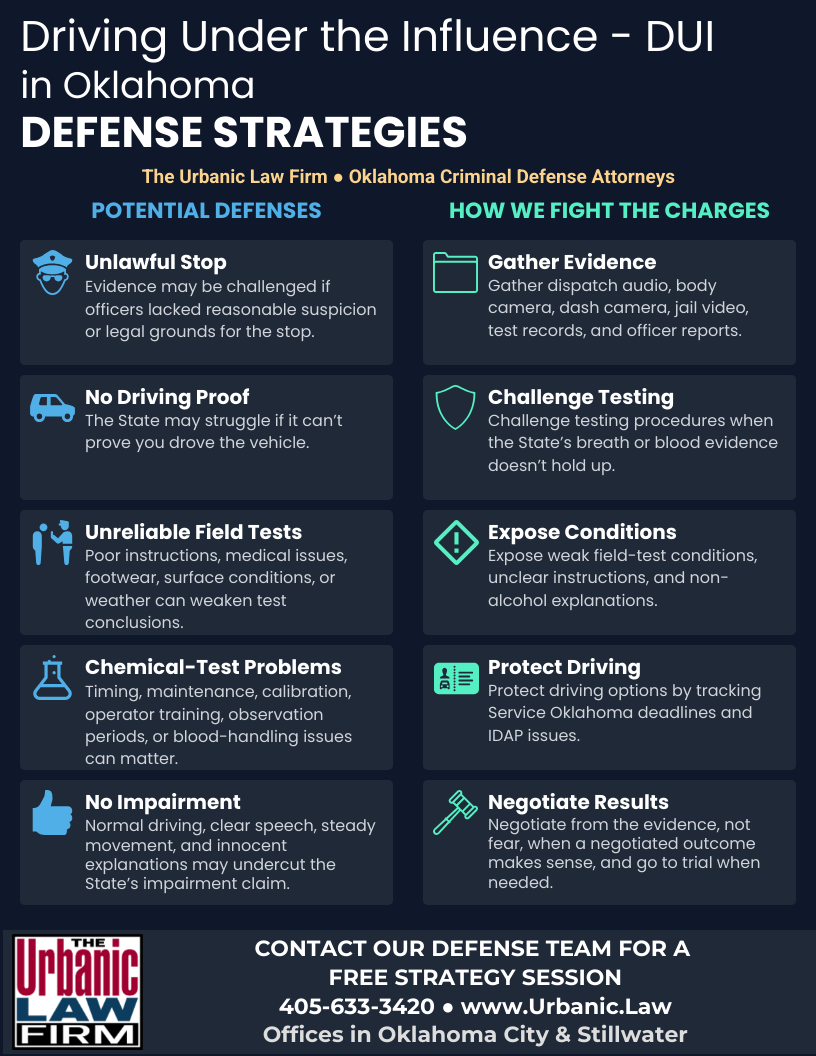
- Unlawful stop: Evidence may be challenged if officers lacked reasonable suspicion or legal grounds for the stop.
- No driving proof: The State may struggle if it can’t prove you drove the vehicle.
- Unreliable field tests: Poor instructions, medical issues, footwear, surface conditions, or weather can weaken test conclusions.
- Chemical-test problems: Timing, maintenance, calibration, operator training, observation periods, or blood-handling issues can matter.
- No impairment: Normal driving, clear speech, steady movement, and innocent explanations may undercut the State’s impairment claim.
How we fight these charges
- Gather dispatch audio, body camera, dash camera, jail video, test records, and officer reports.
- Challenge testing procedures when the State’s breath or blood evidence doesn’t hold up.
- Expose weak field-test conditions, unclear instructions, and non-alcohol explanations.
- Protect driving options by tracking Service Oklahoma deadlines and IDAP issues.
- Negotiate from the evidence, not fear, when a negotiated outcome makes sense, and go to trial when needed.
What The Urbanic Law Firm does to help
An Oklahoma DUI defense lawyer should help you understand both the courtroom case and the license consequences. That means clear planning, not guesswork.
- Explain court dates, license deadlines, plea options, trial risks, and next steps in direct terms.
- Track deadlines so your defense plan accounts for both court and driving issues.
- Prepare you for arraignment, negotiations, motion hearings, and trial decisions.
- Review videos, reports, test records, and officer claims for gaps or contradictions.
- Communicate updates so you’re not left wondering what’s happening with your case.
What happens next
After a DUI arrest, you may have a jail booking, a release decision, a bond, and an arraignment. Then the case usually moves into discovery, negotiations, motion practice, and possible trial settings.
At the same time, you may have license deadlines. So your plan should address both tracks. For a more detailed overview of the criminal process in Oklahoma, you can read more in our Oklahoma criminal process guide.
You should also account for special facts. Drivers under 21 should review our under-21 DUI guide, because age can change the license and case analysis.
Key terms
Driving
Driving means operating a motor vehicle while it’s in motion. In a DUI case, this term focuses the fight on whether the State can prove you actually drove. (jury instruction 6-35)
Motor vehicle
Motor vehicle means every device in, upon, or by which any person or property is or may be transported or drawn upon a highway, with listed exclusions. This term matters because DUI requires a motor vehicle, not just any object that moves. (jury instruction 6-35)
Under the influence
Under the influence means alcohol affected the nervous system, brain, or muscles enough to hinder, to an appreciable degree, the ability to operate a motor vehicle as an ordinary prudent and cautious person would. This definition can make the officer’s observations and video crucial. (jury instruction 6-35)
Public parking lot
Public parking lot means a parking lot on a right-of-way dedicated to public use or owned by the State of Oklahoma or a political subdivision. This can matter when the alleged driving didn’t happen on a road. (jury instruction 6-35)
Chemical test evidence
Chemical test evidence can include blood or breath analysis taken within the legally relevant time period. In DUI cases, that evidence still needs context, timing, and a reliable testing foundation. (jury instruction 6-24)
FAQs
Is a first Oklahoma DUI a misdemeanor or felony?
A first DUI is generally a misdemeanor. However, prior DUI history can make a later case a felony. Injury, death, child endangerment, or other facts can also create different charges.
Can an Oklahoma DUI be based on a BAC test alone?
A BAC result can be powerful evidence, but it isn’t the only issue. Timing, testing rules, machine records, operator training, and driving evidence can all matter.
Will an Oklahoma DUI suspend my driver’s license?
It can. A DUI arrest or conviction may create Service Oklahoma issues, restricted driving rules, IDAP questions, ignition interlock obligations, or appeal deadlines.
Can an Oklahoma DUI be reduced or dismissed?
Sometimes. A reduction or dismissal may depend on the stop, driving proof, videos, chemical testing, witness issues, prior record, and the prosecutor’s evidence.
Can an Oklahoma DUI be expunged?
Some DUI records may qualify for expungement, but eligibility depends on the outcome, waiting periods, prior record, and case history. You can learn more in our Oklahoma expungement guide.
Recent example of this crime in the news
A recent KTUL report discussed a Tulsa officer arrested on suspicion of DUI. The report also noted that an arrest isn’t a conviction. That distinction matters in every DUI case, because the State still has to prove the legal elements with admissible evidence.
Serving Clients Statewide
Oklahoma County, Payne County, Cleveland County, Canadian County, Tulsa County, Logan County, Lincoln County, Pottawatomie County, and all others
Oklahoma City, Stillwater, Moore, Norman, Del City, Edmond, Mustang, El Reno, Lawton, Kingfisher, Valley Brook, Guthrie, Tulsa, Yukon, Midwest City, Bethany, Choctaw, and all others
This page is for informational purposes only and is not legal advice. Every case is unique; consult an attorney about your specific situation. Page last updated April 27, 2026. Consult the statutes listed above for the most up-to-date law.

Immigration Consequences of a Criminal Charge in Oklahoma
Oklahoma Drug Schedules: The Details That Affect Your Case

Friend or Family Member Arrested in Oklahoma? How You Can Help

Stabbin’ the Captain! Boater Goes Berserk in Hawaii!

Age of Consent in Oklahoma: Who You Can & Can’t Have Sex With
| THIS OFFENSE IN THE NEWS |
Driver arrested after suspected DUI crash in Love County
Oklahoma woman arrested for DUI while taking son to little league practice
Driver arrested for DUI after crashing car and walking away from scene, OHP reports
| RELATED OFFENSES |