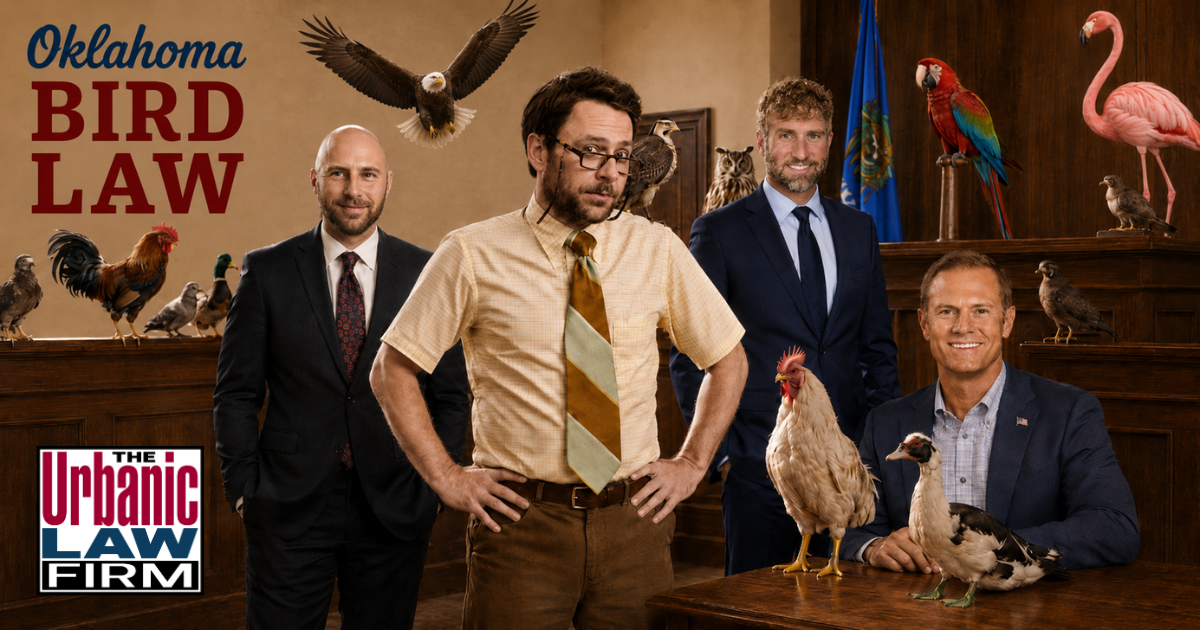
 Charlie Kelly, in the hit comedy show It’s Always Sunny in Philadelphia, claims he’s “the best goddamn bird lawyer in the world.” The lawyers at The Urbanic Law Firm would object to that statement—at least when it comes to bird law in Oklahoma. When police or prosecutors are building an Oklahoma bird-law case against you, The Urbanic Law Firm knows how to handle suspected fowl play. That matters because when cockfighting, migratory birds, quail, endangered species, nests, eggs, feathers, or bird parts start showing up in a case, bird law can become something far more serious than a crazy plot hatched on a sitcom.
Got a Bird-Related Charge?
Because these cases can mix wildlife rules, animal-crime laws, and search issues, early help can matter. We’re the foremost authority on bird law in Oklahoma. Call us at 405-633-3420 or use our secure online form.
What Oklahoma Bird Law Means
Charlie Kelly claims, “Bird law in this country, it’s not governed by reason.” However, Oklahoma bird law is real enough to turn roosters, feathers, nests, eggs, and hunting mistakes into criminal allegations.
Oklahoma doesn’t have one neat “bird law” chapter. Instead, bird-related crimes pop up in animal laws and wildlife laws. So, the exact charge depends on the bird, the conduct, and the legal status of the species.
In It’s Always Sunny in Philadelphia, bird law works best as chaos in a suit. In Oklahoma, it works through statutes. For example, a rooster-fighting case can raise Oklahoma cockfighting crimes. Meanwhile, a duck, goose, quail, hawk, owl, eagle, nest, egg, feather, or mounted bird may point toward bird hunting violations, protected-species violations, or wildlife possession and sale violations.
Cockfighting: The Most Obvious Oklahoma Bird Crime
If Charlie Kelly walked into court yelling about bird law, cockfighting would probably be Exhibit A. Oklahoma treats cockfighting crimes seriously. In addition, several different roles around the same fight can create separate criminal exposure.
Instigating or Encouraging a Cockfight
Instigating or encouraging a cockfight under 21 O.S. § 1692.2 targets conduct that pushes the fight forward. However, the State still has to prove the act and the required mental state.
Keeping a Place, Equipment, or Facilities for Cockfighting
Keeping a place, equipment, or facilities for cockfighting under 21 O.S. § 1692.3 focuses on the setup. Because prosecutors may point to pens, pits, cages, or gear, possession and purpose often become key fights.
Servicing or Facilitating a Cockfight
Servicing or facilitating a cockfight under 21 O.S. § 1692.4 can cover acts that help the event happen. For example, the State may look at promotion, handling, judging, or other alleged services.
Owning, Keeping, Possessing, or Training a Fighting Bird
Owning, possessing, keeping, or training a bird for fighting under 21 O.S. § 1692.5 can turn on what the bird was allegedly for. So, ordinary poultry facts and fighting-bird allegations can matter a lot.
Spectator at a Cockfight
Being a spectator at a cockfight under 21 O.S. § 1692.6 isn’t treated like the main felony cockfighting offenses. Still, it can create a misdemeanor case if the State proves knowing presence and the required intent.
Cockfighting Punishments
Under 21 O.S. § 1692.8, the main cockfighting offenses can be Class B5 felonies. They can carry one to ten years in prison, a $2,000 to $25,000 fine, or both. However, the spectator offense carries up to one year in county jail, up to a $500 fine, or both. The role the State claims you played can change the punishment.
Finally, lawful bird hunting, lawful falconry, and ordinary poultry production don’t become cockfighting just because birds are involved. Charlie Kelly may trust vibes. Oklahoma courts need proof.
Hunting, Game Birds, and Protected Birds
Oklahoma bird law also covers the outdoors. Because bird hunting rules can depend on species, season, method, bag limit, and permission, a lawful-looking hunt can become a wildlife case when one required detail is missing.
Migratory Bird Violations
Migratory bird violations under 29 O.S. § 5-406 can involve ducks, geese, brant, and other migratory birds. However, state law ties those cases to federal rules, treaty obligations, and annual limits.
Double-Crested Cormorant Issues
Double-crested cormorant nuisance violations under 29 O.S. § 5-406.1 sound strange. The statute calls the bird a nuisance. However, that label doesn’t give you a free pass to freelance your own control plan.
Quail Violations
Quail violations under 29 O.S. § 5-407 can involve the method used and the time of day. In addition, quail cases may turn on whether the conduct fit the allowed hunting methods.
Game-Bird Nest or Egg Violations
Taking or destroying nests or eggs of game birds under 29 O.S. § 5-207 reaches more than shooting a bird. Because nests and eggs can count, the evidence may focus on what you touched, moved, kept, or destroyed.
Hawk, Falcon, Owl, and Eagle Violations
Hawk, falcon, owl, and eagle violations under 29 O.S. § 5-410 can include molesting, injuring, or killing those birds. Also, the law addresses nests, eggs, and young birds. That’s a lot of bird law for one statute.
Endangered or Threatened Species Violations
Endangered or threatened species violations under 29 O.S. § 5-412 can involve possessing, hunting, chasing, harassing, capturing, shooting at, wounding, killing, taking, attempting to take, or trapping covered species. However, written permission and federal-law overlap can affect the analysis.
Bird Possession, Sale, Feathers, and Parts
Bird law doesn’t always start with a shotgun. Sometimes it starts with feathers, wings, taxidermy, eggs, parts, online listings, or a freezer. Therefore, possession and sale rules can matter even when nobody saw a hunt.
Wildlife Sale and Protected-Bird Part Violations
Unlawful buying, bartering, trading, or selling protected fish or wildlife under 29 O.S. § 7-503 can involve all or part of a protected bird. It can also involve a protected bird’s nest or eggs. So, the State may focus on the item, not just the hunting event.
Wild-Bird Feather, Plume, Wing, and Skin Violations
Illegal importation, sale, or possession for sale of certain wild-bird parts under 29 O.S. § 7-504 can involve aigrettes, egret plumes, feathers, quills, heads, wings, tails, skins, or parts of skins. However, the law also contains exceptions, so details matter.
Animal Cruelty and Cemetery Bird Law
Because birds are animals, some cases can move outside the hunting code. Oklahoma also has older animal-law provisions that can apply to bird facts. Not every bird case is a hunting case.
Wounding or Trapping Birds in a Cemetery
Wounding or trapping birds within a cemetery or burying ground under 21 O.S. § 1684 sounds like the most Charlie Kelly statute in Oklahoma. However, it addresses birds, nests, eggs, young birds, and buying or selling birds killed or trapped in violation of that law.
Animal Cruelty Involving Birds
Animal cruelty under 21 O.S. § 1685 can apply when the State claims a bird was tortured, cruelly injured, deprived of care, or killed under facts covered by the law. Because the statute reaches animals in subjugation or captivity, poultry and kept birds can raise different issues than wild birds.
Defense Issues in Oklahoma Bird Law Cases
A bird-law case can feel absurd. It’s Always Sunny in Philadelphia gets laughs from that absurdity. However, the State still has to prove the exact conduct, the exact bird, and the exact legal rule.
First, species identification can matter. A duck, quail, eagle, owl, rooster, chicken, cormorant, or songbird can point to different laws. Also, parts, feathers, nests, and eggs may create proof problems.
Second, permission, season, license, method, and location can matter. Because some laws allow conduct under specific conditions, the defense may focus on what the rule allowed at that time.
Third, searches can matter. Wildlife evidence may come from vehicles, land, phones, social media, freezers, barns, sheds, or online posts. If officers overstepped, suppression issues may shape the case.
Finally, intent can matter. The difference between lawful poultry, lawful hunting gear, taxidermy, accidental contact, and a charged offense may depend on what the State can actually prove.
Key Terms
Cockfight or Cockfighting
“Cockfight” or “cockfighting” is a fight between birds, whether or not fitted with spurs, knives, or gaffs, and whether or not bets or wagers are made on the outcome of the fight, and includes any training fight in which birds are intended or encouraged to attack or fight with one another. (21 O.S. § 1692.1) In this topic, the definition keeps the focus on fighting birds, not ordinary poultry facts.
Equipment Used for Training or Handling a Fighting Bird
“Equipment used for training or handling a fighting bird” includes knives or gaffs, cages, pens, feeding apparatuses, training pens and other related devices and equipment, and is declared contraband and subject to seizure. (21 O.S. § 1692.1) Because gear can become evidence, the purpose and use of the item can become a central dispute.
Game Bird
“Game bird” means a bird species normally sought after by sportsmen and includes brant, cranes, doves, ducks, gallinules, geese, grouse, partridge, pheasant, quail, prairie chickens, rails, snipes, swans, tinamous, wild turkeys, woodcock, and any part thereof. (29 O.S. § 2-114) For bird-law cases, that list helps separate ordinary wildlife talk from legally regulated game-bird issues.
Hunting or Taking
“Hunting or taking” means pursuing, killing, capturing, trapping, snaring and netting wildlife, and all lesser acts such as disturbing, harrying or worrying, or placing, setting, drawing, or using any net, trap or other device commonly used to take wildlife, whether resulting in taking or not; it includes every attempt to take and every act of assistance to every other person in taking or attempting to take wildlife. (29 O.S. § 2-118) In bird-law cases, conduct short of actually killing a bird may still draw attention.
Specific Intent
Specific intent means deliberate purpose to accomplish the consequences. (jury instruction 2-14) For attempted bird-law allegations, purpose can matter more than a bad-looking setting.
FAQs About Oklahoma Bird Law
Is Oklahoma bird law a real crime topic or just an It’s Always Sunny in Philadelphia joke?
It’s both a funny reference and a real legal topic. Charlie Kelly may have called himself “the best goddamn bird lawyer in the world,” but Oklahoma bird law can involve actual criminal allegations about cockfighting, protected birds, game birds, bird parts, nests, eggs, hunting methods, possession, and sale.
Can Oklahoma cockfighting charges be felonies?
Yes. Oklahoma cockfighting cases can include felony allegations when the State claims someone encouraged a fight, kept a place or equipment for it, facilitated it, or owned, kept, possessed, or trained a bird for fighting. A spectator allegation is treated differently.
Can I hunt with a falcon in Oklahoma?
Generally, yes it is legal to use a falcon for hunting in Oklahoma. However, you need to follow the state’s falconry provisions under 29 O.S. § 5-206, plus any licensing, season, bag-limit, species, and Wildlife Department rules that apply. Because falconry can overlap with Oklahoma small game and bird hunting violations and protected species hunting violations, the legal issue usually isn’t just whether you used a falcon. It’s whether you had the right authority, hunted the right species, stayed in season, and followed the rules.
Can an Oklahoma protected-bird crime happen if I didn’t shoot anything?
Yes. Depending on the law, Oklahoma protected-bird cases can involve molesting, injuring, possessing, harassing, capturing, attempting to take, trapping, selling, or keeping certain birds or bird parts. Shooting isn’t always required.
Can Oklahoma bird law crimes be expunged?
Maybe. Expungement depends on the exact charge, outcome, prior record, waiting period, and other facts. You can learn more about record clearing on our Oklahoma expungement law page.
This page is for informational purposes only and is not legal advice. Every case is unique; consult an attorney about your specific situation. Law last reviewed on June 9, 2026 by attorney Frank Urbanic. Page last updated June 9, 2026. Review the statutes cited on this page for the most current version of the law.