Receiving or Concealing Stolen Property Defense in Oklahoma
 A receiving or concealing stolen property charge can look simpler than a theft case at first. It often isn’t. The State doesn’t have to prove you were the original thief. Instead, prosecutors usually try to prove you took control of property after the theft, or helped hide it, while knowing or at least allegedly having enough warning signs to know it was stolen.
This page fits inside our broader theft and property crimes section and our narrower stolen property page cluster. If you’re facing this accusation, the details matter. Value matters. Control matters. Messages, marketplace posts, serial numbers, and how police found the item can all matter too.
Quick links
- How the law works
- What the State must prove
- Penalties
- Collateral consequences
- How prosecutors try to prove it
- Practical guide
- What happens next
- Key terms
- FAQs
- Important news example
- Important cases
Talk to The Urbanic Law Firm about receiving or concealing stolen property charges
If you’ve been accused of receiving or concealing stolen property in Oklahoma, reach out for a free consultation before you try to talk your way out of it. Early moves can shape the whole case, especially when police are relying on online listings, text messages, statements, or possession of the item itself. Call us at 405-633-3420 or use our secure online form.
How Oklahoma law defines receiving or concealing stolen property
Under 21 O.S. § 1713, Oklahoma can charge you if the State says you bought or received personal property worth at least $1,000 that was stolen, embezzled, obtained by false pretense, or obtained by robbery, and you knew or reasonably should have known that. The same law also reaches concealing, withholding, or helping hide that property from the owner.
When the claimed value is below $1,000, the charge stays a misdemeanor. Once the claimed value reaches $1,000, it becomes a felony and the class changes by value bracket. These cases also get filed beside burglary, larceny-related counts, vehicle-theft allegations, or embezzlement charges when prosecutors say the property came from some other underlying crime.
What the State has to prove
If the charge is receiving stolen property
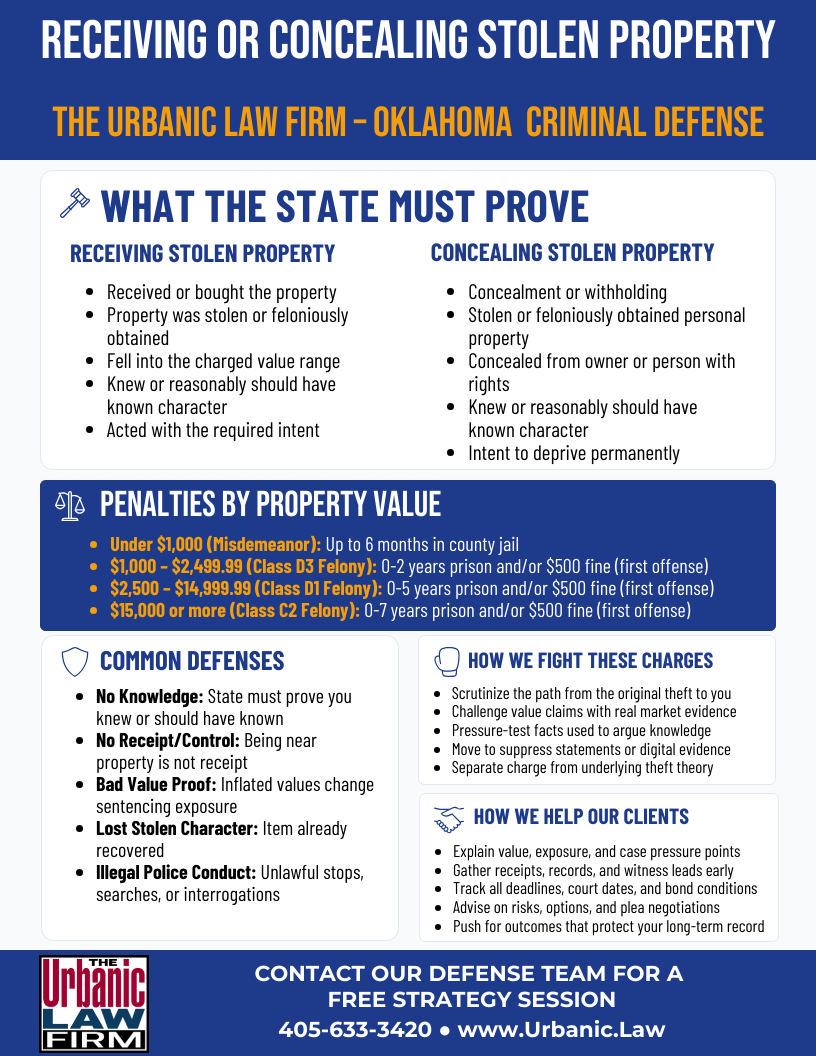
Under jury instruction 5-111, prosecutors generally must prove that you received or bought the property, that the property was stolen or otherwise feloniously obtained, that it fell into the charged value range, that you knew or reasonably should have known its character, and that you acted with the required intent.
If the charge is concealing stolen property
Under jury instruction 5-113, prosecutors generally must prove concealment or withholding, stolen or otherwise feloniously obtained personal property, concealment from the owner or a person with possessory rights, knowledge or circumstances showing you reasonably should have known the property’s character, and intent to deprive permanently.
Receiving or concealing stolen property penalties in Oklahoma
The punishment depends mainly on the value prosecutors assign to the property. That value fight can change the whole case.
- Property valued under $1,000.
- This is a misdemeanor.
- County jail: up to 6 months.
- Fine: the misdemeanor subsection itself does not set a separate fine in this statute.
- Property valued from $1,000 to $2,499.99.
- This is a Class D3 felony under 21 O.S. § 20P.
- First conviction: 0 to 2 years in the Department of Corrections and/or up to $500.
- Second or third conviction: 1 to 4 years and/or up to $500.
- Additional subsequent conviction: 1 to 10 years and/or up to $500.
- Property valued from $2,500 to $14,999.99.
- This is a Class D1 felony under 21 O.S. § 20N.
- First conviction: 0 to 5 years and/or up to $500.
- Second or third conviction: 2 to 7 years and/or up to $500.
- Additional subsequent conviction: 2 to 10 years and/or up to $500.
- Property valued at $15,000 or more.
- This is a Class C2 felony under 21 O.S. § 20M.
- First conviction: 0 to 7 years and/or up to $500.
- Second or third conviction: 2 to 10 years and/or up to $500.
- Additional subsequent conviction: 2 to 12 years and/or up to $500.
- Enhancement risk.
- If prosecutors claim qualifying prior felony convictions, they may also push for enhancement under 21 O.S. § 51.1. You can read more in our Oklahoma sentence enhancement guide.
Collateral consequences
- A theft-related conviction can make employers treat you as untrustworthy, especially for jobs involving cash, inventory, keys, tools, or access to homes and vehicles.
- A felony conviction can trigger longer-term limits on firearms rights, licensing, and some housing opportunities.
- Courts often order restitution, and that financial pressure can last long after the criminal case ends.
- Probation conditions can include reporting, fees, drug testing, employment requirements, and no-contact or property-return orders.
- If the case is tied to other allegations, the record can complicate plea talks, future bond requests, and later expungement options.
How prosecutors try to prove a receiving or concealing stolen property case
- They use serial numbers, receipts, owner markings, pawn records, screenshots, and photos to tie a specific item to a specific owner.
- They point to a price that looks too low, a rushed sale, or a suspicious story about where the property came from.
- They rely on texts, Facebook Marketplace messages, call logs, and interview statements to argue knowledge or control.
- They may lean on jury instruction 5-112 to argue that recent possession, plus other suspicious facts, supports guilt. Still, possession alone shouldn’t end the case.
- They often stack the case with allegations tied to the source of the property, such as burglary, larceny from a building or other larceny counts, or vehicle-theft related charges.
Practical guide
Questions to ask your attorney
- Can the State really prove I knew, or reasonably should have known, the property was stolen?
- What evidence actually shows I received, controlled, concealed, or withheld the item?
- How strong is the State’s value evidence, and can that reduce the charge level?
- Were the search, seizure, interview, or phone review lawful?
- What outcome best protects my record and future expungement options?
Things you can do if you’re arrested for this crime
- Stay off the phone about the facts except with counsel. Casual explanations can become State exhibits.
- Save marketplace posts, receipts, texts, screenshots, and account records before they disappear.
- Write down where the item came from, who handled it, and when you first saw it while the timeline is fresh.
- Do not contact the alleged owner, seller, or witnesses to try to fix the story yourself.
- Bring charging papers, bond paperwork, and any property records to your consultation.
Defenses
- No knowledge. The State still has to prove you knew, believed, or reasonably should have known the property was stolen.
- No receipt or control. Being near property is not the same as receiving it or exercising dominion and control over it.
- Bad value proof. If the State inflates value, the charging level and sentencing exposure can change.
- Property lost its stolen character. If the item had already been recovered and used in a controlled handoff, the completed offense may be harder to prove.
- Illegal police conduct. A bad stop, unlawful search, or improper interrogation can weaken or suppress core evidence.
How we fight these charges
- Scrutinize the path from the original theft to the item police say ended up with you.
- Challenge value claims with real market evidence, depreciation, and better records.
- Pressure-test every fact the State uses to argue knowledge, including price, condition, serial numbers, and marketplace messages.
- Move to suppress statements, searches, or digital evidence when officers crossed constitutional lines.
- Separate this charge from the underlying theft theory when prosecutors try to turn suspicion into a broader narrative.
What The Urbanic Law Firm does to help clients charged with this crime
- Explain the value bracket, the likely exposure, and the immediate pressure points in the case.
- Collect receipts, marketplace records, ownership documents, screenshots, and witness leads early.
- Track deadlines, court settings, discovery, and bond conditions so nothing gets missed.
- Communicate clearly about risk, options, and whether dismissal, reduction, diversion, or plea negotiations make sense.
- Push for outcomes that protect both the short-term case and the long-term record whenever the facts allow.
What happens next
Most cases move through arraignment, bond conditions, discovery, negotiation, and then either motions, plea, or trial. Along the way, the value of the property, the source of the item, and your statements can shape everything. For a more detailed overview of the criminal process in Oklahoma, you can read more in our Oklahoma criminal process guide.
Key terms
Receiving
Receiving means gaining possession of property through an exercise of dominion and control over the property, without regard to whether there is manual possession. That point matters because the State still has to show actual control, not just proximity. (jury instruction 5-114)
Concealing
Concealing means hiding or secreting to prevent discovery. In this kind of case, that definition helps separate mere presence from conduct that actually keeps property away from its owner. (jury instruction 5-114)
Personal property
Personal property means money, goods, chattels, effects, evidences of rights in action, and written instruments effecting a monetary obligation or right or title to property. That definition matters because this offense is aimed at property in that category, not just any disputed item. (21 O.S. § 103 & jury instruction 5-114)
Stolen
Stolen means obtained through larceny, and larceny is the taking and carrying away of personal property of another by fraud or stealth, and with the intent to deprive permanently. That matters because the State must still prove the property had the right kind of unlawful origin. (21 O.S. § 1701 & jury instruction 5-114)
With intent to deprive permanently
With intent to deprive permanently means a purpose to deny property to its rightful owner or possessor forever. That issue can matter when the defense is that you meant to return the item or turn it over rather than keep it hidden. (jury instruction 5-114)
FAQs about receiving or concealing stolen property in Oklahoma
What does receiving or concealing stolen property mean in Oklahoma?
It usually means prosecutors claim you took control of property after it was stolen, or helped hide it from the owner, while knowing or allegedly having enough warning signs to know it was stolen.
Do prosecutors in Oklahoma have to prove I knew the property was stolen?
Yes. Knowledge is a core issue. The fight is often over whether you actually knew, believed, or reasonably should have known the item was stolen based on the surrounding facts.
Is receiving or concealing stolen property in Oklahoma always a felony?
No. If the property value is under $1,000, the charge is a misdemeanor under this statute. Once the claimed value reaches $1,000, the case can become a felony and the class changes by value range.
Can I be charged in Oklahoma if I never stole the property myself?
Yes. Receiving stolen property and theft are separate theories. The State may claim you were not the original thief but still knowingly received or concealed the property afterward.
Can a receiving or concealing stolen property case be expunged in Oklahoma?
Sometimes, yes. Eligibility depends on the final result, your record, and how much time has passed. For a fuller overview, read our Oklahoma expungement law guide.
Important Oklahoma news example
According to a January 14, 2026 KTUL report, police said a stolen $1,500 tool was listed online and the seller was booked on a knowingly concealing stolen property charge. That fact pattern shows why these cases often turn on value, identifying marks, online messages, who controlled the item, and whether prosecutors can prove you knew the property was stolen rather than simply passed through your hands.
Important cases
In Hair v. State, 1956 OK CR 28, 294 P.2d 846, the court explained that when a person was really part of the original taking and the thief never gave up possession, the proper theory is theft rather than receiving stolen property. That can matter when prosecutors try to split one story into two different crimes.
In Booth v. State, 1964 OK CR 124, 398 P.2d 863, the court said the property must still have its stolen character at the time it is received. If the owner or police already recovered the item and then used it in a controlled handoff, the argument may shift away from a completed receiving offense.
Serving Clients Statewide
Oklahoma County, Payne County, Cleveland County, Canadian County, Tulsa County, Logan County, Lincoln County, Pottawatomie County, and all others
Oklahoma City, Stillwater, Moore, Norman, Del City, Edmond, Mustang, El Reno, Lawton, Kingfisher, Valley Brook, Guthrie, Tulsa, Yukon, Midwest City, Choctaw, and all others
This page is for informational purposes only and is not legal advice. Every case is unique; consult an attorney about your specific situation. Page last updated April 18, 2026. Consult the statutes listed above for the most up-to-date law.

Oklahoma Bird Law Attorneys: The Urbanic Law Firm v. Charlie Kelly

Banging More Than the Gavel! Another Judge Sex Scandal Raises Oklahoma Criminal Law Questions

Stick a fork in him! Brent Swadley convicted: Oklahoma post-trial sentencing procedure explained

When Workplace Retaliation Leads To Harm

Brent Swadley Trial Analysis: False Claims & Conspiracy to Defraud State Explained
| THIS OFFENSE IN THE NEWS |