False Pretenses in Oklahoma: Law, Penalties, & Defenses
 A false pretenses accusation usually starts with a claim that someone used a lie, trick, bogus check, fake document, or misleading setup to get money, property, or something valuable. However, the State still has to prove more than a bad deal. It has to prove a knowing deception and an intent to cheat and defraud.
This guide is for people accused of false pretenses in Oklahoma and trying to understand the charge, possible punishment, and defense options before court. Because these cases often start with business records, text messages, invoices, checks, contracts, or store records, early review can change how the case develops.
Quick links
Talk through your false pretenses case early
If you’ve been accused of false pretenses in Oklahoma, reach out for a free consultation before you explain records, texts, checks, or payments to anyone else. Early defense work can protect the difference between a civil dispute and a criminal fraud case.
An Oklahoma false pretenses defense attorney can review the alleged value, the claimed deception, and the evidence of intent before court dates start shaping the case. Call us at 405-633-3420 or use our secure online form.
Can false pretenses be a felony in Oklahoma?
Yes. The penalty depends mostly on the value involved and your prior record. If the value is under $1,000, the charge is usually a misdemeanor. However, when the value reaches $1,000 or more, it can become a felony with prison, a fine, and restitution.
Explanation of the law
Oklahoma’s false pretenses law covers obtaining or attempting to obtain money, property, or a valuable thing by a trick, deception, false representation, false statement, pretense, confidence game, false or bogus check, false instrument, or spurious coin (21 O.S. § 1541.1). The core issue is whether the State can prove a dishonest plan at the time of the transaction.
This charge often overlaps with Oklahoma fraud and deception crimes. It also fits naturally with The Urbanic Law Firm’s guide to property, services, and check fraud, because many cases turn on whether someone got money, merchandise, services, or title through a claimed deception.
Because the law covers several methods, the State doesn’t always need one direct false statement. For example, prosecutors may focus on a setup, a misleading transaction, a returned check, or a confidence-based pitch. In addition, they may add forged instruments, false or bogus checks, identity and impersonation crimes, grand larceny, or receiving or concealing stolen property if the same paperwork suggests more than one offense.
Key elements the state must prove
The jury instructions break this charge into concrete parts. If one required part is missing, the case has a real weakness.
- Obtained title or attempted to obtain title
- For a completed charge, the State must prove you obtained title to money, property, or a valuable thing.
- For an attempt, the State must prove you tried to obtain title.
- Money, property, or a valuable thing of another
- The State must prove the property belonged to someone else.
- In addition, the State must prove the value tier that makes the charge a misdemeanor or felony.
- A deceptive method
- The alleged method can include a trick or deception, false representation, confidence game, false check, false written or printed instrument, or spurious coin.
- Knowledge that the method was false, spurious, or deceptive
- A mistake, misunderstanding, or failed business plan isn’t enough by itself.
- Intent to cheat and defraud
- The State must prove the intent existed when the property or title was obtained or attempted.
For felony cases, the elements come from jury instruction 5-38 and jury instruction 5-39. For misdemeanor cases, the elements come from jury instruction 5-41 and jury instruction 5-42.
Penalties
The result turns on value, prior felony history, and whether prosecutors charge a completed act or an attempt. Value is often the fight that changes the whole sentencing range.
The felony value levels come from 21 O.S. § 1541.2. Because felony classes now control sentencing ranges, the class statutes matter too.
- Less than $1,000 — misdemeanor
- Jail: 0–1 year
- Fine: $0–$1,000
- Other: possible restitution and court costs
- $1,000–$2,499.99 — Class D3 felony
- Class: Class D3 felony under 21 O.S. § 20P
- Prison: 0–2 years for a first conviction
- Fine: $0–$5,000
- Minimum time served: 10% for a first conviction; higher percentages can apply with prior felony convictions
- $2,500–$14,999.99 — Class D1 felony
- Class: Class D1 felony under 21 O.S. § 20N
- Prison: 0–5 years for a first conviction
- Fine: $0–$5,000
- Minimum time served: 20% for a first conviction; higher percentages can apply with prior felony convictions
- $15,000 or more — Class C2 felony
- Class: Class C2 felony under 21 O.S. § 20M
- Prison: 0–7 years for a first conviction
- Fine: $0–$5,000
- Minimum time served: 20% for a first conviction; higher percentages can apply with prior felony convictions
In felony cases, prior felony convictions can change sentencing under 21 O.S. § 51.1. So, the defense has to review the prior-record allegations and the State’s proof of identity, finality, and timing. You can read more about how prior convictions can change sentencing on our Oklahoma sentence enhancement page.
Collateral consequences
A conviction can follow you outside court. Other consequences can matter even when the courtroom punishment is limited.
- Background checks can show a theft-like or fraud-like conviction to employers.
- Professional licensing boards may ask about fraud-related convictions.
- Restitution, costs, and supervision fees can create long-term financial pressure.
- Noncitizens may face immigration review because fraud allegations can carry serious consequences.
- Business relationships, security clearances, and financial credibility can suffer.
How prosecutors prove false pretenses
Prosecutors usually build these cases with records, witnesses, and timing. They try to show the deception existed before the money or property changed hands.
- Statements from the alleged victim about what they believed and why they transferred money or property.
- Texts, emails, invoices, checks, contracts, receipts, bank records, or store records.
- Value evidence showing whether the case falls under a misdemeanor or felony tier.
- Returned-check notices, account records, and communications about payment.
- Conduct before and after the transaction that prosecutors claim shows intent to cheat and defraud.
However, the same records can also help the defense. A written agreement, partial performance, refund efforts, confusing terms, or inconsistent witness statements can weaken the State’s intent theory.
Practical guide if you’re charged with this crime
What we look for first in a false pretenses case
We first look at what was said, when it was said, what changed hands, and what proof shows your intent at that moment. The first defense question is often whether the case is really criminal fraud or a disputed transaction.
Defenses
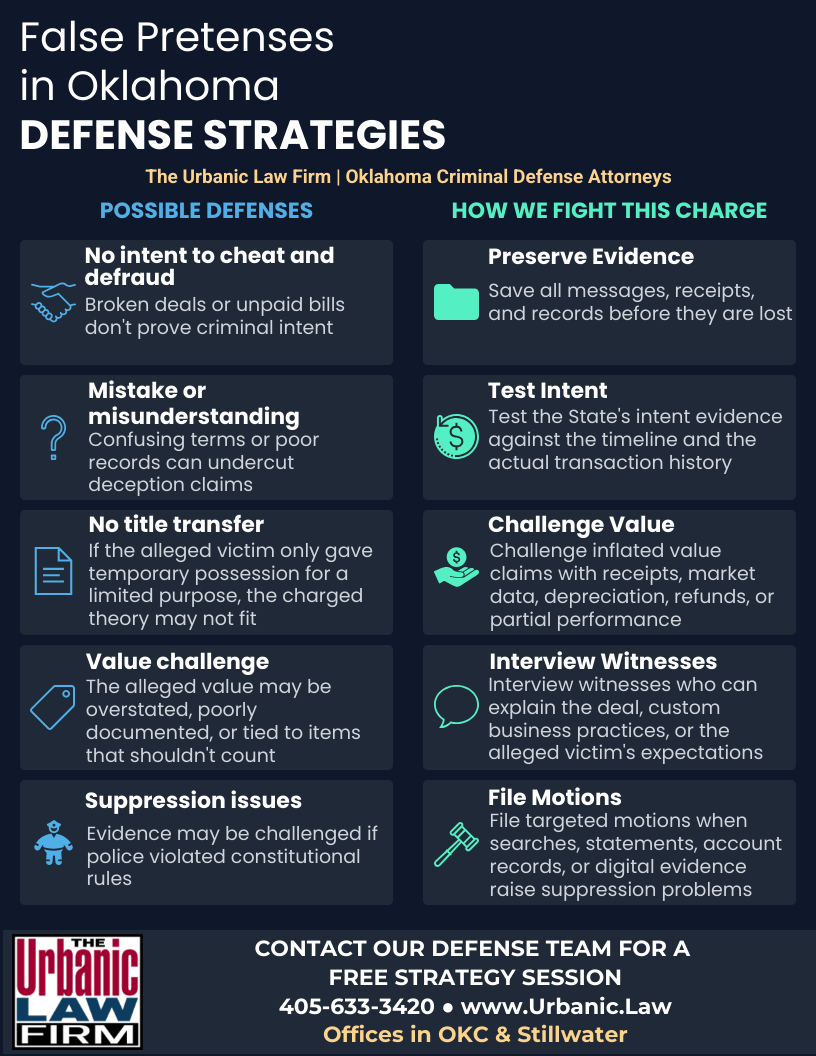
- No intent to cheat and defraud: A failed promise, unpaid bill, or broken deal doesn’t automatically prove criminal intent.
- Mistake or misunderstanding: Confusing terms, poor communication, or incomplete records can undercut the claim of knowing deception.
- No title transfer: If the alleged victim only gave temporary possession for a limited purpose, the charged theory may not fit.
- Value challenge: The alleged value may be overstated, poorly documented, or tied to items that shouldn’t count.
- Suppression issues: Statements, phone data, account records, or seized documents may be challenged if police violated constitutional rules.
How we fight these charges
- Preserve messages, invoices, receipts, bank records, shipping records, and refund communications before they disappear.
- Test the State’s intent evidence against the timeline and the actual transaction history.
- Challenge inflated value claims with receipts, market data, depreciation, refunds, or partial performance.
- Interview witnesses who can explain the deal, custom business practices, or the alleged victim’s expectations.
- File targeted motions when searches, statements, account records, or digital evidence raise suppression problems.
What The Urbanic Law Firm does to help
- Review the charging documents, probable-cause affidavit, discovery, and value allegations.
- Communicate with you about deadlines, court settings, evidence requests, and realistic options.
- Organize documents into a timeline that shows what happened before, during, and after the transaction.
- Coordinate witness information, records requests, and defense investigation tasks.
- Prepare you for court, hearings, and decisions that affect your record and future.
Questions to ask your attorney
- What exact element does the State’s evidence prove least clearly?
- How is the alleged value being calculated?
- Does the evidence show a transfer of title or only temporary possession?
- Are there search, seizure, statement, or digital-evidence problems?
- What outcome would protect my record, job, license, and finances best?
Things you can do if you’re arrested for this crime
- Stay quiet about the facts until you’ve talked with defense counsel.
- Save contracts, messages, invoices, bank records, receipts, and refund records.
- Avoid contacting the alleged victim unless your attorney says it’s safe.
- Write a private timeline for your attorney while details are fresh.
- Track every court date, release condition, and paperwork deadline.
An Oklahoma false pretenses defense lawyer can also evaluate whether a deferred sentence, suspended sentence, or probation issue could affect your strategy.
What happens next
After an arrest or filing, the case usually moves through arraignment, discovery, hearings, motions, and either a trial setting or another resolution. Because felony sentencing can change with priors, the punishment question often stays open until records are checked.
In felony cases, a preliminary hearing may test whether the State has enough evidence to move forward. However, many defense issues start before that hearing, especially when records, statements, and value estimates need review.
For a more detailed overview of the criminal process in Oklahoma, you can read more in our Oklahoma criminal process guide.
Comparison to other crimes
The exact charge matters because similar-looking conduct can carry different elements, value rules, and defense angles. This table compares false pretenses with related Oklahoma offenses that can appear in the same fact pattern.
| Offense | Core issue | Why classification matters | Common defense issue |
|---|---|---|---|
| False pretenses | Obtaining title to money, property, or a valuable thing through a trick, deception, false representation, confidence game, false check, false instrument, or spurious coin | Under $1,000 is a misdemeanor, while higher values create Class D3, D1, or C2 felony exposure | Intent, value, knowledge, title transfer, and whether the facts show a civil dispute instead of fraud |
| False or bogus checks | A check or order isn’t honored because of insufficient funds, a closed account, or a nonexistent account | Several checks or higher value claims can create felony risk and restitution pressure | Notice, payment history, account timing, bank error, and intent at the time the check was given |
| Forged instruments | A writing, instrument, or document is alleged to be false or altered | The focus shifts from deceptive sales conduct to the authenticity and use of the instrument | Authorship, permission, knowledge, handwriting, digital records, and whether the document was actually forged |
| Grand larceny | Taking property with the required theft intent, often without a title-transfer theory | The State may choose a theft theory when it believes the facts fit taking rather than a false transfer of title | Ownership, consent, value, identity, and whether the evidence fits the charged theory |
Key terms
False or bogus check or checks
A false or bogus check or checks includes checks, orders, or electronic-fund-transfer conversions that aren’t honored because of insufficient funds, a closed account, or a nonexistent account, when given for money, property, a benefit, a thing of value, a down payment with immediate possession, or lease or rental payment. In these cases, a returned-check theory can become the alleged deceptive method. Because payment timing matters, bank records and notice records can become central evidence. (21 O.S. § 1541.4)
Intent to defraud
Whenever an intent to defraud is required, it is sufficient if an intent appears to defraud any person, association, body politic, or corporate body, and the false-pretense definition describes intent to defraud as a scheme to take property so as permanently to deprive the owner. For a defense, the timing of that intent can be the whole case. Often, later nonpayment doesn’t prove what someone intended at the start. (21 O.S. § 110 & jury instruction 5-56)
Obtaining title
Obtaining title means inducing the owner to part with his or her rights in property permanently. A limited handoff for a specific purpose can create a different legal issue. For that reason, records showing what the alleged victim meant to transfer can matter a lot. (jury instruction 5-56)
Property
Property includes both real and personal property; real property includes every estate, interest, and right in lands, tenements, and hereditaments, and personal property includes money, goods, chattels, effects, evidences of rights in action, and written instruments affecting legal or financial rights. In false-pretense cases, the claimed property can be cash, merchandise, documents, rights, or other value. Also, the way the State labels the property can affect value and classification. (21 O.S. § 102, 21 O.S. § 103, 21 O.S. § 104 & jury instruction 5-56)
False token
Use of a matured check or other order as a means of obtaining a signature, money, or property, by a person who knows the drawer is not entitled to draw on the drawee for the sum specified, is the use of a false token. Put differently, a payment instrument can become the alleged false token when authorization or funds are missing. Meanwhile, the defense may focus on account access, credit, authorization, and timing. (21 O.S. § 1545 & jury instruction 5-56)
FAQs
What is false pretenses in Oklahoma?
False pretenses means the State claims you obtained or tried to obtain money, property, or a valuable thing through a trick, deception, false representation, confidence game, false check, false instrument, or spurious coin.
Is false pretenses a felony or misdemeanor in Oklahoma?
It depends on value. Under $1,000 is usually a misdemeanor, while $1,000 or more can be charged as a felony with different class levels.
Can Oklahoma charge false pretenses if I planned to pay the money back?
Yes, but your intent matters. If the evidence supports a good-faith plan to pay, perform, refund, or complete the deal, that can weaken the claim that you intended to cheat and defraud.
What defenses apply to an Oklahoma false pretenses charge?
Common defenses include lack of intent, mistake, weak proof of value, no title transfer, unreliable witnesses, incomplete records, and suppression problems involving statements or seized evidence.
Can an Oklahoma false pretenses conviction be expunged?
Possibly. Eligibility depends on the final result, sentence, criminal history, waiting period, and statutory category, so review Oklahoma expungement law before assuming the record can be cleared.
You can read more in our Oklahoma expungement guide.
Important cases
Oklahoma appellate cases show that false pretenses isn’t limited to one spoken lie. They also show why title transfer can become a major defense issue.
Broadway v. State, 1991 OK CR 113, 818 P.2d 1253, explains that the false-pretense statutes may be violated by a trick, deception, false representation, or pretense, not only by a direct false statement. In that case, the court found enough evidence where the defendant used deceptive conduct and statements to obtain money for roof work he didn’t perform.
Bartlett v. State, 1987 OK CR 33, 733 P.2d 1350, explains that obtaining property by false pretense is an offense against title, while larceny by fraud is an offense against possession. Because one alleged victim only transferred possession for a limited purpose, one conviction was reversed.
Example of this crime in the news
In a 2025 report from the Oklahoma Attorney General’s Office, Krysty Jean Scholes and Earl Wayne Salisbury were accused in a multi-county fraud scheme involving fraudulent checks, merchandise, stolen driver’s licenses, and impersonation. The report says they were charged with conspiracy to obtain property by false pretenses and obtaining property by false pretenses, among other counts. That kind of allegation shows how this charge can grow from a single transaction theory into a records-heavy case about checks, identity, value, and intent.
This page is for informational purposes only and is not legal advice. Every case is unique; consult an attorney about your specific situation. Law last reviewed on May 25, 2026 by attorney Frank Urbanic. Page last updated May 25, 2026. Review the statutes cited on this page for the most current version of the law.

Tulsa’s “Serial Defecator” Case: Legal Analysis of a Messy Situation

Oklahoma Discovery Law Changes: 2026–2027 Guide

Oklahoma Domestic Abuse Law Updates Nov. 1: Five Big Changes

Oklahoma Stalking Case Reversed: When a Post Isn’t Enough

Oklahoma DUI Aggregation Law: Can Two DUIs Become One Felony?
| THIS OFFENSE IN THE NEWS |