Cleveland County DUI Lawyers
 A DUI arrest in Cleveland County can put your freedom, driving privileges, and record at risk. The Urbanic Law Firm represents people facing DUI cases in this court, and early review can expose problems with the stop, testing, video, or the State’s impairment theory.
DUI defense in Cleveland County isn’t just about a breath or blood number. Officers may rely on driving, field sobriety tests, video, statements, chemical testing, or crash evidence. Because those pieces don’t always agree, they should be compared early.
This guide is for people accused of DUI in Cleveland County who are trying to understand the charge and find strong representation in court. It explains what can happen next, what the State may use as evidence, and what we examine when building a defense.
What should I do after a DUI arrest in Cleveland County?
After a DUI arrest in Cleveland County, make sure you know your next court date, protect any deadlines involving your driver’s license, and have the evidence reviewed as early as possible. A DUI case can involve two separate concerns: the criminal case filed in Cleveland County District Court and potential consequences for your Oklahoma driving privileges.
Early defense work may include obtaining body-camera and dash-camera video, reviewing the reason for the traffic stop, examining field sobriety testing, preserving other available recordings, and evaluating breath, blood, or toxicology evidence. The sooner that review begins, the easier it may be to identify evidence that could affect the State’s case.
Get Your Cleveland County DUI Case Reviewed Early
If you’ve been charged with DUI in Cleveland County, reach out for a free consultation. We can review what happened, identify evidence that may need to be preserved, and discuss the next court steps.
Fill out our secure online form so our attorneys can better understand your situation before we speak. You may also call us at 405-633-3420.
DUI Charges in Cleveland County
For alcohol cases, the State may rely on a blood or breath alcohol concentration of 0.08 or more, or it may try to prove you were under the influence. In drug or combined-influence cases, the issue may be whether the substance could render you incapable of safely driving. A lawful prescription doesn’t automatically defeat that allegation.
A standard first offense is a misdemeanor. However, qualifying prior DUI convictions can elevate the case to a felony. Current law also creates aggravated DUI when specified facts accompany the underlying DUI. For a deeper statewide discussion of the offense, see our Oklahoma misdemeanor and felony DUI guide.
What Happens After a DUI Case Begins in Cleveland County?
The next steps depend on whether the State files the DUI as a misdemeanor or felony. After an arrest or citation, the case can move through filing, a first setting, discovery, motions, and trial preparation. A felony can add a preliminary hearing before district-court arraignment.
We review reports, video, testing records, and witness information during discovery. Because some recordings have retention limits, early preservation can matter.
Practical Cleveland County Points
- If your case began with a traffic citation, Cleveland County states that the date on the ticket is a report date and isn’t automatically a date to see a judge unless that’s arranged with the District Attorney
- OSCN allows District Court traffic-citation searches by citation number, which can help you locate a filed case
- After you locate the case on OSCN, you can use its text-reminder feature for docket updates tied to that case
- The Cleveland County Court Clerk provides criminal-case records, so filed documents can be requested when you need the official record
These tools help you track a filed case. For broader court information, see our Cleveland County criminal court guide.
Penalties for DUI in Cleveland County
The punishment depends on the DUI classification, prior history, and aggravating facts. Oklahoma law also requires alcohol-and-drug assessment or treatment-related conditions in several DUI categories.
Standard DUI Sentencing Ranges
- Standard first DUI — misdemeanor
- Jail: 10 days to 1 year
- Fine: Up to $1,000
- Assessment: Alcohol-and-drug substance-abuse evaluation and compliance with treatment recommendations
- Qualifying repeat DUI — Class C2 felony
- Prison: Up to 7 years for a first Class C2 conviction; criminal history can increase the range
- Fine: Up to $2,500
- Additional conditions: Treatment requirements and ignition interlock
- DUI after a prior felony DUI — Class B4 felony
- Prison: 1 to 10 years
- Fine: Up to $5,000
- Additional conditions: Treatment, community service, and ignition interlock
- DUI after two prior felony DUIs — Class B3 felony
- Prison: 1 to 20 years
- Fine: Up to $5,000
- Additional conditions: Treatment, supervision, testing, community service, and ignition interlock
Aggravated DUI
Current aggravated DUI is a Class B3 felony and carries mandatory confinement tied to the underlying DUI category. For a first offense, the first 10 days of confinement can’t be suspended, deferred, or served on probation, although the statute permits nights or weekends in jail.
Driver’s License Issues
A DUI arrest can also create a separate driver’s-license problem. Oklahoma’s administrative process can move independently from the criminal prosecution, so review our Oklahoma DUI driver’s-license consequences page if your license is at risk.
How We Defend DUI Cases in Cleveland County
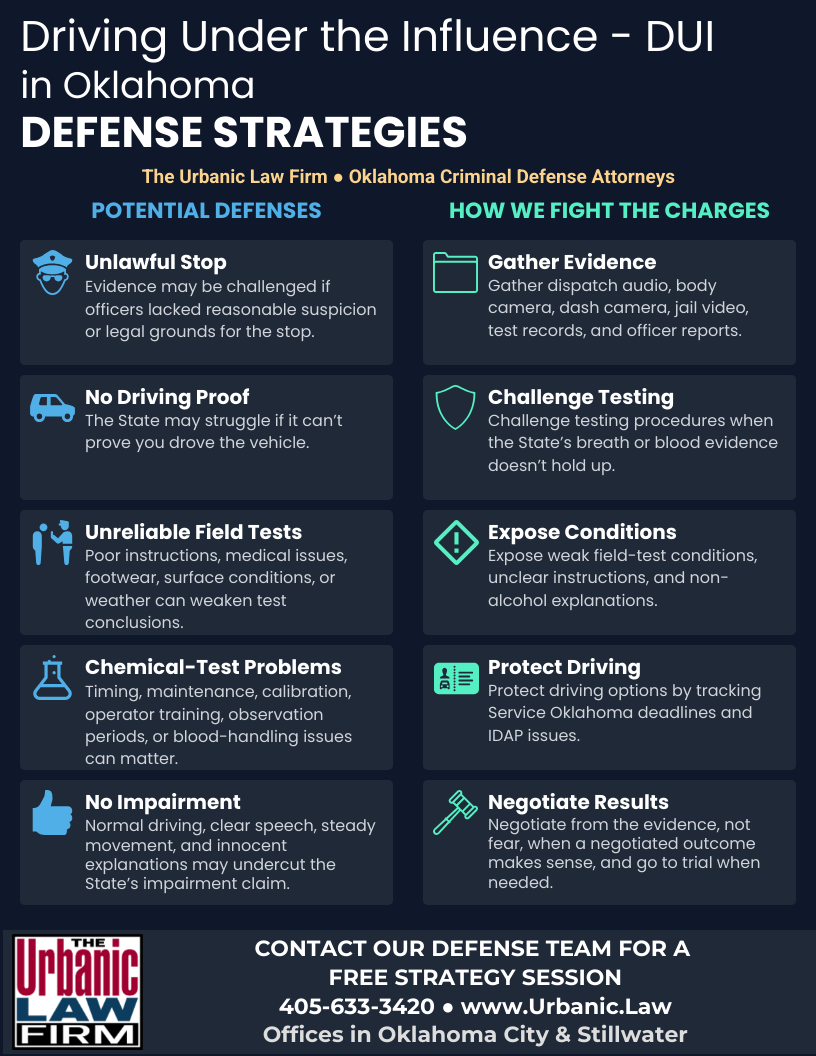
A DUI defense should test the State’s proof instead of treating the arrest report as the final word. A Cleveland County DUI attorney should compare the officer’s account with video, testing records, timing, medical information, and the charged theory.
Was the Stop and Detention Lawful?
A stop needs a lawful basis, and its length matters. An unjustified extension can support a suppression challenge.
Does the Video Match the Report?
Video can confirm some observations while contradicting others. We compare speech, balance, instructions, driving, timing, and the officer’s description.
Were Field Sobriety Tests Administered and Interpreted Properly?
Road surface, footwear, medical conditions, instructions, weather, and officer technique can affect field sobriety testing. Those details matter when the State claims test performance shows impairment.
Can the Chemical-Test Evidence Be Trusted?
Breath and blood cases raise different issues. We may examine collection, timing, device or laboratory records, chain of custody, and what the result actually proves.
Can the State Prove the Charged DUI Theory?
Drug cases can turn on whether substance evidence proves impairment. Actual-physical-control cases can raise different questions about control of the vehicle.
- Challenge an unlawful stop or prolonged detention when the facts support suppression
- Use video to test officer observations and identify differences between the recording and written report
- Examine field sobriety testing closely for instructions, conditions, administration, and interpretation
- Test breath, blood, or toxicology evidence against collection, analytical, timing, and reliability issues
- Require proof of the charged theory instead of assuming substance presence or unusual behavior proves DUI
What We Look for First in a DUI Case
We start with evidence most likely to define the case or disappear with time. We identify why police made contact, what recordings show, how testing occurred, and the charged DUI theory.
- The reason for the stop, detention, or police contact
- Body-camera, dash-camera, surveillance, and crash video
- Field sobriety instructions, conditions, performance, and scoring
- Breath-test records, blood documentation, laboratory reports, or toxicology
- The timeline between driving, arrest, testing, and any crash
- Medical conditions, injuries, prescriptions, and other explanations for observed behavior
- Prior DUI history because it can change classification and sentencing exposure
- License notices and administrative deadlines that may run separately from the criminal case
Evidence Commonly Used in DUI Cases in Cleveland County
Video and Officer Observations
Video can test what an officer says happened. It may show driving, speech, balance, instructions, and test conditions. However, camera angle or missing footage can limit what it proves.
Breath, Blood, and Toxicology
A number can look decisive, but testing evidence still needs a reliable collection and analysis process. Blood cases may involve laboratory and chain-of-custody records. Breath cases may involve device records and procedures.
Driving, Crash, and Third-Party Evidence
Driving, collision evidence, witnesses, surveillance, and medical records can add context. Because a crash doesn’t prove intoxication, we compare it with timing, injuries, and other explanations.
Why Choose The Urbanic Law Firm for a DUI Case in Cleveland County?
DUI cases benefit from counsel who understands both the law and police impairment testing. Frank Urbanic completed NHTSA field sobriety practitioner training, ARIDE, and the NHTSA SFST Instructor Course. He’s qualified as an SFST instructor.
He has also completed the Oklahoma State Bureau of Investigation Forensic Science Academy. That background helps us evaluate field testing, officer observations, toxicology, and forensic evidence from a defense perspective.
A Cleveland County DUI attorney should examine technical proof as carefully as the legal issues. The Urbanic Law Firm applies that training to your facts and court posture.
Frequently Asked Questions About DUI Cases in Cleveland County
Do I have to appear on the date shown on my Cleveland County DUI ticket?
If your case began with a traffic citation, Cleveland County says the printed date is a report date. Don’t ignore the date, and check the filed case for your instructions.
What’s different if my DUI is filed in Cleveland County as a felony?
A felony filing can add a preliminary hearing before district-court arraignment and creates felony sentencing exposure. Prior-conviction records and the charging basis become especially important, so the defense should verify the classification.
Can DUI evidence be suppressed in a Cleveland County case?
Yes, when the facts and law support it. An unlawful stop, prolonged detention, unconstitutional search, or other defect can create a suppression issue. The available argument depends on how police obtained the evidence.
How can I find my Cleveland County DUI court case?
OSCN provides District Court case searches, including a traffic-citation search by citation number. Once you locate your case, you can review docket entries and use the available text-reminder feature. The Cleveland County Court Clerk can also provide criminal-case records.
What should I bring to my lawyer for a DUI case in Cleveland Count?
Bring your citation, bond papers, court notices, driver’s-license documents, and testing paperwork. Also bring medications, relevant medical information, photos, videos, and a short timeline. If you have prior DUI cases, provide enough information to verify them.
About the Author: Attorney Frank Urbanic

Talk to a Cleveland County DUI Lawyer
The State still has to prove the DUI charge with admissible evidence. Early review can help identify video, testing, constitutional, classification, or procedural issues before the case moves further.
If you’re facing a DUI in Cleveland County, contact The Urbanic Law Firm for a free consultation about your next steps.
Fill out our secure online form so our attorneys can better understand your situation before we speak. You may also call us at 405-633-3420.
This page is for informational purposes only and is not legal advice. Every case is unique; consult an attorney about your specific situation. Law last reviewed on August 12, 2026 by attorney Frank Urbanic. Page last updated August 12, 2026. Review the statutes cited on this page for the most current version of the law.