Domestic Abuse by Strangulation Defense in Oklahoma
 A domestic abuse by strangulation charge is a felony. It also tends to scare judges and juries. That’s because the accusation usually involves pressure to the neck, blocked breathing, panic, and a claim that things could’ve turned deadly. If you’re researching this offense, it also helps to start with our domestic violence page and our broader assault, battery, and domestic abuse page.
Still, the charge isn’t automatic just because two people fought. The State still has to prove the relationship fits the law, that the conduct actually qualifies as strangulation or attempted strangulation, and that the evidence is reliable. In addition, prosecutors often stack this charge with other counts like kidnapping, feloniously pointing a firearm, violation of a protective order, interference with an emergency phone call, or domestic abuse in the presence of a child when the facts let them do it.
Quick links
- How the law works
- What the State must prove
- Penalties
- Collateral consequences
- How prosecutors try to prove it
- Practical guide
- What happens next
- Key terms
- FAQs
- Important cases
Talk to a defense lawyer about this charge
If you’ve been accused of domestic abuse by strangulation in Oklahoma, reach out for a free consultation before you make the case harder on yourself. Early choices matter. The police interview matters. Bond conditions matter. And the first version of events in the file can shape everything that follows. Call us at 405-633-3420 or use our secure online form.
How Oklahoma defines domestic abuse by strangulation
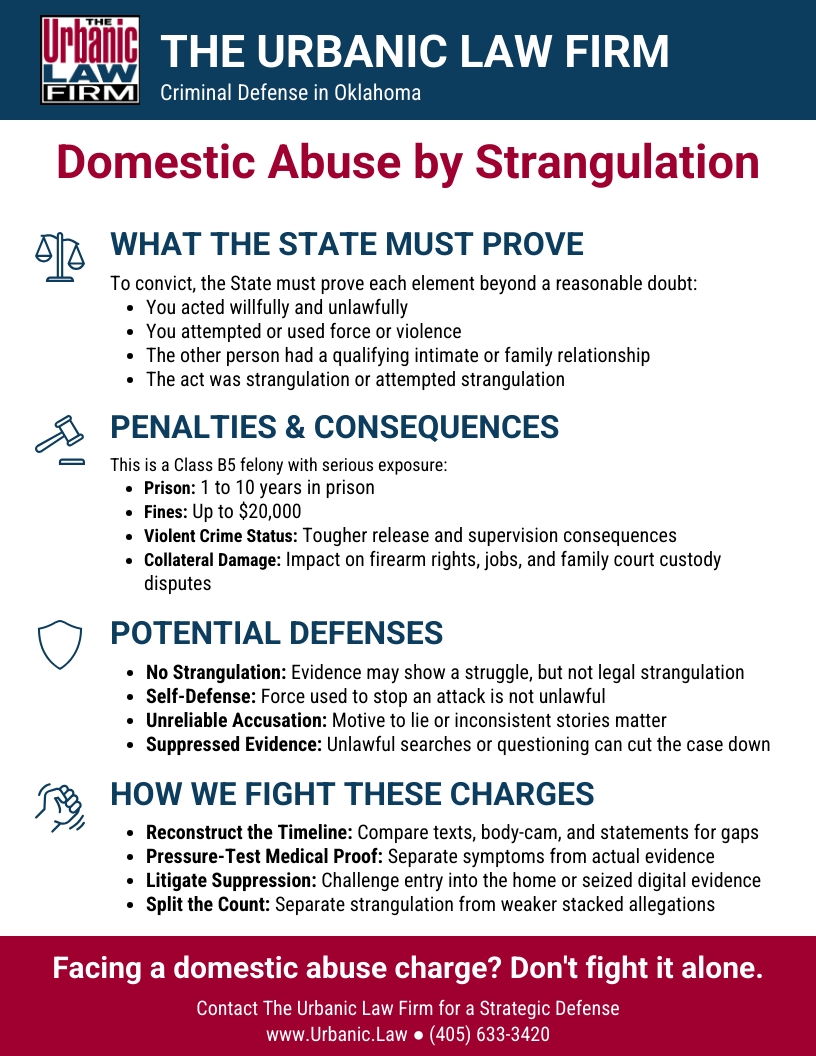
Under 21 O.S. § 644(J), a person commits domestic abuse by strangulation by committing an assault and battery by strangulation or attempted strangulation against an intimate partner or a family or household member defined in 22 O.S. § 60.1. The current law defines strangulation as a form of asphyxia, including pressure that closes blood vessels or air passages in the neck or pressure that closes the nostrils or mouth.
That means the case is about more than an argument. The prosecution is claiming force was used in a way that affected breathing or blood flow, or at least was an attempted strangulation. In practice, the alleged relationship matters too. A dating partner, current or former spouse, co-parent, relative, foster parent, child, or someone who lives or used to live in the household can fall inside the charge, depending on the facts.
What the State must prove
To convict you, the State has to prove each required part of the charge beyond a reasonable doubt. The fight in these cases often centers on one or two elements, not all of them.
- You acted willfully.
- You acted unlawfully.
- You attempted or offered to use force or violence.
- You used force or violence.
- The other person had a qualifying intimate-partner or family-or-household relationship to you.
- The act was strangulation or attempted strangulation.
Penalties
This offense is a Class B5 felony under 21 O.S. § 20J. Because it’s a felony, the sentencing exposure is serious from the start.
- Prison time
- A conviction carries 1 to 10 years in the Department of Corrections.
- Fine
- The court can also impose a fine of up to $20,000.
- Enhancement risk
- If you have qualifying prior felony convictions, sentence enhancement can become a major issue under 21 O.S. § 51.1. You can read more in our sentence enhancement guide.
- Violent-crime status
- Because this offense is listed as a violent crime in 57 O.S. § 571, release and supervision consequences can be tougher. You can read more in our violent crimes guide.
- Probation conditions
- If the court gives any suspended or deferred time, treatment, reviews, and strict compliance conditions can follow. Missing required domestic-violence programming can create new problems and put probation at risk.
Collateral consequences
- Protective orders, bond terms, and later firearm restrictions can become a major issue.
- Custody, visitation, and family-court disputes can get much harder.
- Jobs, professional licenses, and background checks can be affected by a violent felony record.
- Housing applications and private screening decisions can turn against you.
- Immigration consequences can be severe if you are not a United States citizen.
How prosecutors try to prove the case
- Victim testimony about pressure to the neck, blocked breathing, panic, dizziness, or loss of air.
- Photos, nurse-examiner records, ER notes, petechiae, redness, bruising, or neck pain complaints.
- 911 calls, hang-ups, body-cam, dispatch logs, and statements made near the event.
- Texts, calls, witness accounts, and other proof of the domestic relationship required for the charge.
Practical guide for people facing this charge
Questions to ask your attorney
- Does the evidence really show strangulation, or does it only show a struggle?
- Does the alleged relationship actually fit the domestic-abuse statute?
- What statements, body-cam, 911 audio, or medical records can be challenged?
- Are there related charges that can be separated, reduced, or beaten?
- What is the best path in this case: dismissal, reduction, negotiation, or trial?
Things you can do if you’re arrested for this crime
- Stay silent about the facts until your defense strategy is clear.
- Save texts, call logs, location data, photos, and names of witnesses before they disappear.
- Follow bond and no-contact conditions exactly, even if the other person reaches out first.
- Write down your timeline while your memory is still fresh.
- Get counsel involved before you agree to interviews, treatment terms, or informal explanations.
Defenses
- No strangulation happened. The evidence may show an argument or struggle, but not pressure that fits the legal definition.
- No qualifying domestic relationship existed. If the relationship does not fit the statute, the charged offense can be wrong.
- Self-defense or defense of another applies. Force used to stop an attack is not automatically unlawful.
- The accusation is unreliable. Inconsistent stories, motive to lie, alcohol use, or missing corroboration can matter a lot.
- Key evidence can be suppressed. Unlawful questioning, bad searches, or weak seizure practices can cut the case down fast.
How we fight these charges
- Reconstruct the timeline and compare every statement, text, dispatch entry, and body-cam clip for gaps.
- Pressure-test the medical proof and separate symptoms, assumptions, and actual evidence of strangulation.
- Challenge the domestic-relationship allegation when the facts do not cleanly fit the statute.
- Litigate suppression issues involving statements, entry into the home, phones, or seized digital evidence.
- Split the strangulation count away from stacked allegations like kidnapping, gun counts, or protective-order claims whenever the proof is weaker than the charging language.
What The Urbanic Law Firm does to help clients charged with this crime
- Explain the charge, the exposure, the bond terms, and the real risks in a way you can use.
- Appear in court, manage deadlines, and keep the case moving instead of letting it drift.
- Request the evidence early, including 911 audio, body-cam, medical records, and witness material.
- Prepare a defense plan built around the actual elements, not the label placed on the case.
- Communicate clearly about options, likely outcomes, and what needs to happen next at each stage.
What happens next in an Oklahoma case
Most cases start with arrest, booking, bond conditions, and a first court date. After that, the case usually moves into arraignment, discovery, motions, negotiation, and trial preparation. Because no-contact terms, treatment demands, and related charges can shape the case early, the first few settings matter more than many people expect.
For a more detailed overview of the criminal process in Oklahoma, you can read more in our Oklahoma criminal process guide.
Key terms
Strangulation
Strangulation means any form of asphyxia, including closure of the blood vessels or air passages of the neck, or closure of the nostrils or mouth, caused by external pressure. That definition sits at the center of this charge, because the State must prove more than a heated argument or ordinary physical contact. (21 O.S. § 644(J) & jury instruction 4-26D)
Willful
Willful means purposeful. It does not require an intent to violate the law, injure another person, or gain an advantage. Because this word appears in the elements, the State will try to show deliberate conduct rather than accident or reflex. (jury instruction 4-28)
Unlawful
Unlawful means without legal justification. That matters here because self-defense, defense of another, and similar legal justifications can directly cut against this element. (jury instruction 4-28)
Force
Force means any touching of a person, however slight, and it can be applied directly or indirectly. In this kind of case, prosecutors often use that definition to argue the physical part of the encounter is established even when the real dispute is whether the contact was strangulation. (jury instruction 4-28)
FAQs
Can you go to prison for domestic abuse by strangulation in Oklahoma?
Yes. This charge is a felony, and the prison range is serious. A conviction can also carry a large fine, treatment conditions, and other long-term consequences.
What does Oklahoma have to prove in a domestic abuse by strangulation case?
The State has to prove the required elements beyond a reasonable doubt, including willful and unlawful conduct, force or violence, a qualifying domestic relationship, and strangulation or attempted strangulation.
Does Oklahoma need visible injuries to convict for domestic abuse by strangulation?
Not always. Some cases are charged even when the alleged injuries are limited or not dramatic. Because of that, the medical proof and the wording of the allegation often become a major fight.
Can a domestic abuse by strangulation charge in Oklahoma be filed with other crimes?
Yes. Depending on the facts, prosecutors may add counts involving a firearm, kidnapping, a protective order, an emergency phone call, or a child witness. That stacking can change plea leverage and sentencing exposure.
Can a domestic abuse by strangulation charge in Oklahoma be dismissed or reduced?
Yes, sometimes. That usually depends on the proof of strangulation, the domestic relationship, witness credibility, admissibility issues, and whether the facts support a lesser charge instead.
Important cases
In Oliver v. State, 2022 OK CR 15, 516 P.3d 699, the Oklahoma Court of Criminal Appeals said the trial court should not define “great bodily harm” in a way that effectively told the jury intentional strangulation automatically satisfied that element. Even though the conviction stood on the facts there, the case matters because it shows how closely instruction wording can affect a strangulation prosecution.
Recent Oklahoma news involving this charge
One recent Oklahoma example shows why prosecutors often treat these allegations as high-risk cases. In a KOCO report on a Caddo County case, the reported facts did not stop with a strangulation allegation alone. The story says prosecutors also filed counts involving a firearm and kidnapping. That matters because domestic abuse by strangulation charges are often built alongside other allegations when police believe the incident included blocked breathing, confinement, threats, or interference with a call for help. In other words, once officers and prosecutors believe the facts fit this offense, the case can expand quickly into a more serious felony filing with multiple counts.
Serving Clients Statewide
Oklahoma County, Payne County, Cleveland County, Canadian County, Tulsa County, Logan County, Lincoln County, Pottawatomie County, and all others
Oklahoma City, Stillwater, Moore, Norman, Del City, Edmond, Mustang, El Reno, Lawton, Kingfisher, Valley Brook, Guthrie, Tulsa, Yukon, Midwest City, Choctaw, Bethany, and all others
This page is for informational purposes only and is not legal advice. Every case is unique; consult an attorney about your specific situation. Page last updated April 17, 2026. Consult the statutes listed above for the most up-to-date law.

Legislative Payback or Public Safety? Sara Polston’s Shocking Constitutional Fight!

Tulsa’s “Serial Defecator” Case: Legal Analysis of a Messy Situation

Oklahoma Discovery Law Changes: 2026–2027 Guide

Oklahoma Domestic Abuse Law Updates Nov. 1: Five Big Changes

Oklahoma Stalking Case Reversed: When a Post Isn’t Enough
| THIS OFFENSE IN THE NEWS |
| RELATED OFFENSES |