Transporting an Open Container of Alcohol in Oklahoma: Law, Penalties, & Defenses
 A passenger opens a beer on the way home. An officer stops the car and writes you a ticket, even though you’re the sober driver. Whether that ticket holds up depends on who possessed the beer, what you knew, and where it was.
This guide is for people accused of transporting or possessing an open container of alcohol in Oklahoma who want to understand the charge, possible punishment, and defense options before going to court.
Is it legal for a passenger to have an open container of alcohol in an Oklahoma car?
Generally, no. Under 21 O.S. § 1220(A)(1), a passenger who holds an open alcoholic drink in an ordinary car moving on a public highway, street, or alley can face a possession charge, even if the drink belongs to someone else. A driver who knows the open drink is there can face a transportation charge. Title 21 makes an exception for the passenger area of a qualifying bus or limousine.
Have us review what the officer found in your car
We can compare the officer’s report with photos or video to see where the container was and what connects it to you.
Fill out our secure online form so our attorneys can better understand your situation before we speak. You may also call us at 405-633-3420.
Why clients trust The Urbanic Law Firm with open container charges
Evidence training: Frank Urbanic graduated from the Oklahoma State Bureau of Investigation’s Forensic Science Academy.
Criminal defense: Frank has represented people facing Oklahoma criminal charges since 2015.
Published work: Frank authored the Oklahoma DUI Handbook.
Quick links
- What’s an open container of alcohol?
- Which Oklahoma open container law am I charged under?
- Key elements the State must prove
- Open container penalties
- Collateral consequences of a conviction
- How prosecutors prove an open container charge
- Practical guide if you’re charged with this crime
- What happens next
- How open container charges compare with related offenses
- Key terms in an open container case
- Open container FAQs
- This crime in the news
What’s an open container of alcohol?
There are actually two laws that can be used to prosecute you for transporting an open container of alcohol in Oklahoma. Both laws look at the container the drink came in. In the cabin of an ordinary car moving on a public street, the container must remain unopened with its original cap or seal intact. Title 21 expressly covers alcoholic beverages and low-point beer as defined in 37A O.S. § 1-103(3), (34). If you pour liquor into a travel mug, the liquor is no longer in its original container. If you open a bottle and screw the cap back on, it still counts as an opened bottle.
An opened bottle can travel in the rear trunk or rear compartment. Both statutes expressly include the spare-tire compartment of a station wagon or panel truck. An outside compartment also qualifies if nobody inside can reach it while the vehicle moves. Oklahoma’s separate marijuana open container law, 21 O.S. § 1220(A)(2), addresses an operator who possesses an open container of marijuana in the passenger area. Our guide on the marijuana open container law covers that topic.
An open bottle can lead to other Oklahoma alcohol charges. If there’s evidence the driver was under the influence of alcohol, prosecutors can also charge driving under the influence (DUI) under 47 O.S. § 11-902(A)(2). For a driver under 21, a timely test showing measurable alcohol can support a separate underage DUI count under 47 O.S. § 11-906.4(A)(1).
10 everyday examples of an open container of alcohol in Oklahoma
Each example assumes the alcohol is in the passenger cabin of an ordinary car moving on a public highway, street, or alley. Even a full bottle or a container with a leakproof lid can count as an open container.
- A full bottle of bourbon opened just to smell it. You remove the cap, smell the bourbon, and screw the cap back on. The bottle has been opened even though nobody took a sip.
- A box of wine after the first pour. You remove the seal from the spout and pour a glass at home. The spout closes when you let go, but the wine package has already been opened.
- A hard seltzer can with the tab barely cracked. You lift the tab just far enough to break the seal and hear a hiss. The can is already open, even if you press the tab flat and the can is still full.
- A bottle of red wine you opened for a recipe. You use a splash of ordinary table wine in a sauce, put the cork back in, and take the bottle to a friend’s kitchen. Using the wine for cooking still required opening the bottle.
- A new flask filled as a gift. You pour whiskey into an engraved flask and tighten the cap before wrapping it. Even if the recipient has never opened the flask, you transferred the whiskey out of its original bottle.
- A screw-top soda bottle with rum added. You add rum to a bottle of cola and put the soda cap back on. The bottle is the original container for the cola, but the rum came from a different bottle.
- Homemade sangria sealed in a jar. You mix wine and fruit at home, fill a mason jar, and tighten the lid for the drive to a picnic. The lid prevents spills, but the wine has left its original container.
- A recapped beer tucked back into its six-pack. You open one twist-off beer, replace the cap, and slide it back beside the other five. That bottle counts as opened. The five bottles with intact seals remain unopened.
- A partly used keg with the tap removed. You serve beer from a keg at a party, disconnect the tap, and put the keg on the back seat. The valve closes when the tap comes off, but the keg has already been opened to dispense beer.
- A half-full bottle packed for a household move. You tighten the cap on a bottle of gin, wrap it in towels, and tape it inside a moving box on the back seat. Sealing the moving box does nothing to restore the bottle’s original seal.
Which Oklahoma open container law am I charged under?
Check the statute number on your ticket or charging document. Both laws can apply to a driver who knowingly carries an opened bottle of whiskey in the front cup holder on a public street. For a passenger, the statute number tells you what the State must prove about your part in the trip.
| Statute on your ticket | What the State must prove about you |
|---|---|
| 21 O.S. § 1220(A)(1) | If you drove, you knowingly transported the open drink. If you were a passenger, you possessed it while the vehicle was moving on a public highway, street, or alley. |
| 37A O.S. § 6-101(A)(7) | The State must prove that you knowingly transported the open alcoholic beverage in a vehicle on a public highway, street, or alley. This paragraph does not make it a separate offense for a passenger simply to possess the drink. |
Key elements the State must prove
What the State must prove beyond a reasonable doubt depends on which Oklahoma open container law you are charged under.
Driver transportation or passenger possession under 21 O.S. § 1220(A)(1)
- Your role and conduct. If you were the driver, you knowingly transported the beverage. If you were a passenger, you possessed it. The State must prove the conduct that applies to you.
- A moving vehicle on a public road. The vehicle was moving on a public highway, street, or alley when you transported or possessed the beverage.
- Alcohol in the container. The container held an alcoholic beverage or low-point beer.
- The condition of the container. The beverage was in a different container, its original container had been opened, or its original cap or seal had been removed. Putting the cap back on an opened bottle does not restore its unopened condition.
- Where the container was kept. The container was outside the storage areas the law permits: the rear trunk, the rear compartment, or an outside compartment no one in the vehicle could access while it was moving. The rear compartment includes the spare-tire compartment of a station wagon or panel truck.
Bus and limousine exception. Under 21 O.S. § 1220(C), the passenger area of a bus or limousine that meets the definitions in 21 O.S. § 1220(E) is exempt from this alcohol rule. The driver still cannot consume an intoxicating beverage or low-point beer or have it in the driver’s immediate possession.
Knowing transportation of alcohol under 37A O.S. § 6-101(A)(7)
- You knowingly transported an alcoholic beverage. The State must connect you personally to transporting the alcohol. If you were a passenger, the fact that you rode in a vehicle containing an open drink does not, by itself, establish that you knowingly transported it.
- Transportation by vehicle on a public road. You transported the beverage in a vehicle on a public highway, street, or alley.
- The condition of the container. The beverage was in a different container, its original container had been opened, its seal had been broken, or its original cap or cork had been removed.
- Where the container was kept. The container was outside the rear trunk, rear compartment, or an outside compartment inaccessible to everyone in the vehicle while it was moving. Here, too, the rear compartment includes the spare-tire compartment of a station wagon or panel truck.
Open container penalties
Both alcohol open container offenses are misdemeanors with the same maximum fine and jail term under 37A O.S. § 6-125(A). The additional fee depends on the statute of conviction.
- On conviction under either statute
- County jail. Up to six months.
- Fine. Up to $500. The court can impose both a fine and jail time.
- Additional fee for a Title 21 conviction. 21 O.S. § 1220(B) requires a $250 trauma-care assessment on conviction under 21 O.S. § 1220(A). A conviction under 37A O.S. § 6-101(A)(7) alone does not trigger that assessment.
If the court imposes the maximum $500 fine for an alcohol conviction under 21 O.S. § 1220(A)(1), the fine and mandatory assessment total $750 before court costs. Neither alcohol offense carries a minimum jail term. A prior open container conviction alone does not raise the maximum for either charge.
Collateral consequences of a conviction
A misdemeanor judgment can follow you after you pay the fine. Which consequences matter depends on your work, your record, and any other court orders.
- Public record. A court-record search can show the charge and conviction unless the record is sealed.
- Job applications. If an application asks about misdemeanor convictions, this judgment can require a disclosure even when you served no jail time.
- Commercial driving. If you hold a commercial driver’s license and operate commercial vehicles, a qualifying nonparking traffic conviction triggers a 30-day employer notice requirement. It can apply even if you drove your personal car.
- Existing supervision. A new conviction can prompt a violation hearing if your probation in another case requires you to obey the law.
- Timing of record relief. A jail term or suspended sentence can mean a longer wait to seal the record than a fine-only judgment under 22 O.S. § 18(A)(10)–(11).
How prosecutors prove an open container charge
What did the officer see before anyone moved the bottle? A photo of a bottle on the hood can identify the brand. It tells you little about who held it on the road.
- The trip. Dashcam video or an eyewitness can put the car on a particular public street before the stop.
- The drink. An officer might describe the odor, liquid level, label, and broken seal. Those details matter if the defense disputes what was inside.
- Knowing transportation. Under 37A O.S. § 6-101(A)(7), the State must prove that the person charged knowingly transported the alcohol. For example, a driver’s statement that they put the open bottle in the console before driving can help establish knowledge and transportation. If the allegation is that a passenger held the open drink during the trip, 21 O.S. § 1220(A)(1) expressly addresses passenger possession.
- Passenger possession under Title 21. Footage of a rider holding the cup carries more weight than a photo of it on a shared floorboard.
Practical guide if you’re charged with this crime
What we look for first in an open container case
When you meet with an Oklahoma open container defense attorney at our firm, we start with the first recorded view inside the car. Then we check whether anyone moved the drink before the officer identified it as yours.
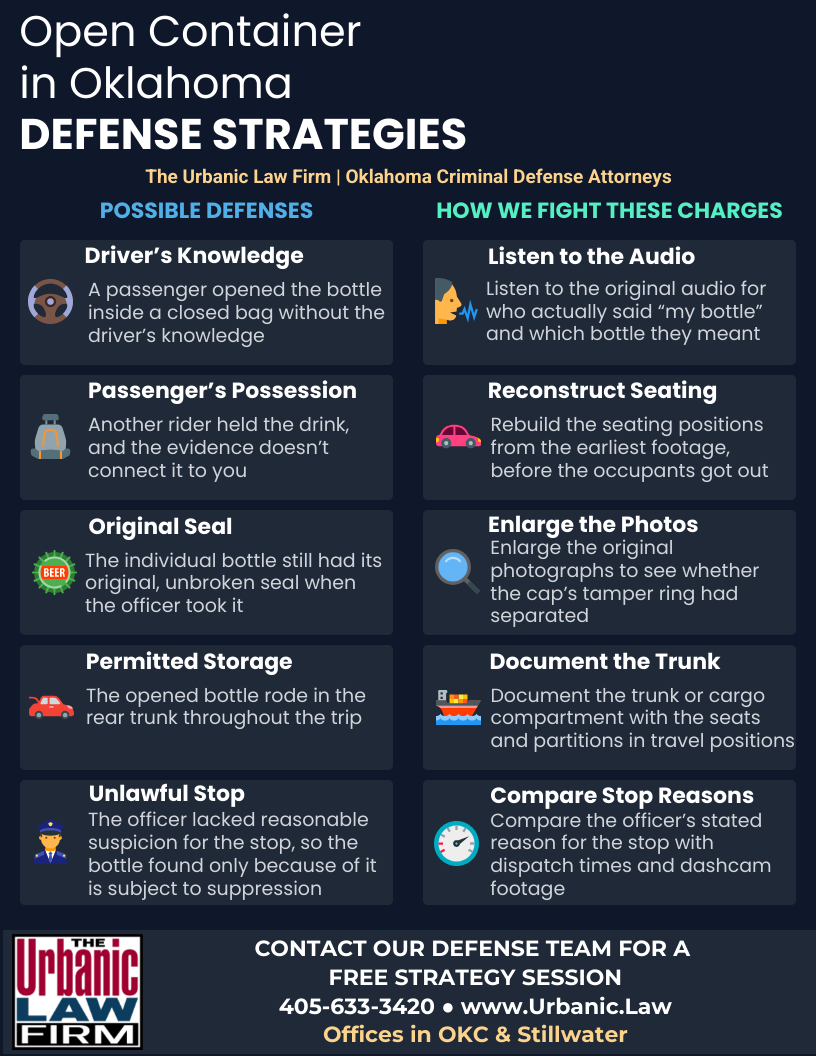
Defenses
- Lack of knowledge. A passenger opened a bottle inside a closed bag, and the driver first learned about it at the stop. Neither statute supports a knowing-transportation charge against the driver on those facts.
- No link to the passenger charged. Another rider brought the bottle and held it throughout the trip. Nothing ties you to possessing it under Title 21 or knowingly transporting it under Title 37A.
- Original seal: The individual bottle still had its original, unbroken seal when the officer took it.
- Permitted storage: The opened bottle rode in the rear trunk throughout the trip.
- Unlawful stop: The officer lacked reasonable suspicion or another lawful basis for the stop, and the bottle found solely because of that stop is subject to suppression.
How we fight these charges
- Listen to the original audio for who actually said “my bottle” and which bottle they meant.
- Reconstruct the seating positions from the earliest footage, before the occupants got out.
- Enlarge the original photographs to see whether the cap’s tamper ring had separated.
- Document the trunk or cargo compartment with the seats and partitions in their travel positions.
- Compare the officer’s stated reason for the stop with dispatch times and dashcam footage.
What The Urbanic Law Firm does to help clients charged with this crime
- Explain each count on your citation so you know which penalties belong to which charge.
- Track your court dates and tell you when you need to appear.
- Walk through the recordings with you so you can flag a voice or detail we wouldn’t recognize.
- Compare available outcomes with your priorities, including work-related reporting obligations.
- Provide the final court paperwork so you can document how the case ended.
Questions to ask your attorney
- Does my citation allege passenger possession under Title 21 or knowing transportation under Title 21 or Title 37A?
- Does the property receipt describe liquid inside the container?
- Did the officer photograph the container before opening or emptying it?
- Which punishments could the judge impose if I plead guilty as charged?
- What would each available plea mean for my particular job?
Things you can do if you’re arrested for this crime
- Save the citation and check both sides for appearance instructions.
- Export your original dashcam file before the camera records over it.
- Write down where each rider got in or out while the trip is fresh in your memory.
- Keep any store receipt that identifies the drink you bought.
- If this was a hired ride, save the booking confirmation and vehicle description.
What happens next
Start with the court and appearance date on your citation or release papers. At a state misdemeanor arraignment, the court advises you of the charge and takes a plea. If you contest it, discovery gives the defense access to evidence such as the report, recordings, and photographs.
If the stop or search was unlawful, your Oklahoma open container defense lawyer can ask the judge to exclude the evidence. If the case goes to trial, the State must prove the charge beyond a reasonable doubt. Our Oklahoma criminal process guide explains what happens between your first appearance and the final judgment.
How open container charges compare with related offenses
Use the statute number on your ticket to identify an alcohol open container charge. The table below compares it with three other charges that can arise during a stop. For example, an open beer in the console can support an open container case even when the driver is sober.
| Offense | Core conduct | Who can face the charge | Classification | Common defense issue |
|---|---|---|---|---|
| Open container of alcohol in a vehicle | Unlawful transportation of open alcohol on a public highway, street, or alley, or passenger possession in a moving vehicle under Title 21 | Title 21 covers a driver who knowingly transports the drink or a passenger who possesses it. Title 37A covers anyone who knowingly transports it. | Misdemeanor under either statute. A Title 21 conviction adds a $250 trauma-care fee. | What connects this person to possessing or knowingly transporting the drink? |
| Open container of marijuana in a vehicle | Possessing an open container holding marijuana in the passenger area on a public highway, street, or alley | The motor vehicle operator under 21 O.S. § 1220(A)(2) | Misdemeanor with a $250 trauma-care fee on conviction | Was the container in the passenger area, and did the operator possess it? |
| Driving under the influence of alcohol (DUI) | Driving a motor vehicle in a location covered by 47 O.S. § 11-902(A)(1)–(2) while under the influence of alcohol, or with a blood or breath alcohol concentration of 0.08 or more at the time of the test | The driver. The same statute separately covers actual physical control. | Generally a misdemeanor for a first, non-aggravated offense. Qualifying priors or aggravating circumstances can make it a felony. | What evidence beyond the open bottle shows that alcohol affected the driver or that a reliable test met the 0.08 threshold? |
| Public intoxication involving a disturbance | Intoxication that disturbs another person’s peace | The person whose conduct caused the disturbance | Misdemeanor with a $10–$100 fine, 5–30 days in jail, or both under 37A O.S. § 6-101(D) | Whose peace did the conduct disturb? |
Key terms in an open container case
Bus
For this exception, a bus must qualify under the vehicle code and be chartered to carry people for hire. The vehicle code covers motor vehicles designed for more than eight passengers and used to carry people. It also covers motor vehicles designed and used to carry people for pay. It excludes authorized transportation-network vehicles. The open container law also excludes school buses carrying children and vehicles operating a regularly scheduled route under a municipal franchise (21 O.S. § 1220(E)(1) & 47 O.S. § 1-105).
If your group chartered a qualifying bus, holding a drink in its passenger area falls within the Title 21 passenger-area exception. The driver still can’t consume alcohol or have it in their immediate possession.
Limousine
A limousine is a chauffeur-driven motor vehicle designed and used to carry people for pay, excluding buses and taxicabs (21 O.S. § 1220(E)(2)).
A taxi fare doesn’t buy the limousine exception. If you hold an open drink in a moving taxi on a public street, you can still face the passenger-possession charge under 21 O.S. § 1220(A)(1).
Alcoholic beverage
The term includes alcohol, spirits, beer, and wine. It also covers any liquid or solid containing one of them that people can consume as a beverage (37A O.S. § 1-103(3)).
Rum mixed into a fountain drink still qualifies. If the cup held only cola, the State lacks a covered beverage for either the driver or passenger charge.
Driving
Driving means operating a motor vehicle while it’s moving (jury instruction 6-35).
If someone first opened the bottle after the car parked and it stayed parked, neither occupant transported or possessed an open drink in a moving vehicle. If the bottle was already open on the road, parking afterward doesn’t undo that earlier conduct.
Open container FAQs
Can an empty beer can get me convicted under Oklahoma’s open container law?
An empty can alone doesn’t establish that it held beer while the vehicle was moving. An officer who saw someone empty it during the stop, however, can testify about what was inside just before that.
Is a torn six-pack an open container of alcohol in Oklahoma?
Tearing the cardboard carrier doesn’t open the bottles or cans inside. If each individual container still has its original seal intact, damage to the carton alone doesn’t establish the offense.
Can Oklahoma charge me with transporting an open bottle if I blew zero?
Yes. A zero breath result addresses alcohol in your body. You can be sober and still knowingly carry an opened bottle in the cabin while driving on a public street.
Where can I carry an opened wine bottle in an SUV in Oklahoma?
Both alcohol statutes allow the rear trunk or rear compartment. In an SUV, look at where the seating ends and how the cargo space is configured. A bottle in a back-seat cup holder is still in the seating area, even if the driver can’t reach it.
Can I expunge an Oklahoma open container conviction?
Yes, if you qualify. One route has no waiting period once you pay a fine under $501 or satisfy it through time served in lieu of payment. It requires no jail or suspended sentence, no felony conviction, and no pending felony or misdemeanor charges. Our Oklahoma criminal record expungement guide explains how to seek sealing and when a different waiting period applies.
This crime in the news
On October 13, 2026, KRMG reported that Victor Trinidad faced an open container charge in Tulsa, in Tulsa County. According to the report, an officer saw the truck moving on the street before police found open beer cans inside it at an apartment complex. The distinction matters because finding open cans in a parked truck doesn’t establish when they were opened. The State would still need to establish what the driver knew during the trip.
About the Author: Attorney Frank Urbanic

This page is for informational purposes only and is not legal advice. Every case is unique; consult an attorney about your specific situation. Law last reviewed on November 24, 2026 by attorney Frank Urbanic. Page last updated November 24, 2026. Review the statutes cited on this page for the most current version of the law.