Child Neglect in Oklahoma: Law, Penalties, & Defenses
 A child neglect accusation can start with a school report, a medical visit, or a home check. It can also begin when a child is found without expected supervision. The allegation may focus on what you did, what you didn’t do, or who had responsibility at a critical time.
This guide is for people accused of child neglect in Oklahoma and trying to understand the charge, possible punishment, and defense options before court. It focuses on nonsexual neglect within Oklahoma crimes involving children.
Does child neglect require a physical injury?
No. The charge can rest on a qualifying failure to provide care, a failure to protect, or abandonment. So the State may pursue a neglect case even when it doesn’t claim the child suffered a physical injury.
Quick links
- What is child neglect in Oklahoma?
- Key elements the state must prove
- Penalties
- Collateral consequences
- How prosecutors prove child neglect
- Practical guide if you’re charged with this crime
- What happens next
- How child neglect compares to related Oklahoma crimes
- Key terms
- Child neglect FAQs
- Important cases
- This crime in the news
Talk with us about the accusation
If you’ve been accused of child neglect in Oklahoma, reach out for a free consultation. We can go over your case and explain the next steps.
Fill out our secure online form so our attorneys can better understand your situation before we speak. You may also call us at 405-633-3420.
What is child neglect in Oklahoma?
The State must connect you to a legally defined caregiving role, a qualifying neglect theory, and the required willful or malicious mental state. Our child abuse, neglect, and endangerment overview explains how these allegations fit together. If the accusation involves sexual abuse or exploitation, check out our page on that.
Depending on the facts, prosecutors may also file child abuse under the same law or child endangerment under 21 O.S. § 852.1. An Oklahoma child neglect defense attorney should test each allegation against the State’s actual proof. The statutory penalty can be severe, so preserving context early can matter.
Key elements the state must prove
Jury instruction 4-37 organizes the accusation around caregiver status, mental state, and a legally defined neglect path. A weakness in any required part can change the case.
- Responsible-person status: You must fit a legally covered role involving responsibility for the child’s health, safety, or welfare.
- Willfully or maliciously: The alleged act or omission must carry the mental state required by the law.
- A qualifying neglect path:
- A failure or omission to provide listed necessities, care, education, supervision, appropriate caretakers, or special care required by the child’s condition;
- A failure or omission to protect a child under eighteen from illegal drugs, illegal activities, or sexual acts or materials that aren’t age-appropriate; or
- Abandonment of a child under eighteen.
- Child under eighteen: The child must fall within the age requirement tied to the charged neglect theory.
Penalties
Child neglect is a Class B1 felony, as listed in 21 O.S. § 20F. The child-neglect law gives the court several sentencing options.
- Prison: 0–life
- Jail: 0–1 year
- Fine: $500–$5,000
- Minimum time served: Child neglect under this subsection is an 85% crime. Under 21 O.S. § 13.1, a prison sentence must reach at least 85% before parole eligibility. Our 85% crime guide explains how that rule works.
- Enhancement: Qualifying prior felony convictions can change sentencing under 21 O.S. § 51.1. Our sentence-enhancement guide explains the general framework.
Collateral consequences
A felony child-neglect conviction can affect family life and employment long after the criminal sentence ends.
- Custody and visitation: The conviction can become important in family-court or deprived-child proceedings.
- Employment: Background checks can create problems, especially for jobs involving children, education, health care, or caregiving.
- Professional licensing: Licensing boards may review a felony conviction when deciding whether to issue, renew, restrict, or discipline a license.
- Firearm rights: A felony conviction can restrict possession of firearms under applicable law.
- Housing and volunteer screening: A felony involving a child can affect applications, placements, and volunteer opportunities.
How prosecutors prove child neglect
These cases often turn on context and timing, not one photo or accusation. Prosecutors may try to build a timeline showing who had responsibility for the child and what care was allegedly missing.
- Caregiving records and statements: Interviews, messages, calendars, custody records, and admissions may be used to show who accepted responsibility.
- Scene evidence: Body-camera video, photographs, home conditions, or physical evidence may be used to describe the alleged risk.
- Witness accounts: Children, relatives, neighbors, teachers, medical staff, or other caregivers may describe what they saw or heard.
- Medical, school, and child-care records: Records may be used to show missed care, a child’s condition, attendance, or prior concerns.
- Digital timing evidence: Calls, texts, app data, and timestamps may be used to place people and events in sequence.
An Oklahoma child neglect defense lawyer should compare those sources for inconsistencies, missing context, and proof of the required mental state.
Practical guide if you’re charged with this crime
What we look for first in a child neglect case
We first identify who actually had responsibility for the child, the exact alleged omission, and the timeline. Then we test whether the evidence supports willful or malicious conduct rather than inability, accident, or a misunderstood event.
Defenses
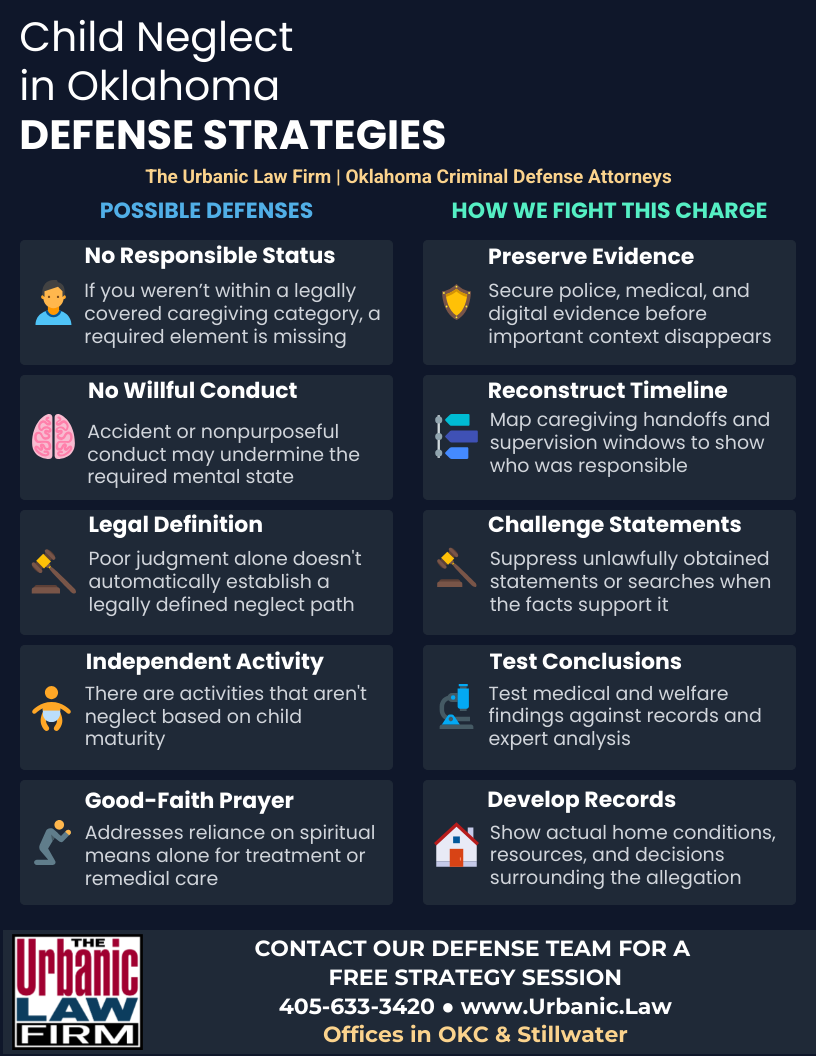
- No responsible-person status. If you weren’t within a legally covered caregiving category, a required element is missing.
- No willful or malicious conduct. Accident, inability, mistake, or nonpurposeful conduct may undermine the required mental state, depending on the facts.
- The conduct doesn’t meet the legal definition of neglect. Poor judgment alone doesn’t automatically establish one of the legally defined neglect paths.
- Protected independent activity. Jury instruction 4-37A recognizes specified independent activities that aren’t neglect unless the responsible person willfully disregards harm or threatened harm in light of the child’s maturity or condition.
- Good-faith prayer defense. When supported by the evidence, jury instruction 4-35B addresses qualifying good-faith reliance on spiritual means alone through prayer for treatment, cure, or remedial care.
How we fight these charges
- Preserve police, child-welfare, medical, school, messaging, and digital evidence before important context disappears.
- Reconstruct caregiving handoffs and supervision windows so the timeline reflects who was responsible at each point.
- Challenge unlawfully obtained statements, searches, or seizures through suppression motions when the facts support them.
- Test medical and child-welfare conclusions against the underlying records and qualified expert analysis when needed.
- Develop witnesses and documents showing the actual home conditions, resources, care, and decisions surrounding the allegation.
What The Urbanic Law Firm does to help clients charged with this crime
- Explain each court setting, deadline, and decision so you know what’s coming next.
- Organize records, messages, photographs, and timelines so important facts don’t get lost.
- Coordinate subpoenas, records requests, investigators, and experts when the case calls for them.
- Prepare you for hearings and major case decisions without leaving you to guess about the process.
- Update you on filings, orders, evidence issues, and upcoming dates as the case develops.
Questions to ask you attorney
- What exact neglect theory is the State alleging?
- What evidence says I was responsible for the child at that time?
- What evidence does the State claim shows willful or malicious conduct?
- Are there statements, searches, or seizures we should challenge?
- What should I avoid doing with witnesses, records, or social media while the case is pending?
Things you can do if you’re arrested for this crime
- Preserve messages, photographs, calendars, and records without editing or deleting them.
- Write a private timeline for your attorney while dates and caregiving details are still fresh.
- Follow every release condition, court order, and no-contact restriction that applies to you.
- Don’t discuss the facts publicly or with potential witnesses while the case is pending.
- Track court dates and tell your attorney promptly if your contact information changes.
What happens next
A felony case usually moves through an initial court appearance, arraignment, evidence review, and pretrial litigation. If the case isn’t resolved earlier, it may proceed through a preliminary hearing, motion hearings, and trial.
What happens at each stage depends on the charging document, the evidence, and the court’s rulings. Possible punishments become clearer as those issues develop. For a more detailed overview of the criminal process in Oklahoma, you can read more in our Oklahoma criminal process guide.
How child neglect compares to related Oklahoma crimes
The label matters because these offenses require different conduct, mental states, and sentencing rules. The comparison below highlights practical distinctions a defendant may need to understand.
| Offense | Core conduct | Mental state / relationship | Classification | Common defense issue |
|---|---|---|---|---|
| Child neglect | Failure or omission to provide required care, qualifying failure to protect, or abandonment | Willful or malicious conduct by a person responsible for the child’s health, safety, or welfare | Felony; 0–life in prison, 0–1 year in jail, $500–$5,000 fine; 85% rule applies to a prison sentence | Whether you had the covered responsibility, whether the alleged omission fits a statutory neglect path, and whether the mental state can be proved |
| Child abuse | Willful or malicious harm, threatened harm, qualifying failure to protect, or injuring, torturing, or maiming a child | Willful or malicious conduct; some theories require a person responsible for the child’s health, safety, or welfare | Class A3 felony; up to life in prison, up to 1 year in jail, $500–$5,000 fine | Whether the alleged conduct is abuse rather than neglect, and whether the required act, harm, relationship, and mental state are supported |
| Child endangerment | Knowingly permitting specified dangers involving abuse, drug manufacturing, or impaired-driving conditions | Knowing conduct by a parent, guardian, or person having custody or control under the charged theory | Class B6 felony; 0–4 years in prison, up to $5,000 fine | Whether you knowingly permitted the specified danger and whether you had the required custody or control |
Key terms
Child neglect
Child neglect means willful or malicious neglect, as defined in Oklahoma’s Children’s Code, of a child under eighteen by a person responsible for the child’s health, safety, or welfare. (21 O.S. § 843.5(O)(2)) The definition ties the criminal charge to the more detailed meaning of neglect rather than to ordinary disagreements about parenting.
Person responsible for a child’s health, safety, or welfare
For this offense, the term includes parents, legal guardians, custodians, foster parents, and specified adult household members. It also includes certain facility or child-care personnel and volunteers, a parent’s intimate partner, and a person who voluntarily accepted care or supervision. (21 O.S. § 843.5(O)(12), 10A O.S. § 1-1-105 & jury instruction 4-40D) Caregiving status can therefore turn on living arrangements, accepted responsibility, and the role you actually held.
Neglect
Neglect includes specified failures or omissions to provide care, qualifying failures or omissions to protect, and abandonment. It excludes listed independent activities unless the responsible person willfully disregards harm or threatened harm in light of the child’s maturity, physical condition, or mental abilities. (10A O.S. § 1-1-105 & jury instruction 4-37A and jury instruction 4-40D) The precise category matters because not every lapse in supervision or care fits the legal definition.
Child neglect FAQs
Can Oklahoma child neglect be charged against someone who isn’t the child’s parent?
Yes. The law reaches several people who can be responsible for a child’s health, safety, or welfare, not just parents. Depending on the facts, that can include guardians, custodians, foster parents, specified adult household members, and certain care providers. It can also include a parent’s intimate partner or someone who voluntarily accepted care or supervision.
Can an unborn child be the basis of an Oklahoma child neglect charge?
Yes, in a limited setting recognized by the Oklahoma Court of Criminal Appeals. The court has held that a viable unborn child can be a victim of child neglect under this law. Whether that rule applies depends on the medical evidence and the facts of the particular case.
Can an Oklahoma child neglect charge affect custody before the criminal case ends?
Yes. A criminal case can exist at the same time as separate child-welfare or family-court proceedings. Orders about custody, visitation, placement, or contact can change before the criminal charge is finally resolved, so the proceedings should be evaluated together.
Can an Oklahoma child neglect charge be expunged?
Possibly. Eligibility depends on how the case ends, the conviction history, waiting periods, and the expungement statute in effect when you apply. Our Oklahoma expungement guide explains the main pathways and limitations.
What if another adult was supposed to supervise the child in an Oklahoma child neglect case?
That can be important because the State must connect the charge to your own responsibility and conduct. Another caregiver’s role doesn’t automatically end the case, but schedules, handoffs, messages, and witness accounts may show who actually had responsibility during the alleged neglect.
Important cases
Oklahoma appellate decisions show that the exact theory of neglect matters. In Lewallen v. State, 2016 OK CR 4, 370 P.3d 828, the court treated child abuse and child neglect as separate offenses with different definitions. The decision also addressed how those distinctions affected sentencing.
In State v. Green, 2020 OK CR 18, 474 P.3d 886, the court held that a viable unborn child can be the victim of child neglect. The case shows that the statute can reach certain prenatal neglect allegations when the factual and medical requirements are present.
This crime in the news
On February 27, 2026, KTUL reported that Christian Love was arrested in Creek County. Deputies said a four-year-old boy left in her care was found alone outside in Mounds. They also said Love had fallen asleep while caring for him. The report illustrates a supervision-based child neglect allegation because investigators focused on who accepted care, the child’s age, the supervision lapse, and the alleged risk of harm.
About the Author: Attorney Corey Brennan

This page is for informational purposes only and is not legal advice. Every case is unique; consult an attorney about your specific situation. Law last reviewed on August 11, 2026 by attorney Corey Brennan. Page last updated August 11, 2026. Review the statutes cited on this page for the most current version of the law.

Oklahoma DUI Aggregation Law: Can Two DUIs Become One Felony?

Oklahoma Bird Law Attorneys: The Urbanic Law Firm v. Charlie Kelly

Banging More Than the Gavel! Another Judge Sex Scandal Raises Oklahoma Criminal Law Questions

Stick a fork in him! Brent Swadley convicted: Oklahoma post-trial sentencing procedure explained

When Workplace Retaliation Leads To Harm
| THIS OFFENSE IN THE NEWS |