Child Abuse in Oklahoma: Law, Penalties, & Defenses
 A child abuse accusation can begin with a bruise, a medical visit, a school report, or a child’s statement. Police and child-welfare investigators may start collecting evidence before you know exactly what someone reported.
This guide is for people accused of child abuse in Oklahoma who are trying to understand the charge, possible punishment, and defense options before court. The possible punishment can reach life in prison, so the details behind the allegation matter from the start.
Oklahoma law covers more than intentionally striking a child. It can also cover threatened harm or an alleged failure to protect. However, the State must still prove the required relationship, conduct, mental state, and age element that fit its chosen theory.
This page addresses the nonsexual form of the offense. Allegations involving sexual conduct fall under a separate child sexual abuse law and involve additional consequences.
The version of Oklahoma’s child abuse law used on this page takes effect November 1, 2026. If the alleged conduct occurred before November 1, 2026, the charge must be analyzed under the law that was in effect when the conduct allegedly occurred.
Is spanking child abuse in Oklahoma?
Oklahoma law doesn’t prohibit a parent or guardian from using reasonable and ordinary force for discipline, but unreasonable force can support a child abuse allegation. The manner, degree, injuries, object used, child’s age, and surrounding circumstances can all become important. A single allegation can carry severe consequences when investigators believe the force went beyond reasonable and ordinary discipline.
Quick links
Talk with a child abuse defense attorney
If you’ve been accused of child abuse in Oklahoma, reach out for a free consultation before answering more questions. We can review the allegation, the child’s statements, medical evidence, and the way investigators gathered the evidence.
Fill out our secure online form so our attorneys can better understand your situation before we speak. You may also call us at 405-633-3420.
Explanation of the law
Under 21 O.S. § 843.5(A), a person commits child abuse by willfully or maliciously engaging in conduct that fits the statutory definition. The law contains two distinct paths for prosecutors.
First, a person responsible for a child’s health, safety, or welfare may allegedly harm, threaten harm, or fail to protect the child. Second, any person may allegedly injure, torture, or maim a child under eighteen.
That distinction matters because the first path requires proof that you had a legally recognized responsibility for the child. The second path doesn’t require a parental, household, or caretaker relationship.
The law expressly preserves a parent’s or guardian’s ability to use reasonable and ordinary force for discipline. Force that goes beyond what Oklahoma law considers reasonable and ordinary may still support a child abuse allegation.
A child’s consent isn’t a defense to a violation of this law. The State must still prove every required element of the charged child abuse theory.
The law also states that raising a juvenile consistent with the juvenile’s biological sex, or referring to a juvenile consistently with the juvenile’s biological sex, doesn’t constitute child abuse or child neglect under the act.
These cases fit within Oklahoma’s broader child abuse, neglect, and endangerment laws. You can also see how this offense fits among other crimes affecting children.
Prosecutors sometimes file related counts from the same household investigation. Those may include child endangerment, assault and battery, or domestic abuse in the presence of a child.
Key elements the state must prove
The State must prove one complete statutory theory rather than mixing parts of two different theories. Jury instruction 4-35 separates the offense into the following alternatives.
Harm or failure-to-protect theory
- A person responsible for the child’s health, safety, or welfare
- The State must prove that you fit one of the legally defined caretaker or household roles
- Willfully or maliciously
- Harmed, threatened harm, or failed to protect
- The alleged harm or threatened harm must concern the child’s health, safety, or welfare
- A child under eighteen
Direct-injury theory
- A person
- Willfully or maliciously
- Injured, tortured, or maimed
- A child under eighteen
Penalties
A conviction is a Class A3 felony under 21 O.S. § 20E. The sentencing statute gives the court several possible forms of confinement.
- Prison
- Up to life
- Jail
- Up to 1 year
- Fine
- $500–$5,000
- Minimum time served
- 21 O.S. § 13.1 makes this an 85% crime, so a person sentenced to prison must serve at least 85% before becoming eligible for parole consideration
- Prior felony enhancement
- A prior conviction may increase the sentencing range under 21 O.S. § 51.1. The effect depends on the prior offense, its class, and the new charge. Our Oklahoma sentence-enhancement guide explains how prior felony allegations can change a case
Oklahoma also classifies child abuse as a violent crime. That classification appears in 57 O.S. § 571 and can affect correctional classification, release issues, and how the case is evaluated. Learn more about Oklahoma’s violent-crime classification.
Collateral consequences
The consequences can extend far beyond the sentence imposed in criminal court. Those penalties may also trigger family, employment, licensing, and housing problems.
- Child-custody consequences: The allegation or conviction may affect custody, visitation, guardianship, or a deprived-child case
- Employment limits: Schools, child-care facilities, health-care employers, and other workplaces may reject or terminate an applicant with this record
- Professional licensing: A licensing board may investigate, suspend, restrict, or deny a professional license
- Firearm restrictions: A felony conviction generally creates state and federal firearm disabilities
- Personal and reputational harm: The accusation may affect housing, relationships, volunteer positions, and community standing before the criminal case ends
How prosecutors prove child abuse
Most cases rely on a combination of statements, medical opinions, photographs, and household evidence. Prosecutors may also use conduct after the allegation as evidence of knowledge or guilt.
- Child statements: Recorded forensic interviews, school disclosures, medical statements, and later testimony
- Medical evidence: Injury patterns, imaging, laboratory results, treatment records, and opinions about whether an injury was accidental
- Photos and videos: Body-camera footage, phone images, home surveillance, school video, or photographs taken during an examination
- Adult statements: Interviews with parents, caretakers, relatives, teachers, neighbors, officers, and child-welfare workers
- Physical evidence: Belts, paddles, household objects, damaged property, clothing, bedding, or items officers claim match an injury
- Digital evidence: Texts, social-media messages, searches, calls, location history, and communications between adults in the home
Practical guide if you’re charged with this crime
What we look for first in a child abuse case
We first compare the accusation to the exact statutory theory and the available physical evidence. We also examine who made the first report, how the child’s account developed, and whether the medical findings actually support intentional harm.
Defenses
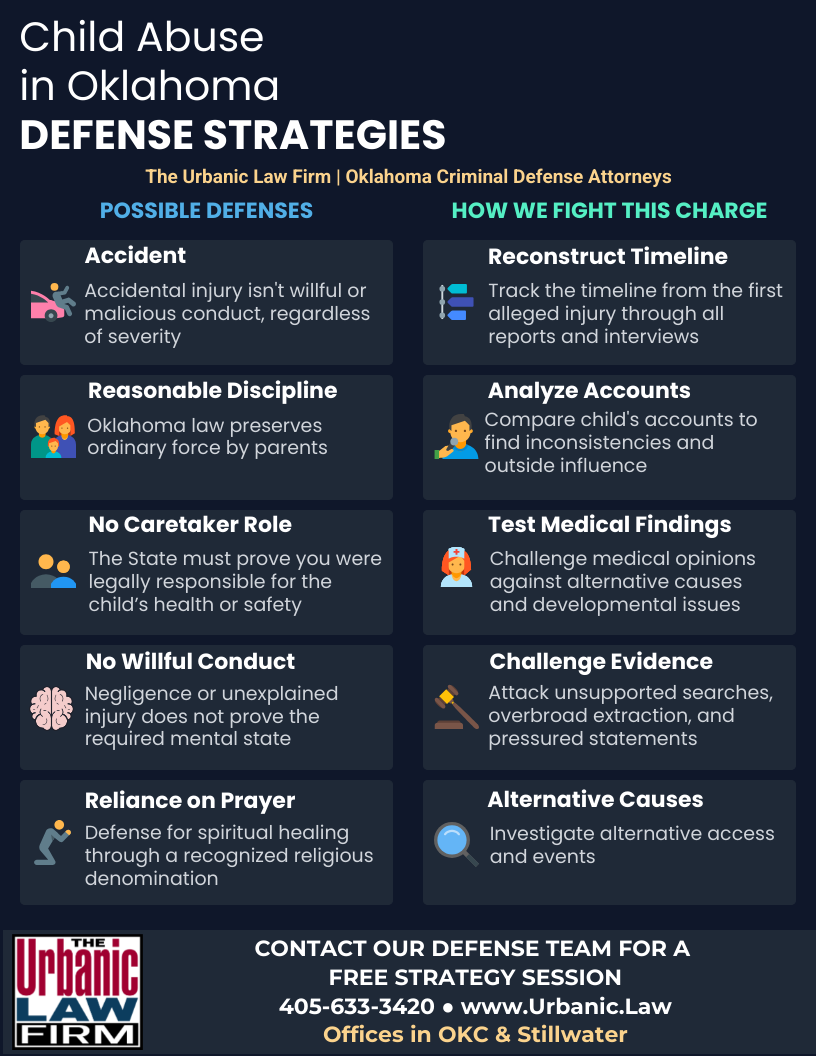
- Accident: An accidental injury doesn’t establish willful or malicious conduct merely because the injury looks serious
- Reasonable discipline: Oklahoma law expressly preserves reasonable and ordinary force by a parent or guardian, and jury instruction 4-35A addresses that protection when discipline is at issue
- No legally defined caretaker role: Under the harm or failure-to-protect theory, the State must prove that you were responsible for the child’s health, safety, or welfare
- No willful or malicious conduct: Negligence, poor judgment, or an unexplained injury doesn’t automatically prove the required mental state
- Good-faith reliance on prayer: In a qualifying treatment case, jury instruction 4-35B provides an affirmative defense based on good-faith reliance on spiritual means through a recognized church or religious denomination
How we fight these charges
- Reconstruct the timeline from the first alleged injury through every interview, photograph, examination, and report
- Compare each version of the child’s account to identify new details, outside influence, repetition, and internal inconsistencies
- Test the medical conclusions against alternative causes, timing evidence, prior injuries, developmental issues, and the limits of the examiner’s opinion
- Challenge unsupported searches, pressured statements, overbroad phone extraction, and evidence gathered outside valid consent or a warrant
- Investigate who else had access to the child and whether another person or event could account for the alleged injury or condition
How The Urbanic Law Firm helps
- Explain each court setting, deadline, investigative step, and decision in language you can use
- Coordinate the criminal defense with related family-court, child-welfare, employment, or licensing concerns
- Organize medical records, communications, photographs, witness information, and defense exhibits
- Communicate with you throughout the case so you know what’s happening and what information is still needed
- Prepare motions, witness examinations, demonstrative evidence, and trial themes that address the State’s strongest allegations
An Oklahoma child abuse defense lawyer must be ready to address both the emotional force of the accusation and the legal limits of the evidence.
Questions to ask your attorney
- Which statutory theory does the prosecution appear to be using?
- Does the medical evidence prove intentional injury or only identify an injury?
- Were the child’s interviews recorded, and how many interviews occurred?
- Can any statements, searches, photographs, or phone evidence be suppressed?
- How could a child-welfare or family-court proceeding affect the criminal case?
Things you can do if you’re arrested for this crime
- Stop discussing the allegation with police, child-welfare investigators, coworkers, relatives, or online contacts until you receive legal advice
- Preserve messages, photographs, calendars, medical records, school communications, and videos without editing or deleting anything
- Follow every no-contact, custody, release, and court order even when you believe the restriction is unfair
- List every person who saw the child, knew about prior injuries, or can explain the household routine
- Write a private timeline for your attorney while dates, statements, appointments, and events remain fresh
What happens next
A felony child abuse case usually moves through several court stages before trial. The exact sequence depends on whether officers arrested you, whether the district attorney has filed formal charges, and whether you’ve received release conditions.
Your first court appearances usually address the charge, counsel, scheduling, and release conditions. Because this is a felony, you may later have a preliminary hearing where the State must present enough evidence to continue the prosecution.
Defense motions may challenge statements, searches, digital evidence, expert testimony, or the legal sufficiency of a count. The case may then proceed through additional hearings, trial preparation, and a jury trial.
Possible punishments depend on the final offense, prior record, verdict, sentencing evidence, and the law applicable on the date of the alleged conduct. For a more detailed overview of the criminal process in Oklahoma, you can follow each stage in our Oklahoma criminal process guide.
How child abuse compares to related Oklahoma crimes
The charge classification matters because similar family allegations can produce very different elements and sentencing consequences. Different punishments may apply even when the charges arise from the same investigation.
| Offense | Core allegation | Mental state or relationship | Classification and consequences | Common defense issues |
|---|---|---|---|---|
| Child abuse | Harm, threatened harm, failure to protect, injury, torture, or maiming of a child | Willful or malicious conduct; some theories require a legally defined caretaker relationship | Class A3 felony, violent-crime classification, 85% requirement, and up to life in prison | Accident, reasonable discipline, causation, medical disagreement, mental state, relationship status, and unreliable statements |
| Child neglect | Failure or omission to provide care, supervision, protection, necessities, or a safe environment | Willful or malicious neglect by a person responsible for the child | Class B1 felony, up to life in prison, up to 1 year in county jail, and a $500–$5,000 fine | Caretaker status, actual knowledge, available resources, causation, medical needs, and whether the alleged condition legally amounts to neglect |
| Child endangerment | Knowingly permitting a child to face a specifically prohibited danger | Usually requires custody or control and proof that the defendant knowingly permitted the danger | The result depends on the prohibited danger and the charged subsection | Knowledge, custody or control, permission, connection to the danger, and statutory exceptions |
| Domestic abuse in the presence of a child | A domestic assault or battery allegedly occurred where a child could see or hear it | Requires a qualifying domestic relationship and proof of the child’s presence | The first offense may be a misdemeanor, while a later offense may become a felony | Relationship, identity, credibility, whether an assault or battery occurred, and where the child was located |
Key terms
Child abuse
The willful or malicious harm, threatened harm, or failure to protect from harm or threatened harm to a child’s health, safety, or welfare by a person responsible for the child, or the willful or malicious injury, torture, or maiming of a child by any person. (21 O.S. § 843.5(O)(1) & jury instruction 4-40D) The definition creates separate caretaker and direct-injury paths. Your relationship to the child may therefore control which elements apply.
Person responsible for a child’s health, safety, or welfare
A parent, legal guardian, custodian, foster parent, qualifying adult in the child’s home, certain facility or child-care personnel, an intimate partner of the parent, or a person who voluntarily accepted responsibility for the child’s care or supervision. (21 O.S. § 843.5(O)(12) & jury instruction 4-40D) Caregiver status is required under the harm, threatened-harm, and failure-to-protect theory. It isn’t required for the direct-injury theory.
Willful
Purposeful; a willingness to commit the act or omission referred to, without requiring an intent to violate the law or acquire an advantage. (21 O.S. § 92 & jury instruction 4-40D) Evidence of an accident or an unplanned event can directly challenge this mental-state requirement. The State still must connect the purposeful conduct to the alleged harm.
Malicious
A wish to vex, annoy, or injure another person. (21 O.S. § 95 & jury instruction 4-40D) The surrounding words, conduct, history, and physical evidence may affect whether prosecutors can prove malice. Anger alone doesn’t remove the need to prove the defined state of mind.
Unreasonable force
More force than that ordinarily used as a means of discipline. (21 O.S. § 844 & jury instruction 4-40D) The degree and manner of force become central when the accusation arose from discipline. An object’s use doesn’t decide the issue by itself, because the surrounding facts still matter.
Child abuse FAQs
Is child abuse a felony in Oklahoma?
Yes. A conviction can result in prison, county jail, a fine, an 85% minimum-service requirement for a prison sentence, and violent-crime classification. Conduct alleged to have occurred before that date must be evaluated under the law then in effect.
Can Oklahoma charge someone with child abuse without visible injuries?
Yes. The caretaker-based theory can include threatened harm or failure to protect from harm or threatened harm. However, the State must still prove the required relationship, mental state, and legally sufficient harm theory.
Can a nonparent be charged with child abuse in Oklahoma?
Yes. Any person may be charged under the direct-injury theory. The caretaker-based theory also covers several nonparents, including qualifying household adults, facility workers, child-care personnel, intimate partners of a parent, and people who voluntarily accepted care or supervision.
Can an Oklahoma child abuse charge be based only on a child’s statement?
A child’s statement can support a charge, but its weight depends on how it was obtained and whether other evidence supports it. Interview methods, repeated questioning, inconsistencies, outside influence, developmental ability, and medical findings may all affect reliability.
Can an Oklahoma child abuse case be expunged?
Sometimes. Eligibility depends on how the case ends, the final offense, your record, and any required waiting period. A violent-felony conviction may create major limits, so the outcome must be compared carefully with Oklahoma’s expungement requirements.
Important cases
State v. Vincent, 2016 OK CR 7, 371 P.3d 1127, explains that a family or parental relationship isn’t required for every child abuse theory. The decision distinguished the direct-abuse allegation from offenses that require proof of responsibility for the child.
Fairchild v. State, 1999 OK CR 49, 998 P.2d 611, addressed the meaning of willful conduct in a child-abuse prosecution. The court explained that the required mental state concerns purposeful conduct and doesn’t create a separate specific-intent-to-injure element.
This crime in the news
A March 26, 2026 report from KJRH 2 News Oklahoma described allegations against Marcus Jeffrey in Okmulgee, located in Okmulgee County. Investigators alleged that Jeffrey struck several minors with a belt during a church youth meeting, and the report stated that video showed him swinging the belt and striking children. The incident illustrates why discipline-based cases often turn on the degree of force, the available video, the setting, the defendant’s relationship to the children, and whether prosecutors can prove willful or malicious harm rather than permissible discipline.

This page is for informational purposes only and is not legal advice. Every case is unique; consult an attorney about your specific situation. Law last reviewed on August 7, 2026 by attorney Ky Corley. Page last updated August 7, 2026. Review the statutes cited on this page for the most current version of the law.

Oklahoma Bird Law Attorneys: The Urbanic Law Firm v. Charlie Kelly

Banging More Than the Gavel! Another Judge Sex Scandal Raises Oklahoma Criminal Law Questions

Stick a fork in him! Brent Swadley convicted: Oklahoma post-trial sentencing procedure explained

When Workplace Retaliation Leads To Harm

Brent Swadley Trial Analysis: False Claims & Conspiracy to Defraud State Explained
| THIS OFFENSE IN THE NEWS |