State of emergency crimes defense in Oklahoma
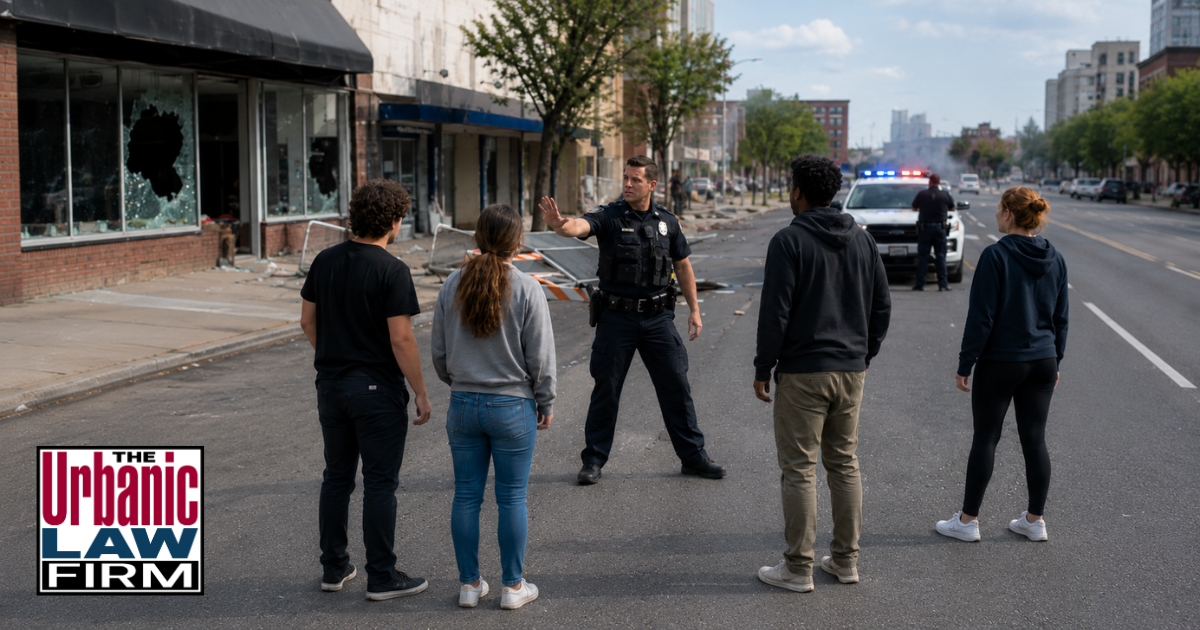 State of emergency crimes in Oklahoma involve allegations tied to a declared emergency, public-disorder rules, emergency proclamations, crowd activity, property damage, injury, or refusal to leave a public way after an order. This guide is for people accused of these crimes in Oklahoma who are trying to understand what the state must prove, what facts matter, and what defenses may apply.
These cases often start with a tense scene. However, the charge should still turn on evidence. The state must prove the required conduct, the required mental state, and the legal basis for the emergency-related rule.
These offenses sit within Oklahoma’s broader riot and public safety crimes category. Because the facts can overlap with protest, crowd-control, property, and officer-contact allegations, small details can change how the case gets filed.
Talk to an Oklahoma criminal defense lawyer
If you’ve been accused of state of emergency crimes in Oklahoma, reach out for a free consultation with The Urbanic Law Firm. Early defense work can protect video, witness names, dispatch records, and the exact wording of the order or proclamation.
Call us at 405-633-3420 or use our secure online form.
What are state of emergency crimes in Oklahoma?
State of emergency crimes in Oklahoma are charges tied to emergency powers, public-disorder rules, and orders given during a declared emergency. They can involve violating an emergency proclamation, damaging property, injuring someone, participating in a riot, or refusing to leave a public way after authorities order you to leave. Some are misdemeanors. Others are felonies.
How Oklahoma state of emergency offenses work
What these crimes have in common
These cases usually depend on three questions. First, did a valid emergency order or proclamation apply? Second, did your conduct fall inside the place, time, and conduct covered by that order? Third, can the state prove the required intent, knowledge, malice, or refusal?
In the same police reports, prosecutors may also allege assault and battery, obstructing an officer, malicious injury to property, arson, or resisting arrest. In addition, a crowd case can include several people, several officers, and several versions of what happened.
Evidence that matters in these cases
Because these cases often involve public spaces, evidence may come from body cameras, surveillance cameras, phones, dispatch logs, social media, 911 calls, and officer reports. However, video can help the defense as much as the prosecution. It may show distance, confusion, crowd movement, unclear commands, or another person causing the damage.
The wording of the order also matters. If the case involves a public way, the defense will look at who gave the order, where you were standing, whether you could hear it, and whether you had a real chance to comply.
The Urbanic Law Firm’s challenge to an Oklahoma City emergency proclamation
In 2020, The Urbanic Law Firm challenged Oklahoma City Mayor David Holt’s emergency proclamation that invoked the Riot Control and Prevention Act to restrict late-night in-person food and beverage service at bars and restaurants. Public Radio Tulsa reported that the lawsuit argued the mayor overstepped his legal authority and improperly used a riot-control law for pandemic restrictions. KOKH reported that Frank Urbanic represented the plaintiffs and claimed Oklahoma City didn’t have authority to enforce the rule. KOCO reported that Holt’s local version allowed city police to enforce the 11 p.m. restriction. That challenge shows why emergency-proclamation cases often start with the legal trigger: whether the government used the right law, followed its limits, and had authority to attach criminal penalties.
Municipal ordinance charges based on the Riot Control and Prevention Act
The Oklahoma City lawsuit also shows another important point: a case may involve a municipal ordinance, not just a state criminal charge. The Riot Control and Prevention Act authorizes cities and towns to enact ordinances in general conformity with the Act under 21 O.S. § 1321.9. So, for the same basic conduct, you could be accused of violating a city ordinance modeled on the state law instead of being charged directly under the state statute. That means the defense should review both the state law and the local ordinance, because the city still has to stay within the authority the Legislature gave it.
Crimes in this group
Violation of Riot Control and Prevention Act or proclamation
Violation of Riot Control and Prevention Act or proclamation, where no specific penalty is provided, covers a violation of the act or a proclamation issued under it when the act doesn’t provide a more specific penalty (21 O.S. § 1321.6). Because this offense works as a misdemeanor fallback provision, the exact rule matters.
However, the state still has to connect you to a valid emergency rule. The defense may review the proclamation, notice, location, timing, curfew language, and whether police applied the rule beyond its actual terms.
Malicious destruction, damage, or injury during a state of emergency
Malicious destruction or damage to property, or malicious injury to another during a state of emergency, applies when the state claims you maliciously damaged real or personal property or maliciously injured someone during the emergency (21 O.S. § 1321.7). The statute treats the offense as a serious felony.
In addition, the state may try to blame one person for another person’s conduct. That makes identification, intent, video, timing, and proof of who caused the damage especially important.
Riot during a state of emergency
Riot during a state of emergency covers participation with two or more people in a course of disorderly conduct during the emergency, when the state claims a listed intent or weapon-related condition exists (21 O.S. § 1321.8). The charge can become a felony if the state proves the required facts.
However, being near a crowd isn’t the same as sharing a criminal purpose. The defense may focus on whether you acted with others, whether the state can prove the required intent, and whether the conduct rose to the level required by law.
Refusal to leave a public way after an order
Refusal to leave a public way after an order during a state of emergency applies when authorities direct someone on a public way within the described area to leave, and the person refuses. The same statute treats this specific refusal offense as a misdemeanor.
Because this charge depends on an order, the defense often starts with the facts around the command. We look at whether the order was lawful, audible, clear, directed at you, and possible to follow.
Defense strategies for state of emergency crimes in Oklahoma
When The Urbanic Law Firm defends these cases, we first look for the legal trigger. That means the proclamation, the described area, the order, and the proof that you knew what police claim you did. Then we test the state’s story against video, witnesses, timing, officer reports, and the exact elements of the charge.
- Challenge the emergency order or proclamation. The state may overstate what the order covered. However, the defense can compare the charge to the actual wording.
- Contest intent, malice, or refusal. Many cases turn on what you meant to do. Because confusion isn’t malice, intent matters.
- Attack identification and video assumptions. A crowd scene can make identification unreliable. In addition, police may confuse presence with participation.
- Separate your conduct from the crowd. The state may try to connect you to someone else’s act. The defense can focus on your actual words, movement, and actions.
- Question the order to disperse or leave. If the command was unclear, impossible to hear, or impossible to follow, that can matter.
Key terms
State of emergency
State of emergency means an emergency proclaimed as such by the Governor under the Riot Control and Prevention Act. That phrase decides whether the emergency-only charges can apply at all. (21 O.S. § 1321.2)
Governor
Governor means the Governor of this state, or, if removed, dead, resigned, or unable to discharge the office, the person who may exercise the powers of Governor under Oklahoma succession law. The issuing authority matters when the charge depends on emergency powers. (21 O.S. § 1321.2)
Disorderly conduct
Disorderly conduct means a course of conduct that causes public inconvenience, annoyance, or alarm, or recklessly creates that risk, through fighting, threatening behavior, unreasonable noise, abusive language, disruption of a lawful procession, or a hazardous condition with no legitimate purpose. It also covers certain group conduct likely to cause substantial harm or serious inconvenience when someone refuses or knowingly fails to obey a peace officer’s order to disperse. The term is central to riot during a state of emergency. (21 O.S. § 1321.8)
Principal
Principal means a person concerned in the commission of a crime, whether the person directly commits the act or aids and abets its commission, though not present. Mere presence alone doesn’t make someone a principal, but aiding, promoting, or encouraging with the required knowledge or intent can. The term matters when the state blames you for another person’s conduct. (21 O.S. § 172 & jury instruction 2-6)
Battery
Battery means any willful and unlawful use of force or violence upon the person of another. The term can matter when a state-of-emergency property case also alleges malicious injury to another. (21 O.S. § 642 & jury instruction 4-3)
FAQs about state of emergency crimes in Oklahoma
Can I be charged with a felony for a state of emergency offense in Oklahoma?
Yes. Some state of emergency offenses are misdemeanors, but riot during a state of emergency and malicious property damage or injury during a state of emergency can be charged as felonies. The exact charge depends on the conduct alleged, the statute used, and the evidence the prosecutor claims supports it.
What does the state have to prove for riot during a state of emergency in Oklahoma?
The state generally has to prove a state of emergency applied, that you participated with two or more people in disorderly conduct, and that the required intent or weapon-related condition existed. The defense may challenge identity, intent, shared purpose, the emergency area, and whether the conduct met the legal standard.
Is refusing to leave a public way during a state of emergency a misdemeanor in Oklahoma?
Yes. Refusing to leave a public way after authorities direct you to leave during a state of emergency is treated as a misdemeanor. However, the state still has to prove the order applied to you, the location was within the described area, and you refused to leave.
Can a state of emergency crime in Oklahoma be expunged?
It depends on the charge, result, sentence, prior record, and waiting period. Some dismissed cases, acquittals, misdemeanors, deferred sentences, and certain nonviolent felony outcomes may qualify under Oklahoma law. You can learn more on our Oklahoma expungement law page.
What defenses apply to state of emergency crimes in Oklahoma?
Common defenses include lack of intent, mistaken identity, unclear orders, invalid or overbroad application of the proclamation, weak proof of property damage or injury, and evidence that you didn’t act with the group. Video, witness statements, and dispatch records can be critical.
State of emergency offense example in the news
A KOSU report described Oklahoma City protest charges involving allegations of rioting, property damage, arson, incitement, and assault and battery on a police officer. The report shows why emergency-related crowd cases need careful defense work. The state may focus on the crowd, but the defense has to focus on your conduct, your intent, the order in effect, and whether the evidence truly connects you to the alleged harm.
This page is for informational purposes only and is not legal advice. Every case is unique; consult an attorney about your specific situation. Law last reviewed on May 7, 2026 by attorney Frank Urbanic. Page last updated May 7, 2026. Consult the statutes listed above for the most up-to-date law.

Two Votes, One Prison Cell: Sara Polston’s Oklahoma Voting Nightmare!

Legislative Payback or Public Safety? Sara Polston’s Shocking Constitutional Fight!

Tulsa’s “Serial Defecator” Case: Legal Analysis of a Messy Situation

Oklahoma Discovery Law Changes: 2026–2027 Guide
Oklahoma Domestic Abuse Law Updates Nov. 1: Five Big Changes
| THESE OFFENSES IN THE NEWS |