Canadian County DUI Lawyers
 A DUI arrest in Canadian County can put several things in motion at once. You may have a criminal case, bond conditions, chemical-test evidence, video evidence, and a separate driver’s-license issue. What happens in the first days can affect evidence that may become important later.
The Urbanic Law Firm represents people facing DUI charges in Canadian County. Early defense work can include reviewing why you were stopped, preserving video, examining field sobriety testing, and identifying problems with breath or blood evidence.
This guide is for people accused of DUI in Canadian County who are trying to understand the charge and looking for strong representation in court. You’ll learn what the State may need to prove, what can happen next, and which parts of the evidence deserve close attention.
What should I do after a DUI arrest in Canadian County?
If you’ve been arrested for DUI in Canadian County, start protecting the evidence and your driving privileges as soon as possible. Keep every document you received, write down what happened while it’s still fresh, preserve any photos, videos, receipts, or witness information, and don’t assume the police report tells the whole story. A DUI defense lawyer can review the reason for the stop, body-camera and dash-camera footage, field sobriety testing, breath or blood evidence, and whether the State can prove the charge. You should also address the separate driver’s-license consequences promptly because they can develop independently from the criminal case.
Get Your DUI Case Reviewed Early
If you’ve been charged with DUI in Canadian County, reach out for a free consultation. The earlier the evidence is reviewed, the sooner potential problems with the stop, testing, video, or chemical evidence can be identified.
Fill out our secure online form so our attorneys can better understand your situation before we speak. You may also call us at 405-633-3420.
DUI Charges in Canadian County
The law covers several different theories. They include a blood or breath alcohol concentration of at least 0.08, being under the influence of alcohol, certain Schedule I substances, another intoxicating substance, or a combination of alcohol and another intoxicating substance.
A first offense is generally a misdemeanor. However, prior qualifying DUI convictions or deferred judgments can change the classification. Current law also makes aggravated DUI a felony when a DUI occurs with specified additional facts. Examples include a BAC of at least 0.15, certain reportable vehicle incidents, eluding, specified dangerous driving, excessive speeding, reckless driving, or having a passenger under 18.
For a deeper statewide discussion of the elements, classifications, and defenses, see our guide to Oklahoma misdemeanor and felony DUI.
What Happens After a DUI Case Begins in Canadian County?
After an arrest, you may first deal with booking and release or bond. The criminal case then moves into court settings, discovery, motions, and eventually a resolution or trial. The path changes if the State files the DUI as a felony instead of a misdemeanor.
A felony case generally includes a preliminary-hearing stage unless that hearing is properly waived. A misdemeanor DUI doesn’t use that same felony preliminary-hearing process. In either type of case, the defense can begin reviewing the State’s evidence well before trial.
Canadian County Details That Can Matter After an Arrest
- The Canadian County Court Clerk’s office is in the Judicial Building at 301 N. Choctaw in El Reno
- The Court Clerk directs the public to OSCN for court information and research, so you can use the docket to follow filed charges and court entries
- The Canadian County Sheriff’s Office provides an online inmate-search resource for current custody information
- The Court Clerk currently requires cash bonds to be posted in cash before 3:30 p.m. and provides separate instructions for bondsmen posting at the jail
Administrative procedures can change, so confirm current instructions before relying on a posting deadline or traveling to the courthouse. For broader information about the courthouse and local criminal process, see our Canadian County criminal court guide.
While the court case moves forward, evidence can become harder to obtain. Video may have retention limits, witnesses can forget details, and records may need to be requested. That’s one reason early preservation work can matter.
Penalties for DUI in Canadian County
Oklahoma law controls the punishment range. Canadian County doesn’t have a separate DUI penalty statute. Your exposure depends heavily on whether the case is a first offense, a qualifying repeat offense, or aggravated DUI.
- First DUI offense: misdemeanor; 10 days to 1 year in jail; fine up to $1,000; assessment and evaluation with compliance with recommendations
- Qualifying subsequent DUI: Class C2 felony; imprisonment under 21 O.S. § 20M, with a base first-conviction Class C2 range of up to 7 years; fine up to $2,500; treatment requirements and ignition interlock
- DUI after a prior felony DUI-related conviction: Class B4 felony; 1 to 10 years in Department of Corrections custody; fine up to $5,000; community service, treatment, and ignition-interlock requirements
- DUI after two prior felony DUI-related convictions: Class B3 felony; 1 to 20 years in Department of Corrections custody; fine up to $5,000; community service, supervision, testing, treatment, and ignition-interlock requirements
- Aggravated DUI: Class B3 felony classification with additional statutory restrictions on confinement, supervision, and ignition-interlock requirements depending on offense history
A deferred or suspended sentence may be legally available in some cases, but the answer depends on the charge and your history. Aggravated DUI also carries specific limits on how portions of a sentence may be deferred, suspended, or probated.
A DUI arrest can create a separate driver’s-license problem before the criminal case ends. Because that process has its own rules, review our guide to Oklahoma DUI driver’s-license consequences as early as possible.
How We Defend DUI Cases in Canadian County
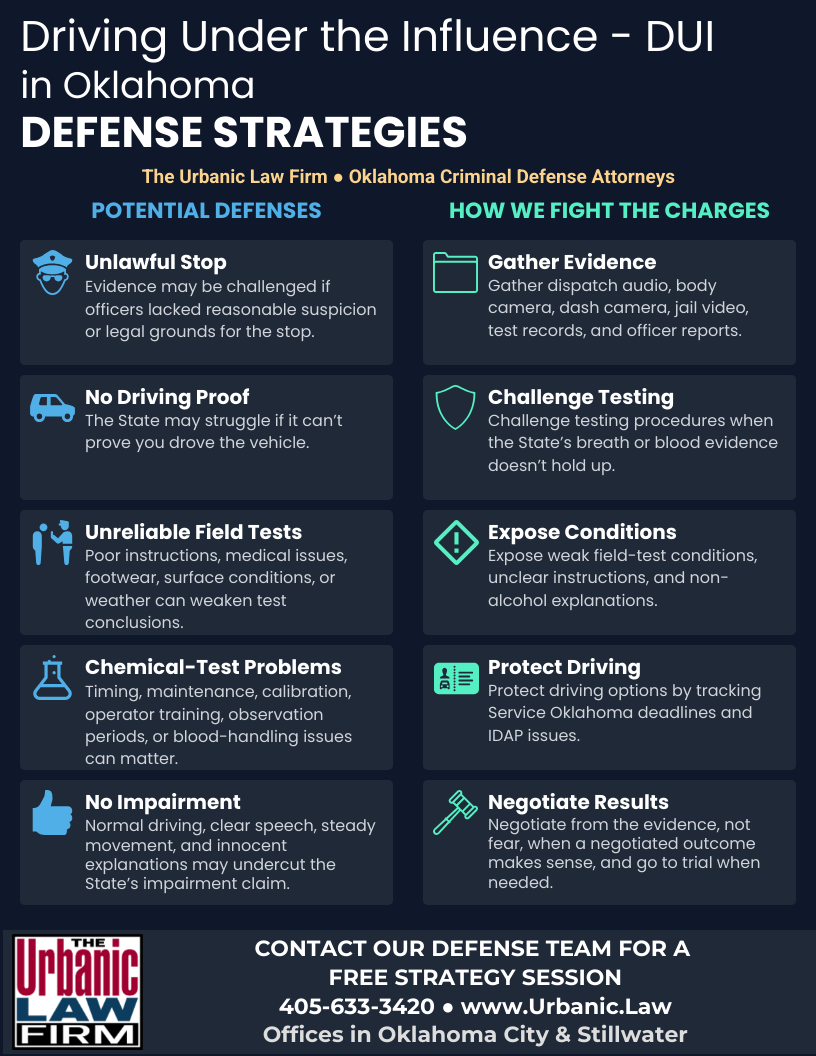
A DUI case can contain several separate points of attack. The police report isn’t the same thing as the underlying evidence. We compare what officers wrote with recordings, testing records, physical conditions, and the legal requirements for the stop and arrest.
-
Was the Stop and Detention Lawful?
An officer needs a lawful basis for the traffic stop. The investigation also can’t be extended without legal justification. Dash-camera and body-camera footage can show why the stop began, what happened next, and whether the report matches the recording.
-
Do the Field Sobriety Tests Support Impairment?
Roadside testing isn’t evaluated in a vacuum. We examine the instructions, demonstrations, scoring, surface, lighting, footwear, weather, medical limitations, and what the video actually shows. A claimed clue matters differently if the test wasn’t administered as trained.
-
Does the Breath or Blood Evidence Hold Up?
A number on a report shouldn’t end the analysis. Breath cases can raise questions about the device, operator, procedures, and surrounding records. Blood cases can raise issues involving the draw, warrant or consent, timing, storage, chain of custody, laboratory procedures, and interpretation of the result.
-
Can the State Prove Driving and Impairment?
Video can sometimes show normal driving, speech, balance, coordination, or behavior that conflicts with the prosecution’s theory. Fatigue, injury, illness, anxiety, and other conditions can also affect observations that an officer attributed to intoxication. The State still has to prove the charged theory with admissible evidence.
What We Look for First in a DUI Case
The first review should identify both the prosecution’s theory and the evidence available to test it. We want the underlying material, not just an officer’s conclusions about it.
- Charging documents: What exact subsection and DUI theory does the State allege?
- Body camera and dash camera: What do the recordings show before, during, and after the arrest?
- Field sobriety testing: Were the tests instructed, demonstrated, administered, and scored properly?
- Chemical testing: What records support the breath or blood result, and what happened before the sample was obtained?
- Timeline: When did the driving, stop, observations, arrest, and testing occur?
- Other evidence: Are there witnesses, surveillance recordings, photographs, receipts, medical information, or digital records that add context?
- Prior history: Does the State have a legally qualifying prior DUI or deferred judgment that changes the charge?
Evidence Commonly Used in DUI Cases in Canadian County
Body-Camera and Dash-Camera Video
Video can preserve driving behavior, speech, balance, instructions, roadside testing, and statements. It may either support or undermine the written report. It can also reveal facts that never made it into the officer’s narrative.
Breath and Blood Testing
Chemical evidence can be central to an alcohol or drug DUI. However, a reported result doesn’t answer every legal or scientific question. Supporting records, collection procedures, timing, laboratory work, and chain of custody can all matter.
Officer Observations and Roadside Testing
Prosecutors may rely on odor, eyes, speech, coordination, driving behavior, field sobriety tests, and other observations. Oklahoma law permits qualified testimony about standardized field sobriety testing. That makes the way the tests were performed and documented especially important.
Independent Evidence
Witnesses, business surveillance, photographs, phone data, receipts, and medical information may help establish a more complete timeline. Because some evidence isn’t kept forever, identifying outside sources early can make a difference.
Why Choose The Urbanic Law Firm for a DUI Case in Canadian County?
DUI defense in Canadian County requires a detailed understanding of how impaired-driving evidence is created. Frank Urbanic has completed the Standardized Field Sobriety Test Practitioners Course, Advanced Roadside Impaired Driving Enforcement course, and SFST Instructor Course. He’s also completed the Oklahoma State Bureau of Investigation’s Forensic Science Academy.
That training helps the firm evaluate what officers were trained to do and compare it with what happened during your investigation. The firm also has experience handling criminal matters in Canadian County. We don’t assume a judge or prosecutor will handle your case a particular way. Instead, the defense is built around your charge, your evidence, and current Oklahoma law.
When you’re choosing a Canadian County DUI attorney, you should be able to get a clear explanation of the evidence that matters and the problems being investigated. That’s the kind of case review The Urbanic Law Firm works to provide.
Frequently Asked Questions About DUI Cases in Canadian County
Do I have to appear at every Canadian County DUI court date?
Don’t assume you can miss a setting because you have an attorney. Whether your personal appearance is required can depend on the type of setting and the court’s order. Confirm each court date and appearance requirement with your attorney.
Can DUI evidence be suppressed?
Yes, in an appropriate case. A suppression issue may arise from an unlawful stop, detention, arrest, search, blood draw, or other constitutional violation. The result depends on the facts and the evidence obtained because of the violation.
What should I bring to a DUI consultation?
Bring the citation, bond paperwork, driver’s-license paperwork, charging documents, and any paperwork you received from law enforcement. Also preserve photographs, videos, receipts, witness information, and a timeline of what you remember.
How long can a Canadian County DUI case take?
There’s no single timeline for every case. The misdemeanor or felony classification, discovery, laboratory evidence, motion practice, court settings, and trial preparation can all affect how long the case remains pending.
Can I receive a deferred sentence for DUI?
A deferred sentence may be legally available in some DUI cases, but eligibility depends on the charge, prior record, and statutory restrictions. Aggravated DUI also has special limits on deferral, suspension, and probation of part of the sentence.
About the Author: Attorney Frank Urbanic

Talk to a Canadian County DUI Lawyer
A DUI arrest doesn’t decide the case. The State still has to prove the charge with admissible evidence. If you’ve been charged, a detailed review can identify legal, factual, and scientific issues that aren’t obvious from the police report alone.
If you’re looking for a Canadian County DUI lawyer, contact The Urbanic Law Firm for a free consultation about the charge, the evidence, and what happens next.
Fill out our secure online form so our attorneys can better understand your situation before we speak. You may also call us at 405-633-3420.
This page is for informational purposes only and is not legal advice. Every case is unique; consult an attorney about your specific situation. Law last reviewed on August 12, 2026 by attorney Frank Urbanic. Page last updated August 12, 2026. Review the statutes cited on this page for the most current version of the law.