What Is a Deferred Sentence in Oklahoma?
 A deferred sentence can feel like a second chance. You plead guilty, but you don’t get an immediate conviction. During the deferred period, the court puts you on probation instead of sending you to jail. If you finish every condition, the court dismisses the case. It also keeps a conviction off your record.
However, a deferred sentence comes with real risk. You stay on probation and under court control the entire time. If something goes wrong, the State can ask the judge to accelerate your deferred sentence and enter a conviction. Because the rules are detailed and the stakes are high, you need to understand how Oklahoma deferred sentencing really works before you decide what to do.
Quick links
How a deferred sentence works
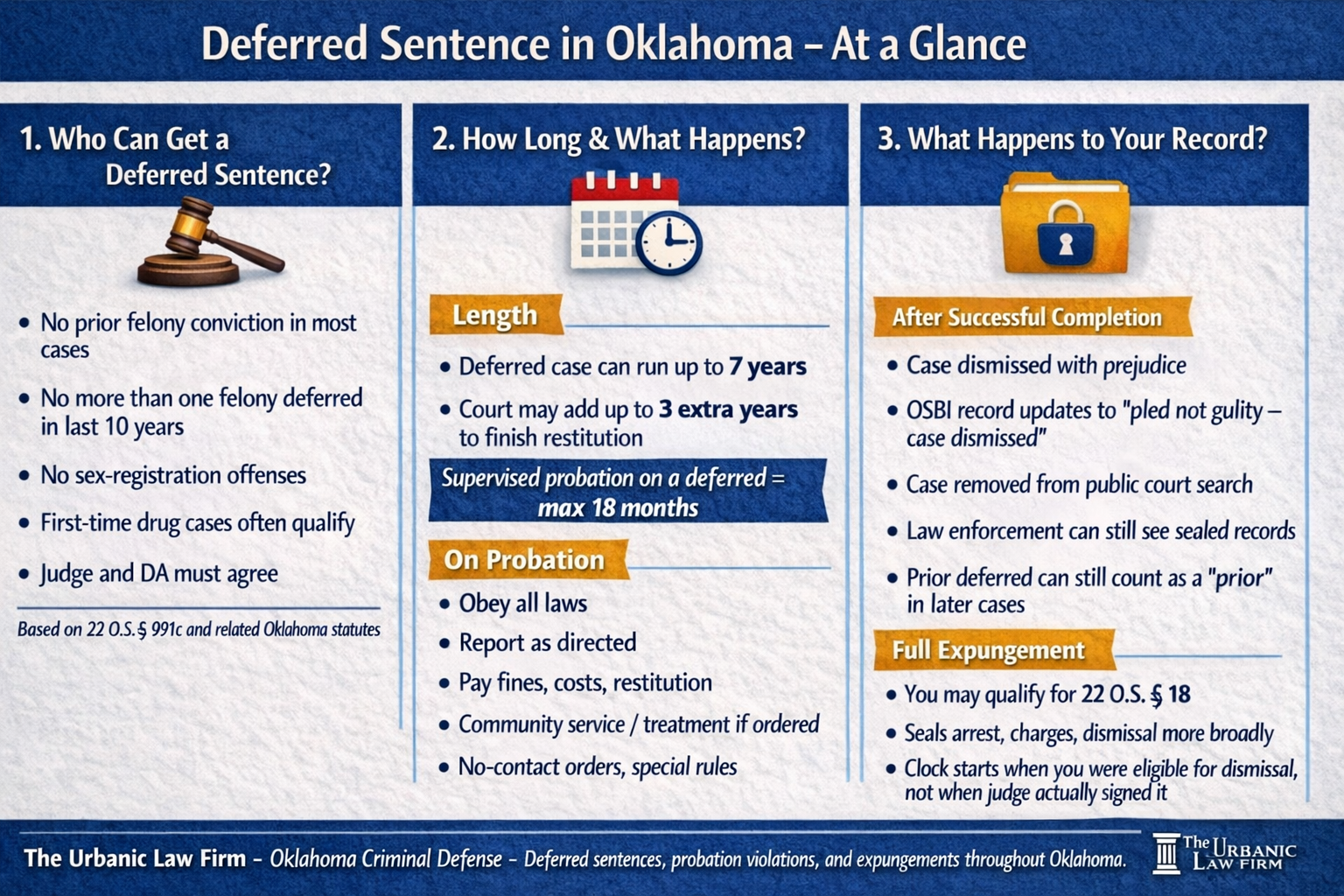
A deferred sentence under 22 O.S. § 991c delays judgment and sentence after you plead guilty or no contest. The court accepts your plea, but it does not enter a judgment of guilt. Instead, the judge places you on probation for a set period. By law, a deferred sentence can run up to seven years. The court can add up to three extra years, but only to give you more time to finish restitution.
Because a deferred sentence is probation, many of the same rules that apply to suspended sentences also apply here under 22 O.S. § 991a. You must report, obey laws, pay money the court orders, and follow supervision rules. Supervised probation on a deferred sentence can last no more than eighteen months unless the State files a violation petition. If you successfully complete the entire term and pay all fines, fees, and assessments, the judge discharges you without a conviction and dismisses the charge with prejudice.
Who can and can’t get a deferred sentence in Oklahoma
Not everyone qualifies for a deferred sentence. The main deferred sentencing statute, 22 O.S. § 991c, sets several limits. Other statutes create more limits for specific crimes, especially sex offenses and repeat cases. So you should expect the judge and prosecutor to review your entire history before they agree to defer your case.
Basic eligibility rules
- You generally must not have a prior felony conviction on your record (22 O.S. § 991c(H)).
- You must not have received more than one felony deferred judgment within ten years before the new offense (22 O.S. § 991c(H)).
- The court can sometimes waive those limits if the district attorney files a written application and the judge agrees on the record (22 O.S. § 991c(H)).
- You can’t receive a deferred sentence if the new offense requires sex offender registration under the Sex Offenders Registration Act (22 O.S. § 991c(I)).
- First-time drug offenders often qualify for a deferred sentence under 22 O.S. § 991c and 63 O.S. § 2-410.
Practical eligibility questions
Sometimes the law gives a judge power to defer sentence, but another statute or prior case complicates that choice. For example, a prior deferred sentence can count as a “conviction” for some enhancement statutes, even though you finished probation without a judgment of guilt. Because of that, the prosecutor may push for a suspended sentence or prison instead of another deferred outcome. A defense lawyer can sort through those overlapping rules and show the court when you still qualify.
Conditions of a deferred sentence and probation
 When the court grants a deferred sentence, it places you on probation with specific rules. The judge can use many of the same conditions that apply to suspended sentences. Some people deal only with the court clerk. Others report to the Department of Corrections or a private supervision provider. Either way, you’re on probation and must follow court orders during the entire deferred period.
Standard probation-style conditions
Courts use a mix of general and case-specific conditions. You and your lawyer should review every line of the order so you know exactly what you must do. Common conditions during a deferred sentence include:
- Pay restitution to any victim in an amount the court sets under 22 O.S. §§ 991a and 991f.
- Pay fines, court costs, prosecution costs, and other assessments on a schedule the judge approves.
- Obey all state, federal, and local laws and avoid new arrests.
- Report as directed to a probation officer, DA supervision unit, or other supervisor.
- Perform community service hours with a verified agency.
- Complete drug, alcohol, or mental health evaluation and follow any treatment recommendations.
- Attend a victims impact panel program if the case involves DUI or similar conduct.
- Maintain or seek employment, or stay enrolled in school or training if ordered.
- Avoid contact with any listed victim, codefendant, or other restricted people.
- Submit to random drug or alcohol testing and avoid any sample tampering.
- Install and maintain an ignition interlock device on any vehicle you drive if the court orders it.
- Follow rules for any electronic monitoring or home detention the judge imposes.
Fees, costs, and supervision duties
Probation also brings regular financial duties. The court may require you to pay monthly supervision fees to the Department of Corrections or another provider. The law often calls for a $40 monthly payment for the first two years of probation to cover prosecution and monitoring costs.
Because unpaid money can lead to violation hearings, you need a realistic plan. You and your lawyer can ask the court for a payment schedule, a reduction, or community service in place of part of what you owe when the law allows it. That plan should match your actual income and family obligations, not just the prosecutor’s wish list.
What happens if you violate deferred sentence probation
Any violation on a deferred sentence matters. However, the law treats technical violations differently from more serious violations. The law says the State must file a written petition to accelerate your deferred sentence. The court then sets a hearing and the State must present competent evidence that you violated a condition.
Technical vs. nontechnical violations
A “technical violation” generally means you broke a court rule of probation, but not in one of several serious ways listed in 22 O.S. § 991b(C). Those serious events include new crimes, repeated failed drug tests, failure to pay restitution, electronic monitor tampering, long-term failure to report, unlawful contact with victims or codefendants, multiple distinct violations in a short period, and any violation of specialized sex offender rules. Technical violations usually involve missed meetings, late payments, or other compliance issues that don’t fall into that list.
Because the law treats technical violations differently, acceleration on a purely technical violation is capped. A first acceleration for a technical violation can add no more than ninety days. A second or later acceleration for technical violations can add up to five years. Nontechnical violations give the court far more power and can lead to a full conviction and much longer supervision or prison.
What is an accelerated deferred sentence?
When the State asks to “accelerate” your deferred sentence, it wants the judge to enter a judgment of guilt and move you from deferred status into sentencing. At the acceleration hearing, the judge decides whether you violated probation and then chooses a new outcome. The court can keep you on probation with modified conditions, change you to a suspended sentence, or send you to jail or prison for some or all of the range allowed by law.
For felony cases, a new felony during your deferred sentence creates special danger. If you’re on a felony deferred sentence and pick up another felony, 22 O.S. § 991c(G) blocks bail pending appeal once the court enters a conviction on the first case. So a deferred sentence can turn into a major custody problem if you face new charges.
Can a deferred sentence be expunged in Oklahoma?
Yes, but “expungement” means more than one thing here. The deferred sentencing statute itself, 22 O.S. § 991c(D), gives you a built-in record clean-up when you successfully complete probation. Separate expungement laws in 22 O.S. § 18 let you seek a full arrest expungement later. Those two steps work together but serve different purposes.
Record update after successful completion
When you complete all conditions and pay all money, the court finds you compliant and discharges you without a judgment of guilt. The judge dismisses the charge with prejudice and orders your plea or verdict expunged from the record under 22 O.S. § 991c(D). The court clerk then removes your name from the public docket and deletes the case from the public index. The clerk keeps a confidential index that links your name and case number but doesn’t release that information without a written court order or your written request to update your Oklahoma State Bureau of Investigation record.
As part of that process, your OSBI report changes to show that you pled not guilty and that the case was dismissed, instead of showing “pled guilty case deferred.” Court records tied to your deferred sentence come off most public websites and online searches. However, those records don’t disappear for law enforcement. The law allows prosecutors to use the sealed file in a later prosecution to prove a prior conviction or prior deferred judgment without first asking the court to unseal it.
Full arrest expungement after a deferred sentence
Section 991c(D) also points you toward the statewide expungement statute, 22 O.S. § 18. After you finish your deferred sentence, you may qualify for a full arrest expungement that seals the arrest, charges, and dismissal on a broader level. The exact waiting period depends on your specific subsection of § 18, but the clock matters in a subtle way. It starts on the date you were eligible to have your deferred case dismissed, not the date the court actually signed the dismissal order.
Because that timing can move your eligibility up or down by months, you should track it carefully. A lawyer can compare your sentencing dates, eligibility dates, and actual dismissal paperwork to see when you can file. Then you can decide whether to rely on the built-in 991c record update or push for a full § 18 arrest expungement as well.
How a deferred sentence affects future Oklahoma cases
Many people think a deferred sentence “doesn’t count” once the case is dismissed. Unfortunately, that’s not always true. Oklahoma law treats a prior deferred sentence like a prior conviction for several purposes. For example, 22 O.S. § 991c(H) often blocks a second felony deferred sentence within ten years. The Controlled Dangerous Substances Act treats a prior deferred sentence for a drug offense as a conviction for ten years after you finish probation, and longer if you later pick up certain new crimes. DUI laws also use prior deferred sentences to enhance a new DUI to a felony when it happens within ten years of completing the deferred term.
So a deferred sentence protects your record from an immediate conviction, but it still follows you. It can affect everything from future plea offers to enhancement ranges and bail decisions. You should view it as a powerful tool, but not as a magic erase button.
How an Oklahoma criminal defense lawyer can help
A deferred sentence is a complex form of probation, not a simple favor. You need a plan that looks beyond today’s plea hearing. A defense lawyer can help you understand the long-term impact, shape the conditions, and protect you if the State later claims a violation.
- Shape the plea. Your lawyer can negotiate charge wording, length of the deferred term, and specific statutes that control later expungement and enhancements.
- Limit harsh conditions. Counsel can argue for affordable payments, realistic reporting rules, and targeted treatment instead of broad, burdensome requirements.
- Defend violation claims. If the State files to accelerate, your lawyer can challenge whether a violation actually happened and whether it was truly nontechnical.
- Plan for expungement. A good strategy tracks your 991c dismissal date and your 22 O.S. § 18 timetable, then lines up the paperwork for a full arrest expungement when you qualify.
Finally, a defense attorney can walk you through how the probation rules apply in your life. That includes work travel, treatment schedules, and the impact on your driver license or professional licenses. With the right plan, you’re much more likely to finish your deferred sentence and keep a conviction off your record.
Key legal terms for deferred sentencing
Probation
Probation is a procedure where a defendant who has been found guilty is released by the court under conditions and supervision instead of being sent directly to jail or prison. The supervising agency may be the Department of Corrections, a private supervision provider, or another person the court designates. Supervision starts when the court enters its probation order and usually can’t last more than two years unless a petition alleging a violation or a revocation request is filed, or another law allows more time (22 O.S. § 991a(E)). For deferred sentences, 22 O.S. § 991c limits supervised probation to eighteen months unless the State files a violation petition during that time.
Technical violation
A technical violation is a violation of court-imposed rules and conditions of probation that doesn’t fall into several serious categories listed in the statute. Those excluded categories include:
- Committing or being arrested for a new crime.
- Trying to falsify a drug screen or having three or more failed drug or alcohol screens within three months.
- Failing to pay restitution.
- Tampering with an electronic monitoring device.
- Missing initial reporting or assigned reporting requirements for more than sixty days.
- Unlawfully contacting a victim, codefendant, or criminal associates.
- Committing five or more separate technical violations within ninety days.
- Violating Specialized Sex Offender Rules.
Any violation that doesn’t fit those listed categories can qualify as a technical violation under 22 O.S. § 991b(C).
Restitution
Restitution means economic loss suffered by a victim as a direct result of the crime. Economic loss includes medical expenses actually incurred, damage to or loss of real or personal property, lost earnings, and other out-of-pocket expenses. It doesn’t include pain and suffering or other noneconomic damages (22 O.S. § 991f(A)(2)). When the court considers a deferred sentence, it must first consider a restitution program among the possible conditions under 22 O.S. §§ 991a and 991c.
Deferred sentence FAQs
How long does a deferred sentence last in Oklahoma?
Most Oklahoma deferred sentences last from one to several years, depending on the charge and negotiation. By statute, a deferred sentence can run up to seven years, and the court may add up to three more years only to let you finish restitution. On a deferred sentence, supervised probation can last no longer than eighteen months unless the State files a violation petition during that time. Your lawyer can explain the likely range for your specific case.
Can you get a deferred sentence in Oklahoma if you already have a felony?
Generally, Oklahoma law doesn’t allow a deferred sentence if you have a prior felony conviction or more than one felony deferred judgment in the ten years before the new offense. However, the court may waive that bar if the district attorney files a written request and the judge agrees. Other statutes may still block a deferred sentence even if the court has that waiver power, so you need a careful review of your record.
What happens if you violate a deferred sentence in Oklahoma?
If the State believes you violated your Oklahoma deferred sentence, the district attorney can file a motion to accelerate. The court sets a hearing and decides whether a violation happened. For technical violations, the law limits how much extra time the judge can add. For more serious violations, the judge can enter a conviction, change you to a suspended sentence, or order jail or prison. Your lawyer can contest both the alleged violation and the State’s requested punishment.
Can a deferred sentence in Oklahoma be expunged from my record?
When you finish a deferred sentence in Oklahoma, the court must dismiss the case and order the plea expunged from the court record. That process deletes your name from the public docket and removes the case from the public index, while keeping a confidential file for law enforcement and future prosecutions. You may also qualify for a full arrest expungement, which can seal the arrest and dismissal on a wider scale.
Is a deferred sentence in Oklahoma the same as a conviction?
On paper, a deferred sentence in Oklahoma keeps a formal conviction off your record if you finish probation. The case ends with a dismissal instead of a judgment of guilt. However, Oklahoma law treats a prior deferred sentence as a conviction for several purposes, including eligibility for later deferred sentences, some drug enhancements, and repeat DUI rules. So you should treat a deferred sentence as a serious event, even though it still offers important benefits compared to a straight conviction.
Talk with The Urbanic Law Firm about your deferred sentence
A deferred sentence decision can shape your record, your freedom, and your future cases. You deserve clear advice before you plead and steady guidance while you’re on probation. If you’re facing charges and wondering whether a deferred sentence makes sense, reach out to The Urbanic Law Firm. You can contact us through our online contact form to schedule a free consultation and get case-specific advice about your options.
This page is for informational purposes only and is not legal advice. Every case is unique; consult an attorney about your specific situation. Page last updated February 14, 2026. Consult the statutes listed above for the most up-to-date law.