First Degree Burglary in Oklahoma: Law, Penalties, & Defenses
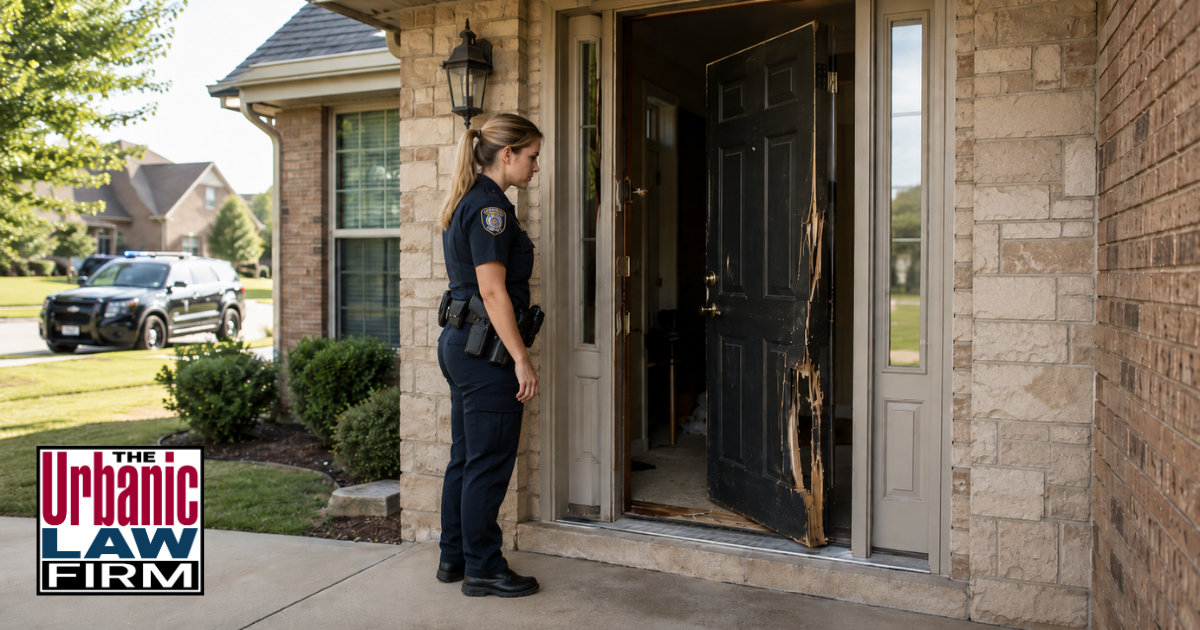 Burglary in the first degree centers on an alleged break-in at an occupied home. The State must prove a breaking, an entry, a dwelling of another, someone present, and criminal intent at entry. This guide is for people accused of burglary in the first degree in Oklahoma and trying to understand the charge, possible punishment, and defense options before court.
Human presence and intent at entry often decide whether the State can prove this offense. An arrest doesn’t establish either point. Door condition, access history, messages, witness timing, and the reason for entering may change the case.
Quick links
- Explanation of the law
- Key elements the state must prove
- Penalties
- Collateral consequences
- How prosecutors prove burglary in the first degree
- Practical guide if you’re charged with this crime
- What happens next
- Comparison to other crimes
- Key terms
- FAQs
- Important cases
- Example of this crime in the news
Talk with The Urbanic Law Firm
If you’ve been accused of burglary in the first degree in Oklahoma, reach out for a free consultation before discussing the facts with police or witnesses. An Oklahoma first degree burglary defense attorney can help you understand the evidence, court process, and risks.
Call us at 405-633-3420 or use our secure online form.
How much prison time can burglary in the first degree carry?
The base penalty is 7–20 years in prison. It’s also an 85% offense, so a person must serve at least 85% of an imposed prison sentence before parole consideration. Prior felony convictions can raise the possible term to life in prison.
Explanation of the law
The State must connect an occupied dwelling, a qualifying breaking, an entry, and criminal intent. Under 21 O.S. § 1431, burglary in the first degree occurs when someone breaks into and enters another’s dwelling while a human being is present, intending to commit a crime inside.
The law recognizes three ways to allege the breaking. The State may claim force against a wall, outer door, window, shutter, lock, bolt, or fastening. It may instead allege another form of breaking while armed or aided by an actually present confederate. It may also claim use of a false key, lock picking, latch lifting, or window opening.
You can review our burglary crimes guide for the other degrees and related laws. The broader burglary and trespass crimes page explains how entry-based accusations fit together.
Depending on the facts, prosecutors may stack grand larceny, assault and battery with a dangerous weapon, first degree robbery, or robbery with a dangerous weapon. Each added count has separate elements, so one accusation doesn’t automatically prove another.
Key elements the state must prove
A missing element can defeat burglary in the first degree even when police believe an unauthorized entry occurred. Jury instruction 5-12 identifies these elements:
- Breaking. Some physical force must remove an obstruction to entry, even if the force is slight.
- Entering. Some part of the body must enter the dwelling. In some cases, inserting a tool that can complete the intended crime may count.
- A dwelling. The place must qualify as a dwelling house rather than only a vehicle, detached structure, or business.
- Of another. The occupancy and possessory rights matter more than bare title ownership.
- A human being present. Someone must be inside when the alleged breaking and entry occur.
- Intent to commit a crime inside. The State must prove that intent existed when entry occurred, not that a dispute developed later.
An unlocked door doesn’t end the analysis. Opening a closed, unlocked door may supply slight force, but walking through an already-open doorway may present a different issue. Consent or authorization can also negate breaking.
Penalties
A conviction is a Class B1 felony under 21 O.S. § 20F. The classification stays Class B1 even when a qualifying prior record increases the available sentence.
- Prison
- 7–20 years under 21 O.S. § 1436
- Fine
- Up to $5,000
- Minimum time served
- At least 85% before parole consideration under 21 O.S. § 13.1
- Earned credits can’t reduce the sentence below 85%
- Violent-crime classification
- Listed as a violent crime under 57 O.S. § 571
- Prior-felony enhancement
- One qualifying prior felony: 10 years to life
- Two qualifying prior felonies: 20 years to life
- Controlled by 21 O.S. § 51.1
Collateral consequences
A violent felony conviction can affect far more than the sentence. Those penalties can follow you into employment, housing, licensing, and future court cases.
- Background checks. Employers and landlords may treat an occupied-home felony as a major trust and safety concern.
- Firearm restrictions. A felony conviction can bar possession of firearms and ammunition under state and federal law.
- Professional licensing. Boards may investigate the conviction, impose discipline, or deny an application.
- Immigration consequences. Noncitizens may face removal, detention, or limits on future immigration benefits.
- Financial obligations. The court may order restitution for damaged doors, locks, windows, or missing property.
How prosecutors prove first degree burglary
Prosecutors usually combine scene evidence, occupancy proof, identification evidence, and facts suggesting criminal intent. No single category necessarily proves every element.
- Entry-point evidence. Officers photograph doors, windows, locks, pry marks, broken glass, latches, and disturbed screens.
- Occupancy evidence. Witness testimony, 911 calls, body-camera video, and home records may show who was inside and when.
- Intent evidence. Texts, statements, tools, threats, property movement, and conduct inside may support the alleged purpose.
- Identification evidence. Surveillance video, fingerprints, DNA, phone data, vehicle records, and eyewitness accounts may connect you to the scene.
- Weapon or confederate evidence. Prosecutors may use a weapon, communications, or another person’s presence to support one statutory breaking method.
However, timing gaps can weaken occupancy proof. Poor video can weaken identity. A lawful access history can also change what door damage or presence inside actually means.
Practical guide if you’re charged with this crime
What we look for first in a burglary in the first degree case
We first examine permission, the entry point, human presence, identity, and intent at entry. We also review how police obtained statements, phone data, forensic evidence, and items from searches.
Defenses
- Consent or authorization. A person entering with valid consent hasn’t committed a breaking, and jury instruction 8-58 applies when evidence sufficiently raises that defense.
- No breaking. Mere presence inside doesn’t prove that physical force removed an obstruction to entry.
- No human present. If nobody was inside at entry, the occupied-dwelling element fails.
- No criminal intent at entry. A later argument, impulse, or unrelated act doesn’t prove an earlier plan to commit a crime inside.
- Suppression of evidence. An unlawful search, seizure, interrogation, or identification procedure may exclude important State evidence.
How we fight these charges
- Preserve door, lock, window, camera, and scene evidence before repairs erase useful details.
- Document keys, codes, prior invitations, shared residence facts, and communications that explain lawful access.
- Test the occupancy timeline against calls, video, device records, and witness movement.
- Challenge unreliable identification through video quality, viewing conditions, forensic limits, and alternate access.
- Litigate warrants, consent searches, phone extractions, statements, and suggestive identification procedures.
What The Urbanic Law Firm does to help
- Organize reports, video, photographs, recordings, forensic material, and charging documents into a usable case file.
- Explain each court setting, deadline, decision point, and realistic outcome before you must act.
- Communicate about new evidence, hearing preparation, and changes that affect your case plan.
- Coordinate investigators, witnesses, records requests, and qualified experts when the facts require them.
- Prepare motions, examinations, exhibits, and trial themes around the elements the State must prove.
Questions to ask your attorney
- What evidence does the State claim proves a breaking?
- What proof shows someone was inside at the moment of entry?
- What specific crime does the State claim I intended to commit inside?
- Which search, statement, phone, or identification issues can be challenged?
- How do my record and the 85% rule affect trial and sentencing risk?
Things you can do if you’re arrested for this crime
- Stop discussing the facts with police, witnesses, friends, or on recorded jail calls.
- Preserve messages, location history, receipts, access codes, photographs, and videos.
- Write a private timeline for your attorney while details remain fresh.
- Avoid contact with alleged victims, witnesses, or codefendants unless your attorney approves it.
- Follow every bond condition and appear for every scheduled court date.
An Oklahoma first degree burglary defense lawyer should build the case around the occupied-dwelling, breaking, consent, identity, and intent disputes that fit your evidence.
What happens next
A felony case usually moves through arraignment, discovery, a preliminary hearing, motion practice, and either resolution or trial. The exact order can vary by county and by whether you remain in custody.
At the preliminary hearing, the State presents evidence to support probable cause. The defense can test witnesses and preserve useful testimony. Later motions may challenge searches, statements, identification, or the legal sufficiency of the evidence.
Prior convictions can raise the available punishments. For a more detailed overview of the criminal process in Oklahoma, read our Oklahoma criminal process guide.
Comparison to other crimes
The location, occupancy, breaking, and intended conduct can change both the charge and sentencing risk. This table shows several nearby alternatives.
| Offense | Core proof | Place or conduct | Classification and punishment | Common defense issues |
|---|---|---|---|---|
| Burglary in the first degree | Breaking, entry, dwelling of another, human present, intent to commit a crime inside | Occupied dwelling with a qualifying method of breaking | Class B1 felony, 7–20 years, up to $5,000, 85% rule | Consent, no breaking, nobody present, identity, intent at entry, illegal search |
| Second degree burglary | Breaking and entry or forced machine opening with intent to steal or commit a felony | Unoccupied dwelling, building, room, structure, tent, railroad car, or covered machine | Class C1 or C2 felony, with the range depending on the location or object | No breaking, lawful access, location classification, identity, no intent at entry |
| Unlawful entry | Unauthorized entry with criminal intent, or specified entry without permission | Building, dwelling, or restricted business area depending on the charged provision | Often a misdemeanor, though some repeat restricted-area conduct can become a felony | Permission, notice, intent, mistake, business-area boundaries, identification |
| Grand larceny | Taking and carrying away another’s property by fraud or stealth with permanent-deprivation intent | Property taking rather than an occupied-home entry | Classification depends on value, property type, and how the property was taken | Ownership, consent, value, identity, mistake, temporary borrowing, intent |
Key terms
Breaking
Breaking means any act of physical force, however slight, by which obstructions to entering are removed. A closed door, window, lock, or latch may supply the disputed obstruction, while an already-open entrance can present a different question. (jury instruction 5-18)
Dwelling house
A dwelling house includes every house or edifice, any part of which has usually been occupied by a person lodging there at night, plus a structure joined to and immediately connected with it. Occupancy history and physical connection can decide whether the place fits this offense. (21 O.S. § 1439 & jury instruction 5-18)
Entering
Entering occurs when any part of a person’s body is within the named object or structure. A tool insertion may also count when the tool can complete the intended crime. Entry proof may depend on video angle, body position, and the alleged purpose of a tool. (jury instruction 5-18)
Of another
Of another means of any person who is in rightful possession of the property. A titleholder can face an accusation involving a dwelling possessed and occupied by someone else. (jury instruction 5-18)
Confederate
A confederate is one who assists in a plot. Actual presence matters when prosecutors rely on assistance by a confederate as part of the alleged breaking method. (jury instruction 5-18)
FAQs
Is burglary in the first degree a felony in Oklahoma?
Yes. It’s a Class B1 felony with a base sentence of 7–20 years in prison and a fine up to $5,000. It’s also subject to the 85% rule and Oklahoma’s violent-crime classification.
Can Oklahoma burglary in the first degree be charged if the door was unlocked?
Yes. Opening a closed but unlocked door can involve slight force and may count as breaking. However, walking through an already-open doorway doesn’t necessarily prove breaking, and consent can defeat that element.
What if nobody was home in an Oklahoma burglary in the first degree case?
Human presence is required for this offense. If nobody was inside when entry occurred, the State may have trouble proving it, though the facts could support second degree burglary or another charge.
Can an Oklahoma burglary in the first degree case be expunged?
A dismissal or acquittal may qualify. A conviction generally needs another statutory path, such as a full pardon, because this is a violent felony and an 85% offense. Eligibility depends on the record, timing, and other cases. Read our Oklahoma expungement law guide for the available categories.
Can Oklahoma burglary in the first degree be charged when nothing was stolen?
Yes. The State doesn’t have to prove a completed taking of property. It must prove an intent to commit some crime inside at the time of entry, so the alleged purpose can involve conduct other than taking property.
Important cases
Roberts v. State, 2001 OK CR 14, 29 P.3d 583, held that consent or authorization to enter negates breaking. Once the evidence sufficiently raises consent, the State must disprove it, and the jury should receive the defense instruction.
State v. Busby, 2022 OK CR 4, 505 P.3d 932, explained that whether a door counts as an outer door requires a fact-specific inquiry. A door between an attached garage and living area can support the charge under the right facts.
This crime in the news
Occupied-home allegations often produce multiple serious counts from the same investigation. On May 1, 2026, a KOKH report said prosecutors accused Pepe Morales of breaking into eight homes in Oklahoma City, within Oklahoma County. The report listed five burglary-in-the-first-degree counts among 28 charges. The allegations illustrate why occupancy, entry method, intent, identification, and the evidence supporting each added count must be examined separately.
This page is for informational purposes only and is not legal advice. Every case is unique; consult an attorney about your specific situation. Law last reviewed on July 28, 2026 by attorney Frank Urbanic. Page last updated July 28, 2026. Review the statutes cited on this page for the most current version of the law.

Legislative Payback or Public Safety? Sara Polston’s Shocking Constitutional Fight!

Tulsa’s “Serial Defecator” Case: Legal Analysis of a Messy Situation

Oklahoma Discovery Law Changes: 2026–2027 Guide
Oklahoma Domestic Abuse Law Updates Nov. 1: Five Big Changes

Oklahoma Stalking Case Reversed: When a Post Isn’t Enough
| THIS OFFENSE IN THE NEWS |