 If you’re trying to save your license after a DUI or Actual Physical Control in Oklahoma, timing matters. In many cases, the real fight starts as soon as Service Oklahoma mails you a notice of driver’s license revocation. If you wait too long, you can lose important options before you even know the clock started.
However, the answer isn’t always as simple as “you have 30 days.” Oklahoma law uses different trigger dates for a court challenge and for IDAP (Oklahoma’s Impaired Driver Accountability Program). In addition, the law includes a 10-day notice rule for mailed notice, and weekends or holidays can shift deadlines. That’s why you need to track every date the moment that notice arrives.
Need help sorting out the deadlines?
Don’t guess on a license deadline. A short delay can close off options that might have been available just days earlier. So, if you’ve received a notice of revocation from Service Oklahoma, it’s smart to get clarity quickly before the timing gets harder to fix. Call us at 405-633-3420 or use our secure online form.
Quick Links
What happens after Service Oklahoma mails the notice?
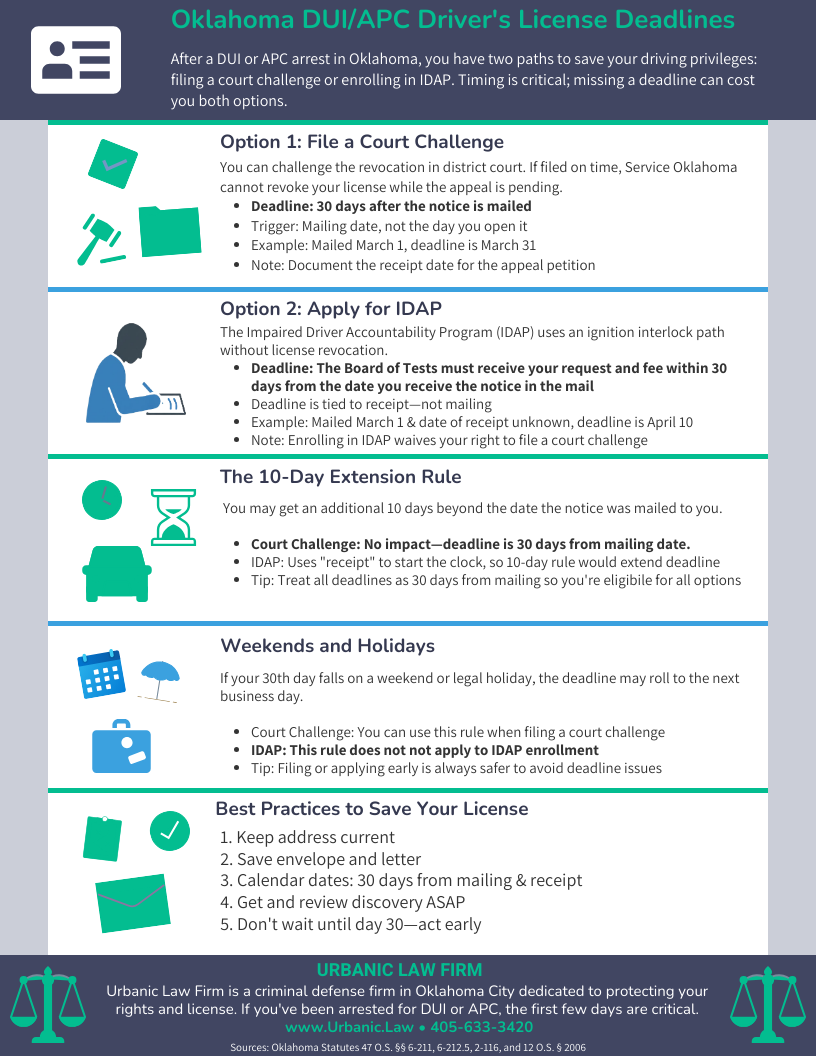
After a DUI/APC arrest, you may face a separate driver’s-license case apart from the criminal case. That means your criminal charge and your license problem can move on different tracks. So, even if your court date feels far away, your license deadline may already be running.
For many drivers, the key notice arrives by mail from Service Oklahoma. That mailed notice can trigger a short deadline to challenge the revocation in district court. It can also trigger a separate deadline to seek IDAP, the ignition-interlock path that may let you avoid a recorded revocation if you qualify and complete the program.
Because these deadlines can affect your job, school, family, and daily life, you should treat that letter like emergency legal mail. Don’t toss the envelope. Instead, keep the envelope, keep the letter, and write down the day you actually received it.
If you’re also dealing with the criminal side of a DUI charge in Oklahoma, or if the accusation involves actual physical control in Oklahoma, don’t assume the license issue will wait on the criminal case. Usually, it won’t.
The two ways to save your license
1. File a court challenge
One option is to file a petition in district court and challenge the revocation. The statute that controls that deadline is 47 O.S. § 6-211. If you file on time, Service Oklahoma must withhold the action or stay the order while the appeal is pending, so long as you’re otherwise eligible.
2. Apply for IDAP
The other option is IDAP. The statute that controls that program is 47 O.S. § 6-212.5. In general terms, IDAP uses an ignition interlock path. You may apply for IDAP either online or by mail. If you qualify, enroll on time, and complete the program, your driving record will be updated to show completion of IDAP without license revocation.
However, there’s a major catch. If you enroll in IDAP, you waive the right to file the court appeal tied to that same arrest. So, you need to think through the strategy early. Waiting too long can cost you both options.
If you want a broader overview of Oklahoma DUI driver’s license consequences, check out our page on that topic.
How long do you have to file a court petition?
For the court challenge, the statute says the petition must be filed within 30 days after the notice of revocation has been mailed to you by Service Oklahoma. That’s the key point. The appeal clock is tied to the mailing date, not to the day you finally open the letter.
So, if Service Oklahoma mails the notice on March 1, the count starts the next day. In that example, day 30 falls on March 31. If you haven’t filed by then, the court challenge may be barred.
That said, the petition itself also requires information about the incident and the date you received the notice. So, you still want to document the receipt date carefully. It may matter to how the case is framed, even though the filing deadline runs from mailing.
How long do you have to apply for IDAP?
IDAP works differently. Under the statute, the Board of Tests for Alcohol and Drug Influence must receive your request for participation and the program fee within 30 calendar days from the date of your receipt of the revocation notice from Service Oklahoma. So, this deadline is tied to receipt, not mailing.
That creates a real timing issue. Your court-petition deadline may run from one date, while your IDAP deadline may run from another. Because of that, the two deadlines can land on different days even though both came from the same arrest and the same notice.
There’s another important detail. The Board must receive the request and fee within the time period. Mailing it at the last minute may not be enough. So, if you’re pursuing IDAP, move early and leave room for delivery problems.
In addition, the statute requires more than just a timely application. To get the benefit of completion without revocation, you must also be otherwise eligible, provide proof of enrollment to Service Oklahoma, and obtain the restricted license before the revocation takes effect.
What does Oklahoma’s 10-day notice rule mean for your deadline?
Oklahoma’s mailed-notice statute says that when Service Oklahoma gives notice by mail, the giving of notice by mail is complete 10 days after the notice is deposited in the mail. That creates a real timing question. If notice by mail isn’t complete until day 10, you might ask whether that adds 10 days before the 30-day deadline starts.
How the 10-day rule affects the court appeal deadline
For the court appeal, that argument exists. The act of mailing the notice is the act of giving notice by mail. So, one possible reading is that notice becomes legally complete 10 days later, and the 30-day court period should run from that completion date. Under that reading, a notice mailed on March 1 would be complete on March 11, and the 30-day filing period would run to April 10.
However, the current appeal statute uses different wording. It says the petition must be filed within 30 days after the notice of revocation has been mailed to you by Service Oklahoma. Because that statute uses mailing as the trigger, not completed notice, the safer reading is that the court deadline runs from the mailing date itself.
So, using the same example, if Service Oklahoma mails the notice on March 1, the cautious approach is to start counting on March 2 and treat March 31 as the court-petition deadline. In other words, there’s an argument for an April 10 deadline, but you shouldn’t rely on that longer reading when your right to challenge the revocation is on the line.
How the 10-day rule affects the IDAP deadline
IDAP works differently because that statute uses a different trigger. It says the Board must receive your IDAP request and fee within 30 calendar days from the date of your receipt of the revocation notice. Because IDAP uses receipt, not mailing, the 10-day mailed-notice rule can matter more when the actual date of receipt is unclear.
If you can prove when you actually received the letter, that actual receipt date is the better date to track for IDAP. Example: the notice is mailed on March 1, and you actually receive it on March 5. In that situation, a 30-day IDAP period measured from receipt would run to April 4.
But if the actual receipt date can’t be pinned down, the 10-day mailed-notice rule may become part of the timing analysis. Example: the notice is mailed on March 1, but no one can show when you actually received it. If notice by mail is treated as complete on March 11, and that date is used as the operative date for timing, then a 30-day IDAP period would run to April 10.
Why the deadlines can end on different dates
That means the same mailed notice can produce different possible end dates. For a notice mailed on March 1, the safest court-appeal deadline is March 31. Meanwhile, the IDAP deadline might be April 4 if you can prove actual receipt on March 5, or April 10 if the 10-day mailed-notice rule is used because the receipt date is uncertain.
The safest way to handle the 10-day notice issue
The practical takeaway is simple. For the court petition, treat the deadline as 30 days from mailing. For IDAP, document the day you actually received the notice, but also track the 10-day mark after mailing in case receipt becomes disputed. That way, you protect the shortest deadline while preserving the best argument on the longer one.
Why some lawyers may still be confused about the 10-day notice rule
For many years, Oklahoma’s appeal statute used service-based language. It said the petition had to be filed within 30 days after the notice of revocation had been “served” on the person by Service Oklahoma. That older wording naturally pushed lawyers to think in terms of when mailed service became legally complete. And because the mailed-notice statute says giving notice by mail is complete 10 days after mailing, some attorneys still read today’s law through that older lens.
However, the current statute changed the trigger. It now says the petition must be filed within 30 days after the notice of revocation has been “mailed” to the person by Service Oklahoma pursuant to the mailed-notice statute. That shift matters. A service-based trigger and a mailing-based trigger aren’t the same thing. So, even though there’s still an argument that the 10-day rule affects notice by mail, the safer reading of the current law is that the court-appeal deadline runs from the mailing date itself, not 10 days later. That’s why a cautious lawyer shouldn’t assume the older service-centered timing rule still controls today.
What if the deadline falls on a weekend or holiday?
Oklahoma’s time-computation statute is 12 O.S. § 2006. In plain terms, you don’t count the day of the act or event that starts the clock. Instead, you begin counting on the next day. Then you count the last day unless it falls on a legal holiday or a day when the court clerk’s office doesn’t stay open for public business until regular closing time.
If the last day lands on a Saturday, Sunday, legal holiday, or a day the clerk’s office is closed early, the period runs until the end of the next day that isn’t a legal holiday and the clerk’s office is open. So, if day 30 falls on Sunday, you usually get until Monday. If Monday is a legal holiday, you usually get until Tuesday.
12 O.S. § 2006 fits the court challenge, not IDAP. It is a court time-computation rule, so it naturally applies to filing the appeal petition in district court. IDAP is an administrative application to the Board of Tests, and its statute uses its own 30-calendar-day deadline without referring to Title 12. So, the safer reading is that § 2006 can extend the court-petition deadline, but it does not extend the IDAP deadline.
Still, don’t push your luck. Filing or applying early is the safer move. A missed deadline can turn a fixable problem into a much harder one.
Examples of how these deadlines can work
Example 1: Normal mail with clear receipt
Service Oklahoma mails the notice on March 1. You receive it on March 5. The court-petition deadline runs 30 days from mailing, so the filing deadline is March 31. However, the IDAP deadline runs 30 calendar days from receipt, so that deadline is April 4. In that example, the deadlines are different.
Example 2: You don’t know the exact receipt date
Service Oklahoma mails the notice on April 5. You don’t have a good record of when you actually received it. Under the mailed-notice statute, notice by mail is complete 10 days later, on April 15. In that setting, April 15 may matter to how the timing issue is argued. The court-petition deadline would still be May 5 if you count 30 days from mailing. A 30-day IDAP period measured from April 15 would run to May 15.
Example 3: The deadline lands on a weekend
Service Oklahoma mails the notice on June 7. You start counting on June 8. Day 30 falls on July 7. If July 7 is a Sunday, the court deadline usually rolls to Monday, July 8. If that Monday is a legal holiday, the deadline usually rolls again to the next open business day.
Example 4: Forwarded mail arrives late
Service Oklahoma mails the notice on August 1, but you don’t actually receive it until August 12 because the mail was forwarded. The court-petition deadline would still be tied to the mailing date. Yet the IDAP timing issue may look different because that statute uses the date of receipt. This is one reason you should preserve the envelope and write down the day you received the letter.
Best practices after a DUI arrest if you want to save your license
Keep your address current
First, make sure Service Oklahoma has your correct mailing address. If the notice goes to an old address, that can create serious problems. So, fix your address early, not after the letter goes missing.
Keep the envelope and letter
Next, save the envelope. The envelope may help show the mailing date and postmark. Also, write the day you actually received the notice on the letter itself. Then take clear photos of both.
Calendar more than one deadline
Then calendar at least three dates: 30 days from mailing for the court petition, 30 days from actual receipt for IDAP, and the 10-day mark after mailing because the mailed-notice rule may matter if receipt becomes disputed. Because these triggers differ, you shouldn’t rely on only one date.
Get and review discovery ASAP
Bring in counsel early so the evidence can be requested without delay. That gives you a better chance to see the reports, video, and test records before the key deadlines hit. Otherwise, you may have to decide between a court challenge and IDAP before you know whether the stop, arrest, or testing creates a solid issue to fight. Finding that out after the deadlines pass can be a painful result.
Don’t wait until day 30
Finally, don’t wait until the last day. Mail delays, office closures, payment issues, and missing paperwork can ruin a good plan. Filing early or applying early is almost always the safer move.
Why people miss these deadlines
Many drivers miss these deadlines because they assume the criminal case controls everything. It doesn’t. Others miss them because they think the clock starts when they read the letter. Sometimes it doesn’t. And some people wait because they believe they can decide later between appeal and IDAP. Often, that delay is what causes the real damage.
The problem gets worse when the notice arrives during a move, a work trip, or a stressful stretch after the arrest. Because of that, you should build a paper trail fast. Preserve the envelope, save screenshots, note the dates, and act before the deadline becomes a fight.
Bottom line: how long do you have to save your license after a DUI or APC in Oklahoma?
In many cases, you may have 30 days from mailing to file a court petition and 30 calendar days from receipt to pursue IDAP. However, those deadlines don’t always line up. The 10-day mailed-notice rule can complicate the timing issue. In addition, weekends and holidays can move the final day to the next open business day.
That’s why the safest answer is simple: act immediately, preserve every date, and don’t wait to decide. If you want to save your license, the first few days after the notice arrives may matter more than anything that happens later.
Hiring a lawyer quickly is important because it allows your attorney request the discovery (video and reports) sooner. That gives your attorney more time to get the records, analyze them, and review them with you before the appeal and IDAP deadlines expire. If you wait too long, the deadlines may arrive before that process is finished. You may have to choose between a court challenge and IDAP without seeing the full picture. That can be a costly mistake. It would be unfortunate to get the discovery after the deadlines and learn there was a strong reason to challenge the revocation in court—when it’s too late.
FAQs About Oklahoma DUI License Deadlines
How long do you have to challenge a DUI license revocation in Oklahoma?
In many cases, you have 30 days to file a court petition from the date Service Oklahoma mailed the revocation notice. Because timing rules matter, you should count carefully and act early.
How long do you have to apply for IDAP after a DUI or APC in Oklahoma?
The Board must receive your IDAP request within 30 calendar days from the date you received the revocation notice. Because the program uses a receipt-based trigger, that deadline may differ from the court-appeal deadline.
What does the 10-day notice rule mean in Oklahoma license cases?
It means Oklahoma law treats mailed notice as complete 10 days after mailing. That rule can matter when there’s a dispute about timing or about when notice was effectively completed. The only situation in which this could possibly apply would be if you applied for IDAP—not a court challenge. Additionally, you shouldn’t simply just add these 10 days onto your application window. Timely action will make sure you are well within your deadlines.
What happens if an Oklahoma license deadline falls on a weekend or holiday?
If the last day falls on a weekend, legal holiday, or a day the clerk’s office is closed, the deadline usually moves to the next open business day. Still, waiting until the last day is risky. This deadline extension only applies to the court appeal—not IDAP.
Can you do both an Oklahoma court appeal and IDAP after the same DUI arrest?
No. Enrolling in IDAP for that arrest waives the right to file the related court appeal. Because of that, you should choose your strategy early.•
In Oklahoma driver’s license cases, is the mailing date the date on the letter or the date on the envelope?
Oklahoma law focuses on when Service Oklahoma actually mailed the notice. So, the date on the letter and the postmark on the envelope are both evidence of mailing, but neither is automatically conclusive in every case. If those dates differ, the safest practice is to preserve both and calculate from the earliest supported mailing date.
This page is for informational purposes only and is not legal advice. Every case is unique; consult an attorney about your specific situation. Page last updated March 18, 2026. Consult the statutes listed above for the most up-to-date law.